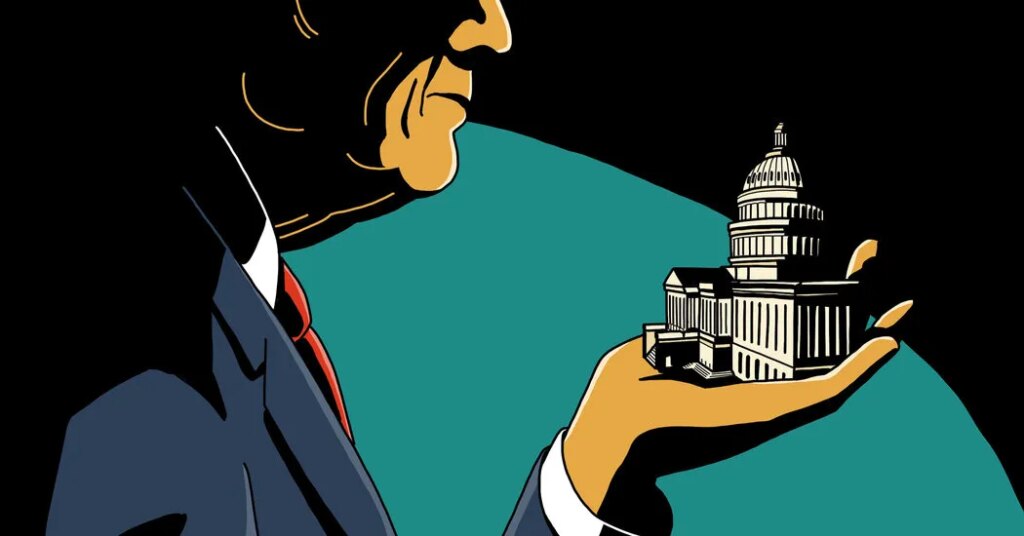
Think potential Democratic majorities in the House of Representatives and Senate will prove to be formidable adversaries for President Trump? Think again.
The problem isn’t the fecklessness of whoever leads both chambers. It’s the structure of our constitutional system, which is more tilted than ever in favor of the executive branch.
True, under the Constitution, the government can spend only money that Congress appropriates (in a bill that is subject to the president’s veto). Likewise, congressional committees, which are led by the majority party in each house, have long enjoyed wide latitude to conduct investigations, including by issuing subpoenas for testimony and documents.
But those congressional powers may be less than they appear to be, especially lately. Democrats controlled the House in the last two years of Mr. Trump’s first term, and he was able to stonewall most attempts at meaningful oversight. He refused to comply with subpoenas and fought enforcement in the courts, where he exploited the inevitable delays that come with appeals to run out the clock on his term.
To cite just two examples, the House Oversight Committee sued over access to information about the census, and the case ended with President Joe Biden providing the information over two years later. The Ways and Means Committee sued to obtain Mr. Trump’s tax returns, and the Biden administration settled that case, too — nearly four years after it began.
That kind of resistance from the White House will be a certainty once again if the Democrats take control. And if a new majority in one or both houses targets private parties with ties to the Trump administration, like the Trump family’s partners in grift in crypto and other businesses, those companies and individuals will still have recourse to use the courts to delay, or to prevent, compliance.
Even better for President Trump, the law is now more skewed toward the executive branch, thanks to the Supreme Court’s 2024 decision in Trump v. United States. Its main holding was that former presidents, including Mr. Trump, enjoy absolute criminal immunity for actions in connection with their core constitutional powers and presumptive immunity for other official acts. In short, the president could not be criminally prosecuted for any “official” actions he undertook while in office.
There is also language in Chief Justice John Roberts’s opinion that suggests the president cannot even be investigated for his official actions.
The president, the chief justice wrote, has “‘exclusive authority and absolute discretion’ to decide which crimes to investigate and prosecute.” In a future fight with Congress, President Trump’s lawyers could cite that language to argue that the lawmakers have no right to examine any of his most controversial actions — like the Justice Department’s sham prosecutions of the former F.B.I. director James Comey and New York’s attorney general, Letitia James, and the Department of Homeland Security’s search of the home of Representative Ilhan Omar of Minnesota.
That same principle — that the executive has absolute discretion when it comes to investigations and prosecutions — will also limit the ability of Congress to use its power of the purse to control the president. The lawmakers can use their budgetary authority to cut back on prosecutions of certain crimes; a lower court, for example, ruled that Congress could bar the Justice Department from using government funds to bring cases against medical marijuana providers. But the president, as Chief Justice Roberts made clear, retains the power to decide which individuals to prosecute.
The congressional budget rules allow lawmakers to impose some prohibitions on how money is spent, but they can’t use spending to usurp authority that belongs to the president, like the power to issue regulations. For this reason, Congress can change the budget for the Environmental Protection Agency, but it can’t use its power of the purse to force the leaders there to repeal its recent regulations that reward polluters.
On the even more consequential question of whether Congress could bar continued funding for the war in Iran, the answer is yes — sort of. Toward the end of the Vietnam War, Congress did use the budget to stop the bombing of Cambodia. During the Reagan administration, the Boland Amendment barred military aid to the contras in Nicaragua.
But even that power has important limitations. Congress cannot usually block the use of previously appropriated dollars, and given the vast size of the Pentagon budget, the administration can surely use existing funds to keep paying for that war. Even more to the point, the federal budget — with any restrictions that Democrats might seek to attach — is subject to a presidential veto. Following any plausible outcome of the midterms, the chances are remote that two-thirds of the lawmakers in each house will vote to override any of President Trump’s vetoes.
Indeed, funding battles are likely to be the chief preoccupation of Congress in the next two years even if only the House (and not the Senate) goes Democratic. Standoffs over the budget have made government shutdowns almost routine in recent years, and that pattern is likely to recur, and could accelerate, after the midterms. As in previous years, confrontations over the budget will probably end in grudging compromises, not a soaring rejection of President Trump’s policies.
If Democrats take control of the Senate, they will have the chance to vote on the president’s nominees. That power will probably not matter a great deal when it comes to votes on the president’s choices to lead cabinet departments. Whoever winds up in those positions, even if they are only in “acting” capacities, will certainly be doing Mr. Trump’s bidding.
The judiciary is another story. In a Senate controlled by Democrats, they will have the absolute right to reject any Trump nominees to lifetime appointments to the federal courts. The new majority will be, and should be, under enormous pressure from supporters to exercise that power with a heavy hand.
This is especially true if there is a vacancy on the Supreme Court. When Justice Antonin Scalia died in 2016 with nearly a year left in President Barack Obama’s term, Senator Mitch McConnell, then the leader of the Republican majority, refused to hold hearings or a vote on Mr. Obama’s nomination of Merrick Garland to the Supreme Court. Democrats can — and must — return the favor if Mr. Trump tries to fill a seat on the court in his final two years in office.
Democrats should exercise that power because it’s the right thing to do, but also because they are going to have little power to do much else.
The Times is committed to publishing a diversity of letters to the editor. We’d like to hear what you think about this or any of our articles. Here are some tips. And here’s our email: [email protected].
Follow the New York Times Opinion section on Facebook, Instagram, TikTok, Bluesky, WhatsApp and Threads.
The post Even a Blue Wave Can’t Stop Trump appeared first on New York Times.