The young man from the Dominican Republic slipped into the United States through the southern border about four years ago, acquaintances said, evading U.S. immigration authorities.
He was in his mid-20s and headed to New York, but his attempts to fly under the radar — and to find his footing in a new country — quickly spiraled.
He got a job at a carwash, and then selling carpets, but couldn’t hold down either job. He rented a bedroom in Upper Manhattan, but was taken to court after failing to pay thousands of dollars in rent.
Less than a year after arriving, the man, Oscar Belgal, was arrested after being accused of stealing cash and jewelry from two acquaintances, with help from an associate who had a gun. Two years later, he was arrested again, this time charged with drug dealing, after he sold bags of cocaine to an undercover police officer outside his apartment building, according to prosecutors.
By 2026, his past had caught up to him: The Trump administration was going after undocumented immigrants, and he was on its radar.
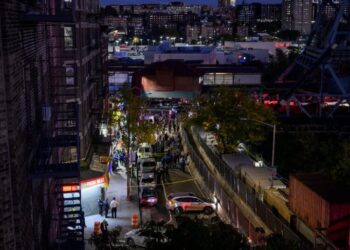
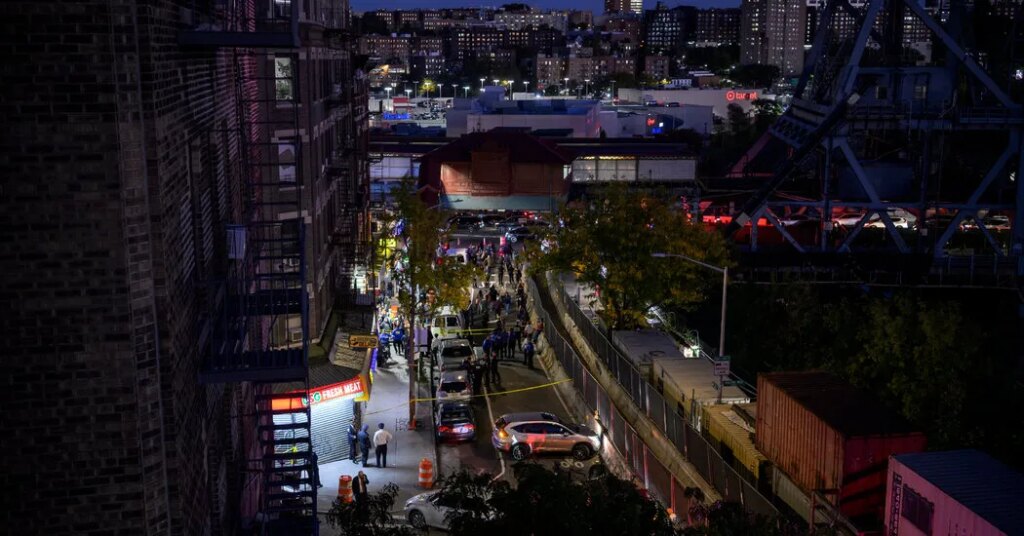
Mr. Belgal’s collision course with Immigration and Customs Enforcement came to a violent climax on Oct. 8, bringing a sudden hail of gunfire to a residential pocket of the city that straddles Manhattan and the Bronx.
It was a sunny autumn afternoon, and Mr. Belgal had just picked up his 5-year-old son from school and taken him to McDonald’s. While they were parked, with the boy in the back seat, a team of ICE officers in plain clothes surprised them.
Two officers in hats and sweatshirts, one with his gun drawn, rushed at the car and Mr. Belgal accelerated his vehicle. At least one officer fired multiple rounds, striking Mr. Belgal on the left side of the neck as he crashed into a concrete traffic barrier. His son was not injured.
Mr. Belgal, 28, was taken to a hospital and later transported to a federal prison in Brooklyn, where he was being held in solitary confinement, a bullet still lodged in his neck, his lawyers say.
Key elements of the encounter — most critically, whether the officer’s use of deadly force was legally justified — remain fiercely contested. In court filings, Mr. Belgal’s lawyers said that the officers never identified themselves — which ICE denied — and said that “Oscar was terrified for his and his son’s lives.”
While the New York Police Department released footage that shows the lead up to and aftermath of the shooting, ICE has not released body camera footage from its officers that could show the shooting itself. Local and federal officials said they are investigating the incident.
Since the start of President Trump’s immigration crackdown, shootings by ICE officers — of immigrants and of demonstrators — in Minneapolis and Maine, Chicago and Los Angeles have ignited furious protests.
Now, that tumult has arrived in New York.
For ICE, the encounter cast a spotlight anew on its tactics and provoked criticism from city and state leaders, including Mayor Zohran Mamdani, who renewed calls to abolish the agency.
For Mr. Belgal, a father of two whom ICE said had entered the country illegally, the shooting marked the culmination of a brief but turbulent time in New York. Some who knew him — particularly those who felt harmed by his actions — were outraged by the shooting but said that a string of bad decisions had paved a direct path to his arrest and potential deportation.
The New York Times interviewed more than a dozen people who knew Mr. Belgal, obtained internal federal records of his apprehension by ICE and reviewed hundreds of pages of court records.
From the moment Mr. Belgal arrived in New York, his life was fraught with turmoil.
Destination New York
Mr. Belgal hailed from a poor urban neighborhood in Santo Domingo, the capital of the Dominican Republic.
In an interview there last week, his grandmother, Juana de León, said she had raised Mr. Belgal, as well as other grandchildren, because his mother was absent.
Mr. Belgal, a slim man with long dark hair he often braided, bounced between low-wage day jobs in construction and moved out of the house after meeting a woman and having a son with her, Ms. de León said.
“He got by through odd jobs,” Ms. de León said outside her home on Thursday, as she sold shoes and clothes that had been shipped from the United States. “One day he would go work with one bricklayer, the next with another.”
Like other migrants, Mr. Belgal left the Dominican Republic alone in search of better economic prospects and made it to Colombia by October 2022, according to Carlos Martínez, a Dominican man he befriended there.
Together, they made the same journey that thousands of migrants undertook on foot during the Biden administration, cutting through the treacherous Darién Gap in Panama until reaching Mexico.
“We slept together, we ate together, we did everything together,” Mr. Martínez, 25, said in an interview.
They split up before crossing the border, though they would reunite in New York.
Mr. Belgal told acquaintances that he crossed the U.S.-Mexico border in late 2022 without being apprehended. He soon found refuge in Washington Heights, the Upper Manhattan neighborhood bustling with immigrants from the Dominican Republic.
A pair of Dominican sisters whose relatives knew Mr. Belgal said they extended him a hand when he arrived in November 2022, apparently penniless.
Cruz María Reyes, 49, one of the sisters, said that they let him stay in a spare bedroom for free over nine months. They helped him find a gig washing cars, which he abandoned once it got colder, she said, and later selling carpets at a store in downtown Manhattan.
By late 2023, Ms. Reyes, who lived in the three-bedroom apartment with Mr. Belgal, said she began charging him $250 a week for the room.
A few months later, in December 2023, Ms. Reyes heard loud knocks at the door.
It was two police officers looking for Mr. Belgal. They handcuffed him and took him away.
Police officers arrested him because two months before, according to prosecutors, Mr. Belgal and another man had robbed two people Mr. Belgal knew: Mr. Martínez and his wife, Yesica Torres.
The couple told the officers that they had gone clubbing in the Bronx on Oct. 2, 2023, with Mr. Belgal and the other man, whom they did not know, according to court filings.
While they were all sitting inside a car, Mr. Belgal’s accomplice pointed a gun from the driver’s seat at the couple, who were seated in the back, and demanded they hand over their jewelry, prosecutors said. Mr. Belgal, seated in the passenger’s seat, took their chains and rings, and about $1,100 in cash, before kicking them out of the car, according to prosecutors.
Mr. Belgal faced 18 criminal charges, but his lawyer, who argued at the time that Mr. Belgal was in the car but not involved in the robbery, negotiated a deal with prosecutors. Mr. Belgal pleaded guilty to just one charge: grand larceny in the fourth degree, a nonviolent felony.
He received five years of probation.
Mr. Martínez and Ms. Torres, who said they were scarred by Mr. Belgal’s betrayal, said they fled to the Dominican Republic after his arrest because they felt intimidated by him.
“We put him in jail, and he stayed in touch with us,” Ms. Torres, 35, said in a phone interview last week from the Dominican Republic, describing how Mr. Belgal had accused them of “snitching” on him. “He threatened us.”
The Times was unable to interview Mr. Belgal.
In a statement, the Legal Aid Society, which is representing Mr. Belgal, denied that he had “threatened or intimidated witnesses.”
A second arrest
Mr. Belgal continued to share the apartment with Ms. Reyes after his first arrest.
Soon, his partner and their son, a toddler at the time, arrived from the Dominican Republic and moved in, Ms. Reyes said.
Mr. Belgal later left his job selling carpets and the couple stopped paying rent at the end of 2024, said Ms. Reyes, who took them to housing court.
Around that time, Mr. Belgal also appeared to have turned to drug dealing, according to Manhattan prosecutors.
From January to June 2025, Mr. Belgal sold plastic bags of cocaine to an undercover officer during multiple exchanges near his building on Wadsworth Avenue, and on at least one occasion, a bag that also had fentanyl and heroin, prosecutors said in a criminal complaint.
Mr. Belgal was arrested in August 2025 and charged with 10 counts of criminal sale of a controlled substance. He pleaded not guilty to all counts; the case has not been resolved.
Some of Mr. Belgal’s neighbors said the arrests didn’t define him, adding that he was generally a kind person who helped older residents with their groceries and even took them to their doctor’s appointments.
“You knew he was often out of a job,” said Aldenia Casanova, 53, who said that Mr. Belgal replaced the locks on her door in his free time. “But he was very well-behaved and mild-mannered.”
When Mr. Belgal was released from custody after his second arrest, he never returned to the apartment. His partner and their son also moved out after a judge ordered them to vacate the premises because of the lapsed rent payments, records show.
Ms. Reyes said that she is owed seven months of rent, or about $7,000.
She criticized ICE’s conduct in the shooting, but said that Mr. Belgal’s run-ins with the law had ultimately exposed him.
“I’m not out for revenge,” Ms. Reyes said. “But he’s paying for the consequences of his actions.”
In a statement, the Legal Aid Society said that Mr. Belgal’s “past does not diminish his humanity, lessen the gravity of what happened to him or erase the profound trauma his child has experienced.”
Gunfire on a city street
ICE first tried to arrest Mr. Belgal last month.
When officers found him in the Bronx on Sept. 18, he ran into a nearby building and got away before he could be arrested, according to internal federal records.
Federal agents tried again 20 days later.
They fanned out in plain clothes and unmarked vehicles on Oct. 8 in the Marble Hill neighborhood, where Mr. Belgal had moved.
They spotted him at about 4 p.m. inside a gray Honda, parked in front of a fire hydrant on West 225th Street, his blinkers still on.
Moments later, surveillance footage shows, two officers run up to the driver’s side of his car, one with his gun pointed at Mr. Belgal, who puts his car in reverse and backs up a few feet.
Then, he accelerates, steering away from the officers, as one smashes the side window of the car and the other points his gun at the windshield, the video shows.
At least one officer fired multiple shots at Mr. Belgal’s vehicle, according to local and federal officials.
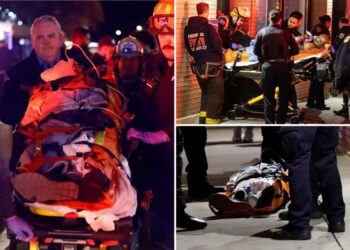
After the crash, Mr. Belgal emerged from his car, its back window shattered and its windshield pierced. His son, unharmed in the back seat, was crying. Mr. Belgal held his neck, and shouted in Spanish.
“He yelled, ‘Help me!’” Viely Herrera, 21, a bystander, said. “‘Help me! I’m dying!’”
ICE officers forced Mr. Belgal onto the pavement and handcuffed him, according to witnesses.
Minutes later, New York police officers carried Mr. Belgal into an S.U.V., and drove him to a hospital.
The aftermath
ICE officials argued that Mr. Belgal had refused orders to exit his vehicle and accused him of “weaponizing” his car.
The agency said that Mr. Belgal smashed his car into two ICE vehicles and tried to run over an officer, an account that has not been corroborated by the publicly available footage.
Federal officials said that they would release ICE body camera footage upon concluding their investigation. The Bronx district attorney, Darcel Clark, said her office was investigating the shooting, which she described as “a matter of grave concern.”
Arianna Montero, the mother of Mr. Belgal’s son, said in a brief interview that her son had been “traumatized,” speaking little and having nightmares.
“Why fire so much at a single person, and a child?” she said.
Federal officials said that the officers did not know the boy was in the car.
Markwayne Mullin, the homeland security secretary, said that officials believed Mr. Belgal had “indirect or direct knowledge” about a shooting that injured an off-duty customs officer in Manhattan in July 2025, but Mr. Mullin did not elaborate.
ICE officials said that Mr. Belgal had ties to a gang known as the Trinitarios, but offered no evidence. His lawyers said in filings that Mr. Belgal — whom they said most recently worked in construction — “vehemently” denied any gang affiliations.
In a statement, the Department of Homeland Security blamed New York’s so-called sanctuary laws, which they said prevented the city from transferring Mr. Belgal to ICE when he had been previously arrested.
“Make no mistake: ICE is not going anywhere, and we will continue to target the worst of the worst in sanctuary cities who refuse to jail criminal illegal aliens,” the agency said.
Mr. Belgal’s lawyers argued that his arrest was illegal because the officers arrested him without a valid warrant and without having started deportation proceedings against him.
His lawyers said he was semiconscious when he arrived at NewYork-Presbyterian Allen Hospital the night of the shooting. Inside, doctors stopped his bleeding and, when he awoke, ICE officers handcuffed him to his bed, his lawyers said.
Mr. Belgal spent about five hours in the hospital and was discharged after doctors found that he was medically stable, the federal records say.
ICE officers moved him the next day to the Metropolitan Detention Center, a federal prison in Brooklyn.
His lawyers, who are suing for his release, said that he was being held without proper medical care while awaiting surgery that doctors had told him he needed to remove the bullet, adding that “the left side of his face is numb, and he can barely hear out of his left ear.”
Anusha Bayya, Hurubie Meko, Oishika Neogi, Wesley Parnell, Nate Schweber and Ed Shanahan contributed reporting from New York. Hogla Enecia Pérez contributed reporting from the Dominican Republic. Susan C. Beachy contributed research.
The post How a Dominican Migrant in New York Became an ICE Target appeared first on New York Times.