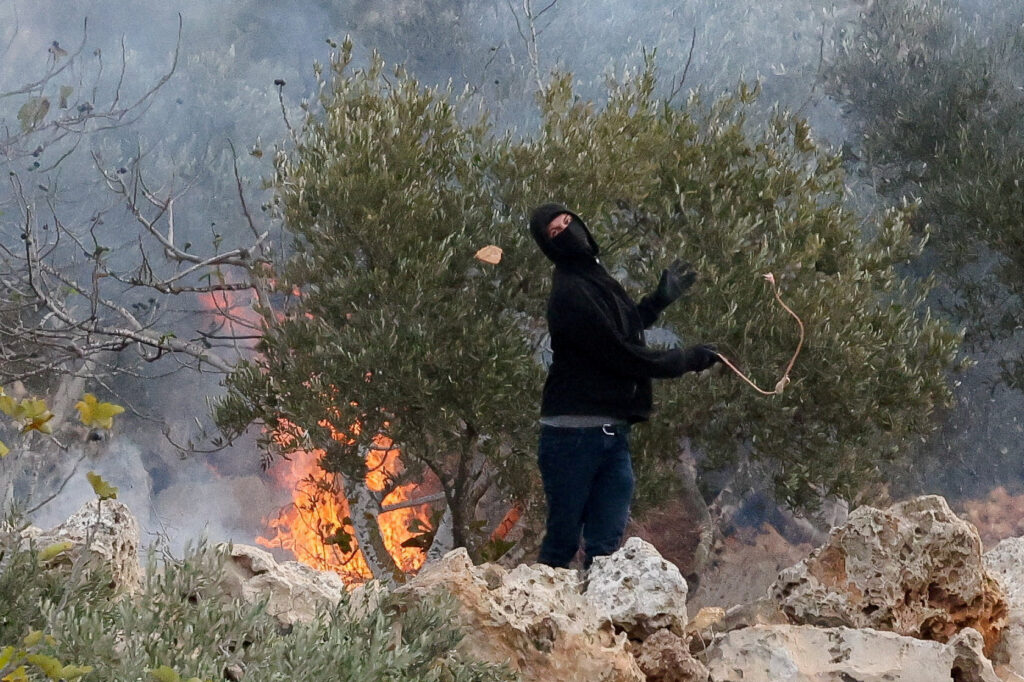
JERUSALEM — A group of European diplomats was assaulted in the West Bank on Saturday, allegedly by Israeli settlers, a day after an attack by settlers that seriously injured Washington Post photographer Heidi Levine near the Palestinian village of Abu Falah.
Israeli police and military officials said they had opened an investigation into the incident involving the diplomats in Taybeh, northeast of Ramallah, and about a half-hour drive south of Abu Falah. Video showed the delegation, including representatives of France, Belgium and Poland, being assaulted by masked figures.
The two attacks have sparked outrage among some Israelis, who have decried what they describe as a pattern of escalating violence by settlers and lawlessness in the West Bank.
The Israel Defense Forces said in a statement that it condemned the targeting of diplomatic representatives. It added that the visit had not been coordinated in advance, which it said was required to avoid such incidents.
Prime Minister Benjamin Netanyahu’s office issued a statement saying it was still unclear what had happened. “Any violence against diplomats is unacceptable,” Netanyahu’s office said. “The more serious the accusation, the greater the demand for compelling evidence.”
The statement said the diplomats “entered a sensitive areas with a history of confrontations” without alerting the IDF in advance. The statement also accused a French mayor, who had joined the delegation, of previously raising “the Palestinian flag over his municipal building.”
It said images of the incident “do not establish the complete sequence of events or individual responsibility” and that an investigation was underway.
Bashar Fawadleh, the parish priest of Taybeh Church, said the diplomats had come to join farmers picking olives, and that settlers who stole olives from the trees beat up several members of the mission and attacked the Belgian consul’s car.
In Friday’s attack, Levine, a veteran photojournalist, was knocked to the ground, beaten with sticks, kicked repeatedly, and stripped of her cameras and phone by masked settlers. She suffered lacerations across her body, a broken rib, four broken vertebrae and injuries to her hand, including a finger that was ripped open, exposing bone.
Levine, 64, who was wearing a vest clearly marked “PRESS” on front and back when she was assaulted, underwent surgery on her hand Saturday and was in stable condition, according to a spokesperson for the hospital near Tel Aviv where she was being treated.
Israeli President Isaac Herzog said he had spoken with Levine on Saturday evening. “I strongly condemn this outrageous and shocking phenomenon of violence — both in the terrible attack you endured and in other serious incidents, such as what happened today in Taybeh,” Herzog said, adding that he was “was morally tormented.”
“I express deep sorrow and apologize for what you went through,” he told Levine. “The despicable behavior of these criminals does not represent the citizens or the values of the State of Israel.”
Herzog added: “Israel is a democratic state governed by the rule of law, and it must act with an iron fist against any form of violence.”
With just 10 days to go until Israeli national elections — which are seen as a referendum on Netanyahu’s government — the attacks were seized upon most vociferously by opponents of Netanyahu, who accused his government of turning a blind eye to criminal conduct by militant settlers.
Netanyahu’s office on Friday said in a statement that facts of the incident “remain unclear and are under investigation” and added that competing accounts claimed that hundreds of “Arabs and far-left activists confronted approximately 40 Israeli youths.” The Post has pressed the government for a full investigation and follow-through in the attack.
Gadi Eisenkot, a leading Israeli general who quit Netanyahu’s war cabinet after accusing him of lacking a strategy in Gaza and has emerged a leading challenger in the Oct. 27 election, said that “footage of violent lawbreakers attacking Washington Post photographer Heidi Levine … is unacceptable.”
“This handful of rioters does not represent the Israeli public,” Eisenkot said. “The actions of this small group stain an entire country and severely harm the security of Israel’s citizens and of all IDF soldiers.”
Naftali Bennett, a former prime minister and Netanyahu aide who is another top contender seeking to replace him, condemned the “inaction and willful blindness of the Ben Gvir–Smotrich–Netanyahu government toward Jewish terror” in the West Bank.
Bennett was referring to Itamar Ben Gvir and Bezalel Smotrich, right-wing ministers who strongly support Israeli settlers.
“In the new government, we will take a hard line against these criminals,” Bennett said in a statement on X, which did not directly reference the attack on Levine.
Yair Golan, a retired general and leader of the dovish Democrats party, shared an article about Levine on X and said that “the rampage of Jewish terror, fueled by Smotrich and Ben Gvir, will bring disaster on Israel, both for its security and its standing in the world. The Israeli government is turning the State of Israel into a pariah state.”
Under Smotrich, the finance minister whose portfolio includes settlement policy, and Ben Gvir, the national security minister — both settlement dwellers themselves — constraints on settlers have largely fallen away.
Over the past year, as Israel accelerated its control over the West Bank, settler violence has sharply risen. In recent months, Levine, who has covered the region for decades, had focused on documenting advances by settlers in the West Bank.
In a letter addressed to Levine, which was shared with The Post, hundreds of former senior officials from Israel’s security establishment, police and justice system, along with academics and business leaders, expressed their “heartfelt sympathy and profound outrage at the violence inflicted upon you as you performed your important journalistic work.”
“We are deeply ashamed that Jewish terrorists in the West Bank continue to inflict suffering on innocent Palestinians, assault those who come to their defense, and target those who document and expose their despicable conduct,” said the letter, which was signed by former defense minister Moshe Yaalon, former director of Mossad Tamir Pardo and former head of Shin Bet Ami Ayalon.
Neither Smotrich nor Ben Gvir, who are also competing in the election, commented on the attack against Levine.
In response to the statement by Netanyahu’s office, The Post’s executive editor, Matt Murray, posting on X, wrote: “Some facts are neither in dispute nor unclear.”
“Our photographer was clearly marked as Press,” Murray wrote. “She was clearly beaten. These are not partisan or risible statements, but indisputable. We urge a thorough investigation and accountability.”
Witnesses to the attack on Levine said Israeli military forces at the scene had fired tear gas at Palestinians who threw rocks at the settlers but did not do anything to halt the settlers who appeared to carry out a coordinated assault on the olive grove, in which they set some trees ablaze.
Responding to the attack on diplomats, the IDF said a preliminary investigation showed there were no military forces at the scene.
Fawadleh, the priest in Taybeh, denounced the settlers. “These are criminals without morals,” he said. “People without conscience. They have no respect for any human being.”
The post European diplomats attacked in West Bank a day after beating of Post photographer appeared first on Washington Post.