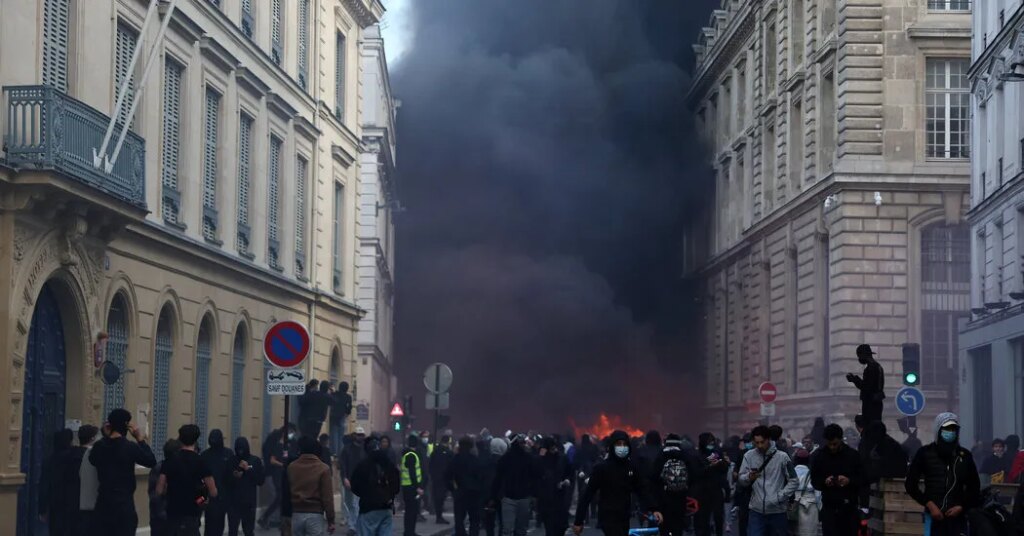
Unrest flared across France on Saturday amid demonstrations against rising living and fuel costs that built on weeks of high school protests that have heightened a sense of fiscal and social crisis in the country.
Some of the calls for demonstrations were made by social media accounts associated with the “yellow vest” protest movement that roiled France nearly a decade ago with its roadside demonstrations against high gas prices, among other complaints.
Officials said there had been rallies in roughly 140 places by the early afternoon, and large marches later took place in the country’s major cities, including Paris, Lyon, Nantes and Rennes. The protests marked a convergence between a student-focused movement that has spurred unrest in hundreds of schools, and a broader social movement that appeals to French citizens of different ages.
There were confrontations between police officers and rioters in several cities, including in Marseille, France’s second-largest city, where people briefly broke into the City Hall and knocked over a bust of Marianne, a symbol of the French Republic, before being cleared out by police.
A tourism office in Lyon was also broken into and set on fire by rioters, many of them dressed in black clothes, masks and goggles. In Paris, where thousands marched peacefully in the streets, a few hundred rioters also faced off against riot police, mostly in the Place de la République, a central square, according to the police.
Since the student protests began last month, hundreds of people have been injured amid escalating clashes with riot police. Thousands have been arrested, most of them minors, law enforcement officials said.
The protests erupted in a heated climate, as the government tries to pass a belt-tightening budget and as France approaches presidential elections next year. The French government has acknowledged that some of the students’ demands are legitimate but has condemned “urban violence.” It has also accused the far-left party, France Unbowed, of stoking the demonstrations, an accusation that the party has rejected.
Here’s what to know.
Why are people demonstrating?
Students are frustrated by crumbling infrastructure, overcrowded classrooms, overloaded schedules, a shortage of teachers and staff, and underfunded schools, according to the student union that is one of the movement’s main organizers.
Some are also calling for the abolition of state-run admissions platforms for higher education and universities that they call unfairly selective.
“Classrooms are not ventilated and we can barely open the windows,” Issam Makhloufi, 15, a student at Rosa Parks High School in Seine-St.-Denis, a working-class suburb of Paris that is a center of the protest movement, told The New York Times.
Now, others are joining the demonstrations to protest a broader range of issues, including people angry over the cost of living and rising fuel costs that have surged, in part, because of the Iran war.
Unions and left-wing parties have also seized on the protests as part of a wider expression of discontent as President Emmanuel Macron, who is limited to two terms, nears the end of his time in office.
Have the protests become violent?
Many of the demonstrations began peacefully but escalated as protesters fired mortar-style fireworks and attacked schools and other infrastructure, resulting in millions of dollars of damage, officials said.
At least 24 schools have been ransacked or set on fire, Édouard Geffray, the education minister, told France 2 in early October.
Rights groups, including Amnesty International, criticized the use of tear gas and stun grenades to disperse minors.
Prosecutors and a police watchdog are investigating at least 34 accusations of police misconduct during the protests. The cases include a 15-year-old boy whose left hand was ripped off, officials said, likely by the explosion of a police stun grenade; and a 14-year-old boy who was hit by a tear-gas grenade that an officer had fired at close range.
Nearly 8,000 people have been arrested, and about 900 police officers, as well as more than 350 students and staff members, have been injured, according to French officials.
France has a long history of youth protests that sometimes have turned violent, including student-led protests in 1968 that nearly toppled the government and helped transform French society.
How have the authorities responded?
The French government has condemned the violence and responded forcefully. Gérald Darmanin, France’s justice minister, said this month that he had directed prosecutors to pursue criminal charges where possible and to hold parents liable for damage.
But the government has acknowledged some of the students’ grievances. It quickly scrapped plans to increase some higher education registration fees announced as part of the 2027 budget.
It has also vowed to quickly deploy 3,000 substitute teachers to high schools hit hardest by staffing shortages and announced plans to do a better job of including students in decision-making related to schools. The education ministry set up an anonymous national online survey for high schoolers to voice their concerns — and Mr. Geffray, the education minister, said on Thursday that nearly 100,000 had done so.
But student leaders have largely dismissed the government’s proposals, calling them insufficient fixes for longstanding structural problems.
Reporting was contributed by Giulia Imbert, Catherine Porter and Ségolène Le Stradic.
The post Protests and Unrest Spread in France: What to Know appeared first on New York Times.