One of President Trump’s many false claims about the 2020 presidential election, which he has repeatedly, and falsely, claimed was rigged against him, was an assertion that there had been “thousands and thousands” of “crooked votes” cast in Wisconsin nursing homes.
The allegation was unfounded. Yet the view that American nursing homes are a hotbed of illegal voting, where aides regularly change the votes of unwitting residents, lives on in Trumpworld. And like a number of other enduring conspiracies about election fraud, the false claim has seeped into the mechanics of governance this year.
In July, the Department of Health and Human Services issued fresh guidance on the topic of voting assistance, “reminding facilities and their staff that they cannot engage in inappropriate coercion or other violations of residents’ rights.” Voting rights advocates decried the message for its potential to discourage nursing-home aides from providing lawful assistance to elderly voters.
The episode has heightened fears that the Trump administration plans to use the power and force of the federal government to cast doubt on the election, discourage participation or, in a worst-case scenario, try to delegitimize the results.
Election fraud in nursing homes is one of many conspiracy theories from years past that are haunting the 2026 midterms. Though some of the wilder schemes offered to support Mr. Trump’s effort to overturn his 2020 loss have been largely abandoned — there is little talk these days about unleashed Krakens, or the nefarious influence of Italian satellites — other 2020-vintage conspiracies have carried over into the present.
And this year, some of them carry the force of the executive branch behind them.
Among the most prominent are Mr. Trump’s unproven claim that significant numbers of noncitizens have made their way onto American voter rolls, and his baseless assertion that mail voting is “inherently corrupt.” Hundreds of investigators from several federal agencies have been dedicated this year to hunting for noncitizen voters, even though experts say the practice is exceedingly rare.
In September, the U.S. Supreme Court rejected a Trump administration plan that would have used the U.S. Postal Service to enact complicated changes to the way Americans vote by mail in the weeks before Election Day. The plan also called for the agency to deny mail services for ballot delivery in states that refused to comply, raising the specter of the disenfranchisement of millions of Americans.
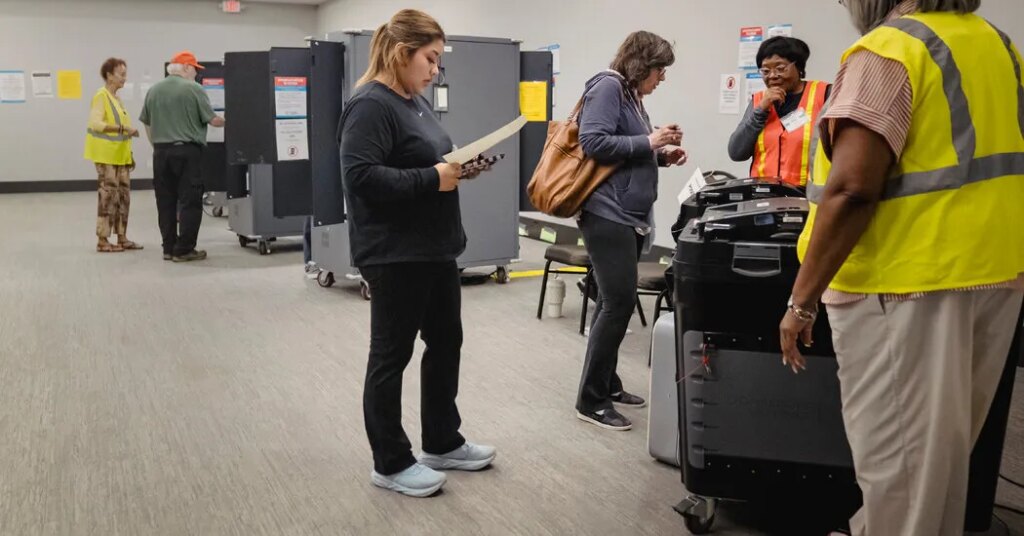
Other administration efforts appear to stem from old conspiracies that live on today, including the idea that certain voting hardware is untrustworthy.
Last month, Markwayne Mullin, Mr. Trump’s homeland security secretary, asked the Justice Department to look into whether voting machines that tally votes with the aid of electronic codes can be trusted to create a verifiable record. Tina Peters, a Trump ally and former Colorado county clerk who was convicted in state court of tampering with voting machines after the 2020 election, recently met with the president, who had symbolically pardoned her, in the White House. Ms. Peters has raised concerns about voting machines that have foreign-made parts, and has said that she wants Mr. Trump to seize such machines.
“To have the federal government undermining the credibility of our elections is troubling,” said David Becker, a former voting rights lawyer for the Justice Department who now runs the Center for Election Innovation and Research, a nonpartisan group that works to support election officials in both parties.
To Mr. Becker, that effort is a “tired” one. He noted that conspiracists have failed, over the course of six years, to verify their claims. But he said there was still reason to be concerned.
“For the first time in our nation’s history, the federal government appears to be prepared to act as an active amplifier of disinformation,” he said.
Lauren Bis, a White House spokeswoman, defended Mr. Trump in an email.
“Despite extreme Democrats and the media claiming it never happens, the evidence of voter fraud continues to pile up,” she wrote. “Anyone who illegally votes in our elections will be held accountable.”
‘Right about everything’
Critics of the administration fear that the embrace of conspiratorial ideas could be used to justify actions that may disenfranchise voters before the election. For example, the administration has encouraged states to use a database that goes by the acronym SAVE to check for noncitizen voters, even though the use of the database is known to have resulted in numerous errors.
Alternatively, critics are concerned that if state or local election officials decline to address dubious concerns about their voter rolls or voting machines, the administration could use their refusal to act to construct post-election arguments that the results are not valid.
In addition to creating opportunities for tactical advantage, however, the embrace of conspiracies also appears to be motivated by something more fundamental: the belief among some of Mr. Trump’s supporters that he “was right about everything,” as one of his signature ball caps once put it — especially his fantastical belief that he never actually lost to Democrat Joseph R. Biden Jr. in 2020.
“The core belief of the MAGA movement is we won the 2020 election,” Steve Bannon, the right-wing influencer and former Trump adviser, said in a recent interview with “CBS News Sunday Morning.”
The Wisconsin nursing home conspiracy, and recent executive branch moves that appear to be inspired by it, demonstrate how the conspiracy-promotion machine translates into actions that could affect midterm voters.
Mr. Trump alleged in a speech in Arizona in 2022 that “almost everybody” had voted in the state’s nursing homes in 2020 — an anomaly, he said, because only a “small portion” of such residents typically vote. A few days after the speech, the website Factcheck.org debunked the claims in a detailed post. “There is no evidence of fraud and voting rates in the state’s nursing homes were not out of the ordinary,” the post’s author wrote.
Four years later, with the 2026 midterms approaching, administrators for Mr. Trump’s Centers for Medicare and Medicaid Services sent a memo to nursing home inspectors around the country that warned workers at the facilities about taking part in “inappropriate coercion or other violations of residents’ rights.”
That language replaced previous federal guidance that had “encouraged nursing homes to take proactive steps to help residents participate in elections,” according to an analysis by the Long Term Care Community Coalition, a nonprofit that advocates on behalf of patients in nursing homes and other facilities. A group of liberal senators argued that the new memo could serve to intimidate nursing-home workers who want to help residents of the facilities cast their votes.
Last month, the Election Integrity Network, a right-wing group headed by Cleta Mitchell, a key figure in the failed effort to overturn Mr. Trump’s 2020 loss, released a “tool kit” meant to help volunteers “confirm” that nursing home residents “are protected from leftist groups.”
During an appearance on Mr. Bannon’s “War Room” podcast, Ms. Mitchell argued that liberal groups “go into nursing homes, and they go into group homes, and they basically steal the votes of these most vulnerable people.”
Ms. Mitchell encouraged volunteers to guard against such actions, particularly in nursing homes located in “competitive House districts.”
Hacking into ‘a toaster’
Mr. Trump promulgated unfounded concerns about noncitizen voting after his 2016 election victory, when he claimed that millions of them illegally participated in the contest. At the time, the nonpartisan Brennan Center for Justice looked into the allegations and found them to be untrue. This year, Mr. Trump’s Justice Department sent letters to every state government threatening criminal prosecution if election officials counted ballots cast by noncitizens.
His allegations that mail voting was suspect began in the months before he lost his re-election bid in November 2020 — in the midst of the coronavirus pandemic, when state and local election officials had scrambled to expand their mail ballot programs to keep voters safe.
The president has continued that drumbeat this year — until this month, when, with his party facing low polling numbers in congressional races, he released a video urging Republicans to vote by mail anyway. Mr. Trump himself voted by mail in Florida primaries this year.
Mr. Trump also has a longstanding obsession with voting machines, and has claimed that they were somehow manipulated as part of a plot to steal the 2020 election from him. In a January 2026 interview with The New York Times, he said he regretted not ordering the National Guard to seize voting machines in swing states after his re-election loss.
Election security experts have found flaws in certain American voting machines; a 2022 report by the federal Cybersecurity and Infrastructure Security Agency, or CISA, a part of Homeland Security, identified several vulnerabilities in machines manufactured by Dominion Voting Systems, which has since been acquired by the company Liberty Vote. Dominion sued multiple media outlets and Trump allies over their false claims about machine security, and reached settlements with all of them.
But the executive director of CISA at the time said there was no evidence that anyone had taken advantage of the vulnerabilities. And a number of election security experts agree that there is no evidence to show that machines have been exploited to manipulate recent elections.
“Voting machines, under federal law, can’t be networked, can’t be connected to the Internet,” said Representative Joseph D. Morelle, a Democrat from New York who works on election security issues as ranking member of the Committee on House Administration. “You could no more hack into a voting machine in America than you could hack into my toaster.”
Mr. Becker, the former Justice Department lawyer, noted that the courts, so far, have done much to block conspiracy-fueled efforts to change election procedures. Still, the disinformation had made the job of administering elections more difficult and sowed mistrust among voters.
In a recent interview, Phil McGrane, a Republican who serves as secretary of state in Idaho, said his office tries to push back against the mistrust with education campaigns and even one-on-one conversations with voters.
Mr. McGrane was also asked if he thought the Trump administration was acting irresponsibly in its embrace of conspiracies.
“I’m not going to comment on that,” he said.
The post Trump Revives 2020 Election Conspiracy Theories as Midterms Loom appeared first on New York Times.