The Various-Minded Leader. I have long thought that The Odyssey is the greatest work written on innovation leadership. Christopher Nolan’s recent film reminded me of another time when the world was awash in ambiguity and leaders needed to navigate the perilous voyage across unfamiliar territory.
Over 30 years ago, before I had published any of my books on innovation, I was asked to make a presentation to the Aspen Institute as part of a summit on “Tomorrow’s Corporation.” The august speakers included an Oxford don, a Harvard strategy professor, a New York Times reporter, and … me, the lone representative for the young and technologically adept, unencumbered by conventional wisdom. The implied theme was the disruptive effect of the rapidly emerging internet and the imminent dislocation of the familiar commercial landscape.
I called my talk “How Far to Ithaca?” I started with a simple proposition: There is no data on the future, and that’s where innovation happens. As such, the greatest obstacle to genuine transformation is getting stuck in the planning cycle. You know, the meeting about the meeting, the report about the report. The better, and the new, are seldom found in the safe harbor of the planning meeting. They are discovered well beyond the bounds of the strategic map, where the winds shift, the old answers sink, and the pilot must find the way by dead reckoning. Then I advanced my central thesis: Odysseus as the archetype of the modern leader, driven off course by outrageous fortune and forced to adjust his plan as he went along. To describe this form of active and adaptive creative thinking, I coined a term: creativizing. The presentation at Aspen was a shipwreck, but somehow the term made it to shore.
In the decades since, I have studied this problem as a business school professor, written books about it, and worked with organizations trying to innovate when the old answers no longer work. Along the way, I have come to understand creativity as more than something we possess. A noun. It’s something we practice. Creativizing suggests that the act of creation is generative. A verb. We Martinize our cocktail attire, winterize our vehicles, and modernize our organizations. The suffix transforms a condition into an action. Creativity in action becomes creativizing.
Like many of my generation, I first met our intrepid hero, Odysseus, in tenth-grade English, where culture was poured on thick, accompanied with Shakespeare’s Julius Caesar and Whitman’s Leaves of Grass. Our teacher, Mr. Johnson, declared that “The Bible and The Odyssey are the cornerstones of Western civilization.” That may have been a slight overstatement, but it pointed in the right direction. He read us the invocation that opens the epic, asking the Muse to tell the tale of the “various-minded man.” But what did that mean? After the class struggled with the question, Mr. Johnson suggested that Odysseus was a “clever man.” Such a small word for such a large character. Creative, quick, and devious come to mind. Clever people figure things out. They move around obstacles, sometimes following the rules, sometimes working around them, and sometimes inventing new rules.
Different Monsters Require Different Minds
That brings us to today. Many of us thought we knew the way to our own Ithaca: earnings, market share, sustainability. But there be monsters along the routes we once took. These forces, many with us since antiquity, are seldom factored into the course: plagues, wars, calamities. Nothing goes according to plan.
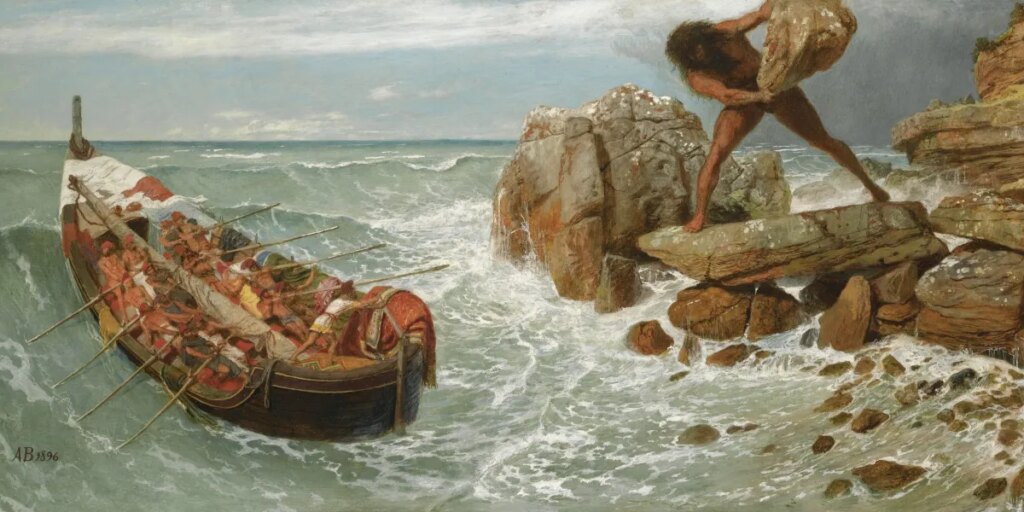
The Cyclops, Polyphemus, renders the strength of Odysseus’ crew insufficient, much as expertise that took a company decades to develop can suddenly be commoditized. AI appeared faster and bigger than most of us anticipated, even in its nascent form. The ten years you spent perfecting a proprietary process can now be replicated by an upstart with an AI algorithm. And they can do it before lunch. Our old maneuvers are no match for it. Business models and strategies have a shelf life and go sour like milk left out too long. When more of the same won’t work, look at what you have at hand with new eyes and act in novel ways the monster couldn’t imagine. You don’t defeat the Cyclops by becoming a bigger Cyclops. You beat him by seeing what he can’t. That’s creativizing.
The Sirens seduce Odysseus’ men with their sensuous song much as synthetic intelligence tells us exactly what we want to hear. Certainty is an aphrodisiac. It attracts us with plausible opportunities. It plays to our preferences. We get what we desire, even if it means our undoing on the jagged shore of misfortune. Ask your favorite AI engine about an acquisition you think makes sense, and watch it come back with a cogent and persuasive case for why you are right. It’s your personal echo chamber, supporting all the nonsense you already believe. Odysseus, understanding the real danger, had his crew plug their ears with wax and had himself lashed to the mast, ordering the men to ignore his pleas to be freed. The most dangerous voice is the one telling you what you most want to hear. Before you can outsmart the monster, you must outsmart yourself. That’s creativizing.
The most dangerous monster may be the one that doesn’t appear to be one at all. One who is alluring and enchanting, like the nymph Calypso. She offers our intrepid hero comfort, sanctuary, and the possibility of immortality. She’s a legacy business, a dominant market position, a prestigious institution. She is the expertise that made you successful. And as you linger, your motivation wanes until you fade into Kodak or Blockbuster or Nokia. You become a story of the past. Like Odysseus, you lose yourself in the ease of where you are until you choose to leave before circumstances make the choice for you. That’s creativizing.
Yet the greatest of these monsters is Poseidon himself, the great disruptor, the earth-shaker and master of the stormy seas. He is change itself, arriving in forceful shifts: geopolitics, competitors, regulations, and, sometimes, technologies like AI. It is foolish to provoke him and more foolish still to ignore him, for he is constantly changing the conditions of your voyage. Odysseus survives them all, not because he is prescient, but because he can actively adjust his thinking to meet the circumstances. That’s creativizing.
What Would Odysseus Do?
Odysseus was making it up as he went along. He rarely knew exactly what he was doing. The winds of fate will do that to a leader. What makes Odysseus the great hero of the epic is that he knows how to proceed when he doesn’t know. This is the practical discipline of moving ever onward in the face of ambiguity. That’s creativizing.
So, what does the various-minded leader do when the map runs out? Like Odysseus, start with a few simple questions.
1. Where is my Ithaca?
Have a clear sense of what you are trying to achieve, but don’t confuse the destination with the route to it. Persist toward Ithaca, but be prepared to correct your course as the winds and circumstances change.
2. What monster am I facing?
Every monster has unique strengths and weaknesses, and each demands a different response. Diagnose the monster before deciding which mind and which move are required to outwit it.
3. What can I do with what I have?
Inventory your assets before asking for more resources: people, networks, information, capabilities, and technologies. Recombine what you already have in new and unexpected ways, then make the next intelligent move.
4. What is the voyage teaching me?
Every maneuver reveals something the map can’t tell you: a hidden challenge, an unforeseen opportunity, an unexpected detour. Pay attention. Learn from what happens, and let what you discover guide your next move. The point of the experiment isn’t just to produce a better result. It’s to develop better judgment about what to do next.
This is the deeper meaning of creativizing: what we create creates us. The entrepreneur creates the business, but the business creates the entrepreneur. The leader changes the organization, but the organization changes the leader. The technologies we create to extend our capabilities can either enlarge our judgment or diminish it.
Odysseus creates his way home, but somewhere along the way, the voyage creates Odysseus.
The opinions expressed in Fortune.com commentary pieces are solely the views of their authors and do not necessarily reflect the opinions and beliefs of Fortune.
The post There be monsters: what Odysseus can teach us about innovation when maps fail appeared first on Fortune.