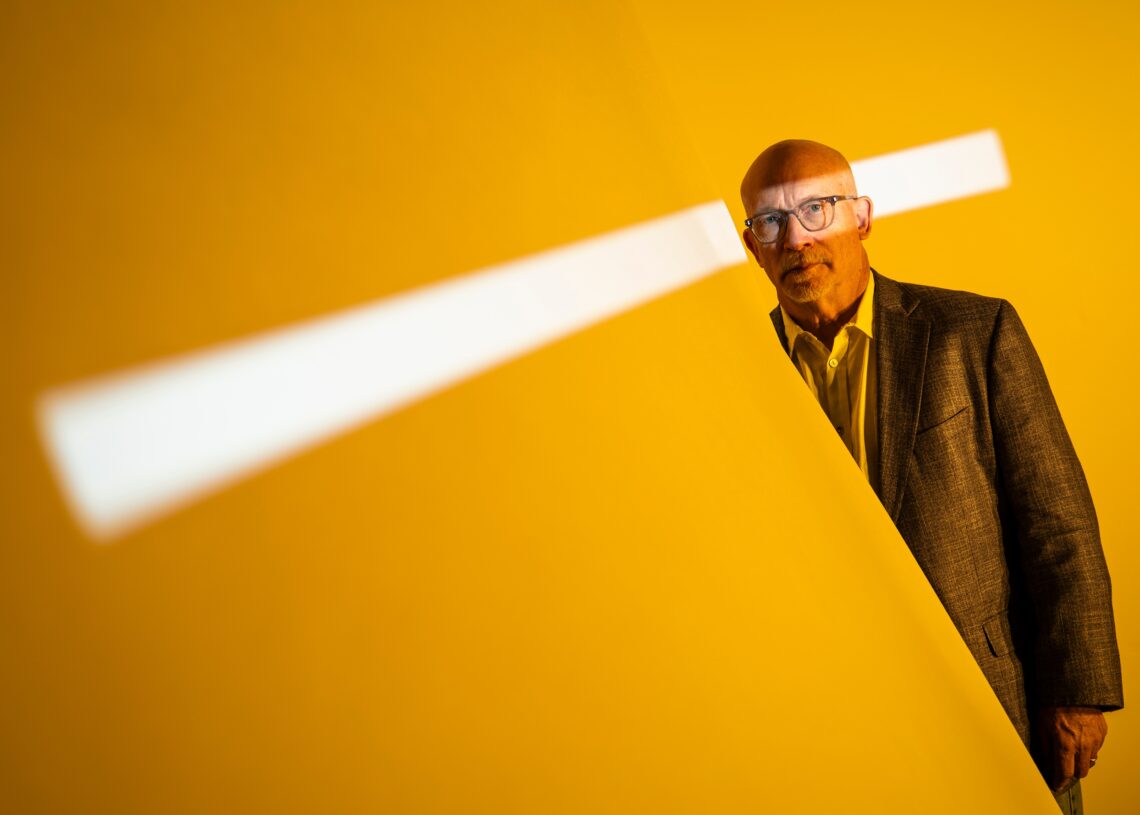
The day Alex Gibney visited The Washington Post newsroom, the newspaper reported that Elon Musk will co-direct a Pentagon initiative. This news felt pretty relevant to Gibney, who just made a 3-hour-and-45-minute documentary on the man, simply titled “Musk.” It opens nationwide Friday.
“It’s like putting the Joker in charge of the Manhattan Project,” Gibney said.
Gibney has been described by Esquire as “becoming the most important documentarian of our time,” tackling such powerful people and institutions as Enron, Eliot Spitzer, Vladimir Putin and Elizabeth Holmes.
His latest subject is Musk, who was so unwilling to even discuss participating that he tweeted“Gibney is a douche” before the filmmaker had a chance to approach him for an interview.
Musk did not participate. Instead, a computer-generated avatar of the tech titan appears in the film and says things Musk has said in previous interviews.
Through deep reporting, interviews with dozens of former colleagues, romantic partners and even Musk’s father, plus all the public statements Musk has made on his path to becoming the world’s richest person, Gibney reached this conclusion of Musk’s ultimate ambitions:
“There is no real purpose to it except to play the game. That’s the chilling part I include at the end with that interview where he was asked, ‘Why have you accreted all this power?’”
Musk had no answer.
‘Is this guy Oz?’
Gibney’s original impression of Musk, formed long before he made the film, was generally positive. He owned a Tesla Powerwall, a home battery that can be used to power a house during an outage, and had Tesla solar panels on his house. He considered driving a Tesla.
He knew Musk had a “fake it until you make it” vibe, but since his work seemed to be the betterment of the world, he almost admired it.
“He did what he had to do in order to get where he needed to go,” Gibney said.
When Gibney embarked on the film project, Musk had already become the richest man in history. One of Gibney’s primary interests in his documentary work is power: how it’s accrued, how it’s used, how it corrupts.
“I thought, ‘Well, he represents 21st-century power,” Gibney said. “With that in mind, I dug in.”
He read “Ludicrous,” Edward Niedermeyer’s book on Tesla, which presents Musk more as a flimflam man than the ambitious genius presented in Walter Isaacson’s authorized biography, “Elon Musk.”
“That started me on this road: ‘Is this guy Oz?’” Gibney said.
What Gibney found is a man who “changed over time as he accrued more and more power,” Gibney said. “That made him become more reckless, it fed into his worst instincts.”
Nature or nurture? Gibney isn’t sure whether power brought out Musk’s worst traits or corrupted him. But as his power grew, Gibney said, “He became more and more self-centered, more and more sociopathic, more and more childish.”
The documentary intersperses footage from the 1937 film “The Man Who Could Work Miracles,” which is based on an H.G. Wells story in which an ordinary man is granted the ability to bend reality to his will and ultimately destroys the world by making Earth stop spinning.
“This is not a new story,” Gibney said of the movie, and of Musk. “It’s an old story in a new bottle.”
One segment of the film reveals the ways in which Musk’s interests changed. It’s long after he fretted over finally achieving a successful SpaceX launch, just after he’s bought Twitter. He’s at the Super Bowl, and he’s furious that one of his tweets isn’t the most popular on the platform. Immediately after the game, he flies to Twitter headquarters, calls in all the engineers and makes them work all night until the platform’s algorithm primarily promotes his own tweets.
“That is so, so insubstantial compared to the engineering feats they were trying to engage in at SpaceX,” Gibney said. “… He became less and less serious as he become more and more powerful.”
Gibney seemed especially fascinated by Musk’s general worldview, and how much of it came to exist: through science fiction and comic books.
“Even the science fiction he gets wrong. He’s inspired by science fiction. He says, ‘I want to make science fiction real.’ That phrase is kind of mystifying, because most of the science fiction he’s interested in are warnings. They’re saying, ‘Let’s hope this doesn’t come true.’ They’re not aspirational. Does he see Saruman as a force for good?” Gibney asks, referring to the Lord of the Rings character.
“The biggest one was ‘Hitchhiker’s Guide to the Galaxy,’ where the inciting incident is literally the destruction of planet Earth in order to make way for a superhighway, which seems to be the ethic of every one of these tech bros,” he continued. “The only thing that matters is that they be phenomenally successful in economic terms. And for the rest of us, it’s extinction.”
Another chapter
In spring of 2024, Gibney had almost finished the documentary. It was primarily a business story, clocking in at around two hours with a strong focus on Twitter and “the beginnings of the transformation of that platform from a sort of public square into a propaganda machine.”
It also focused heavily on Musk’s claims that the Tesla Autopilot feature was so powerful, drivers could take a nap or play video games while the cars drive themselves. This was not true.
No only was that false, but Tesla used cameras instead of advanced lidar sensors (like Waymo uses), a cost-cutting decision that, according to the film, led to more than 60 fatal accidents. The film presents a few in excruciating detail.
Most of this version of the film, however, ended up being merely the first half of the documentary.
“What I wasn’t prepared for is that he would hitch his wagon to Trump,” Gibney said.
There was more work to do. More history to unfold before he could finish it.
What happened next — the election, the U.S. DOGE Service, the annihilation of USAID and all of the global death that ensued because of it — suddenly felt like the natural end to what Gibney already had learned. It’s the focus of most of the documentary’s second half.
Gibney referenced Chekhov’s gun, the narrative rule that if a gun appears in the first act of a story, it must go off in the third.
“We realized that some of the early stuff we had done were guns on mantels,” he said. “In order to properly understand DOGE and particularly USAID with that kind of callous disregard for human life, you need to understand what happened with Autopilot.”
Lost cause
“Noble-cause corruption” is a fancy term for the idea that the end justifies the means. It’s usually applied to law enforcement: A cop plants a bag of dope on a murderer if he doesn’t have enough evidence to put him away for the real crime.
What often happens with noble-cause corruption, Gibney said, is the person sidestepping the rules begins to feel “empowered, and you cheat more and more and more until you’re just a cheater, and the noble cause has been left in the rearview mirror.”
It’s a phenomenon he’s explored time and again in his movies, from Holmes attempting to revolutionize the medical industry to the Enron guys trying to redesign capitalism, only for both to defraud everyone.
“A classic example of this is Musk, who imagined himself a climate savior helping to elect a president, Donald Trump, whose central slogan was ‘Drill, baby, drill,’” Gibney said. “He’s literally trying to destroy the planet for money.”
Of course, Musk’s ambitions now are not merely earthbound, as the documentary’s final leg explores. He’s said that he wants to die on Mars, “just not on impact.” He says he wants to help the human race spread to the stars before Earth is unlivable.
The movie suggests, though, that Musk is helping make it unlivable, pointing to Grok data centers pouring out pollution, Teslas crashing and the fallout from the shuttering of USAID affecting children across the globe.
“He’s created this alternative universe that he lives in, in which he’s the savior of the planet,” Gibney said, “while he’s literally destroying the planet.”
The post A filmmaker spent years in an Elon Musk rabbit hole. Conclusion? ‘Sociopathic.’ appeared first on Washington Post.