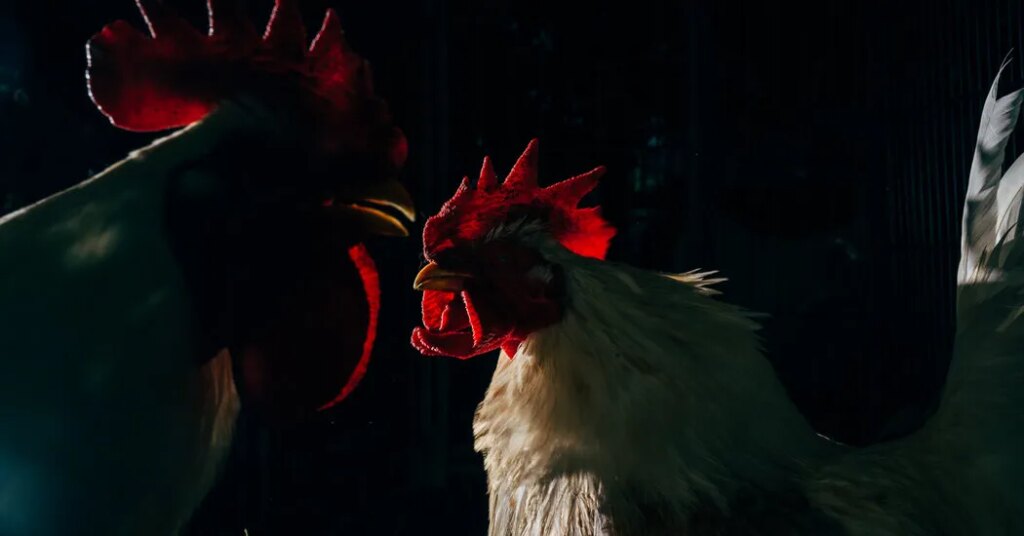
“If slaughterhouses had glass walls, everyone would be vegetarian,” Paul McCartney has said.
Perhaps for that reason, slaughterhouses and factory farms have not only thick walls but also often barbed wire fences. Yet every now and then we catch a peek of what goes on behind those walls. One glimpse comes from video taken by an undercover investigator who worked at a chicken slaughterhouse in Dobson, N.C., from June through September.
The investigator, an employee of the nonprofit Animal Outlook, shared the video with me, and it can also be seen on the Animal Outlook website. The scenes underscore the frantic pace of the assembly line — except that in this case it’s a disassembly line, in which the birds come apart.
My takeaway from this glimpse is that the inside of even a well-run slaughterhouse is a sickening sight and that the comforting narrative of humane slaughter — as federal law terms it — bears little relation to the horror that livestock and poultry often endure in their final moments on the way to our dinner plates.
The situation in American meatpacking plants could soon get worse, for the Trump administration proposed raising the maximum normal speed of chicken slaughter lines from 140 birds per minute to 175 per minute. The maximum pace for killing turkeys would also increase under the new rules, and there would be no maximum whatsoever for the slaughter of pigs.
The increased speeds would probably increase efficiency somewhat. But critics of the industry warn that the gains would come at the expense of the animals and workers alike.
“Everyone in the room is suffering to some degree,” said the investigator, Daniel, who asked that his full name not be published because he hopes to get other undercover jobs. He said that the workers regularly suffered hand injuries and often didn’t last long at the plant, even though wages were relatively good — $21 an hour, plus a $2-an-hour bonus on some days. He calculated that he helped kill about 500,000 chickens, a task that was soul-sucking.
“Any reasonable person seeing this would understand that this is simply cruelty,” Daniel said as together we watched video he had taken of the slaughter line. “It’s caused in part because of line speeds. And it’s not just cruelty toward the chickens. The workers are suffering as well.” One worker, he said, had passed out and was bundled out while the rest of the crew kept hanging chickens on the line.
The slaughterhouse where Daniel worked is part of Wayne-Sanderson Farms, one of America’s largest poultry producers, and it already has a waiver from the Agriculture Department to operate the Dobson plant at the higher speed, as something of a test case. So the video provides a sense of how the faster line would work.
There is no horrific gotcha in the video, nothing that seems illegal. The video shows workers grabbing chickens and rapidly shoving their feet hard into shackles on an assembly line that then carries them upside down to their deaths. The operation is immensely loud and frenetic. Daniel said that it was difficult to tell if they were breaking the chickens’ legs but that some birds already had broken legs or wings from previous aggressive handling. Meanwhile, the terrified chickens are defecating, so bird poop is flying all over the workers and covering them, he said.
I shared the video with Wayne-Sanderson Farms for its reaction. “The general agreement is that there’s no violation of industry standards there per se,” said Frank Singleton, a company spokesman, although he added that the company’s animal welfare experts would also review it and weigh in. After the review, the company said it had found some instances in which employees did not meet proper standards but that these were not pervasive. It said it had immediately added training to address shortcomings.
Faster line speeds do not necessarily harm animals or workers, Singleton said, or jeopardize food safety.
Animal welfare advocates disagree, and they warn that accelerating the line would mean that some animals would not be stunned properly before they were killed. To me, that seems a grievous risk.
Typically, a slaughter line carries chickens by the shackles into an electrified bath that is supposed to stun them into unconsciousness, and then an electric saw cuts their throats to kill them. The line then dunks them into a tank of extremely hot water so that their feathers can be plucked — but sometimes, even at slower speeds, the birds miss the stunning and the saw and end up scalded to death.
How many chickens are scalded to death each year? Animal welfare advocates cite some evidence indicating it may be in the hundreds of thousands each year.
As for what one sees on the video of what happens in a slaughter plant, Wayne-Sanderson Farms doesn’t try to argue that it is uplifting but simply an indication of how the modern meat industry operates.
“Perhaps it’s intrinsic,” Singleton said. “I mean, you have to produce meat. You have to go through a process to get there.”
I think he has a point: Slaughtering animals is an ugly business. Many human societies live with a contradiction: a fondness for meat on the plate and distaste for how it gets there.
By averting our eyes from this contradiction, we’ve allowed livestock and poultry operations to become industrialized in ways that lower meat prices and thus benefit consumers.
And yet. What about the animals?
Ben Williamson, the executive director of Animal Outlook, agreed with Wayne-Sanderson Farms that the undercover video captured typical industry practices. But what he and I both see, above all, is not industrial efficiency but industrial cruelty. Some day, I suspect, our descendants will see our treatment of farm animals as a great moral blind spot of our age.
“When you watch this footage, this is standard practice,” Williamson said. “And even this standard practice is horrifically cruel.”
The Times is committed to publishing a diversity of letters to the editor. We’d like to hear what you think about this or any of our articles. Here are some tips. And here’s our email: [email protected].
Follow the New York Times Opinion section on Facebook, Instagram, TikTok, Bluesky, WhatsApp and Threads.
The post ‘If Slaughterhouses Had Glass Walls’ appeared first on New York Times.