This article contains spoilers.
As I watched “You Can See Everything,” the new documentary about convicted fraudster Elizabeth Holmes, at an advance screening in New York earlier this week, I couldn’t help but feel envy. Ms. Holmes had granted the film’s directors, Nathan Fielder and Lance Oppenheim, the access she denied me a decade ago.
I was a reporter for The Wall Street Journal then, looking into Ms. Holmes’s claims about her medical technology. In media interviews and meetings with investors, she had stated that her company, Theranos, could perform hundreds of tests on a drop of blood pricked from a fingertip — a game-changing medical breakthrough that would have revolutionized the field of diagnostics. After months of reporting, I had concluded this wasn’t true and wanted to meet with Ms. Holmes to ask her about my findings. But she denied my repeated requests for an interview and instead dispatched David Boies, one of the country’s most feared litigators, to try to intimidate me and silence the whistle-blowers I had spoken to.
Ms. Holmes has wanted to tell her side of the story for a long time. In the summer of 2016 she had discussions with Errol Morris, the Academy Award-winning documentary filmmaker she had hired to make sleek Theranos commercials at the height of her pre-scandal fame. Mr. Morris entertained the notion of doing a film about Ms. Holmes seriously enough that he called me to ask me to participate.
“I see it as a ‘he said, she said,’” he told me.
“That’s not how I see it,” I responded. “There are basic facts and those facts show that Elizabeth Holmes committed fraud.”
When it became clear that Mr. Morris remained wedded to his dueling-narratives approach, I put a polite end to the conversation and hung up.
(Reached by phone Thursday, Mr. Morris said he did not dispute Ms. Holmes’s guilt but, at the time, he wanted to explore the theme of self-deception.)
It was therefore not surprising that Ms. Holmes had granted full access to another set of filmmakers seven years later on the eve of going to prison. Having lost her criminal case — in 2022, she was convicted on four counts of defrauding investors in her blood-testing start-up and sentenced to more than 11 years in prison — she no longer had anything to lose. Now was her chance to take control of the narrative and counter the unflattering story told in “Bad Blood,” my book on Theranos, and the sundry other podcast and TV portrayals that followed.
Part of me wished I could have been in Mr. Fielder’s chair at the beach bungalow that Ms. Holmes and her romantic partner, Billy Evans, had rented in San Diego a month before she was required to report to prison in the spring of 2023, sitting across from her at a table laden with pieces of her blood-testing machine.
But Mr. Fielder, I soon found out, was no gullible mark. If Ms. Holmes thought she could manipulate him and Mr. Oppenheim and take advantage of their lack of expertise in the subject matter to spin an empathetic account of an innocent woman who was misunderstood and wrongly accused, she made a colossal mistake.
Instead, something very different happened: By letting them train their ultra-long zoom lenses on her face while subjecting herself to Mr. Fielder’s polite but insistent questioning, Ms. Holmes handed them — and us — a microscope with which to observe and dissect her lies.
As Ms. Holmes denies to Mr. Fielder that she did anything wrong, one can spot her tells: the long, unblinking stares; the little nods of the head; the forced half-smiles beneath innocently lifted eyebrows; the tears manufactured on demand. The dishonesty becomes ever more obvious. She tells Mr. Fielder at one point that she’s never once told a lie. “Liz, what?” an incredulous Mr. Fielder exclaims.
One of the film’s many highlights is a sequence where Mr. Fielder shows Ms. Holmes Abbott and Costello’s famous “Who’s on First?” routine. Ms. Holmes says she’s not familiar with it, which is credible given that she was born in 1984, decades after the duo’s heyday. But after they watch it together, she claims to still not grasp the joke. When Mr. Fielder explains it to her, she says softly: “I didn’t get it.”
You would expect someone who hadn’t initially understood a joke to blurt out “Oh!” or show some flicker of recognition when it registers, but Ms. Holmes has no visible reaction. To me, it was another tell: She had understood the joke but was playing dumb.
Why would she do this? Because in a previous sequence, Mr. Fielder had floated the notion that she interacted with the world differently, which might explain why past statements she saw as innocent were viewed by her investors as lies. By pretending not to understand the Abbott and Costello routine, she was reinforcing that notion and casting herself as the neurodivergent entrepreneur who operated on a different wavelength.
But the performance was no more convincing than her denials of wrongdoing.
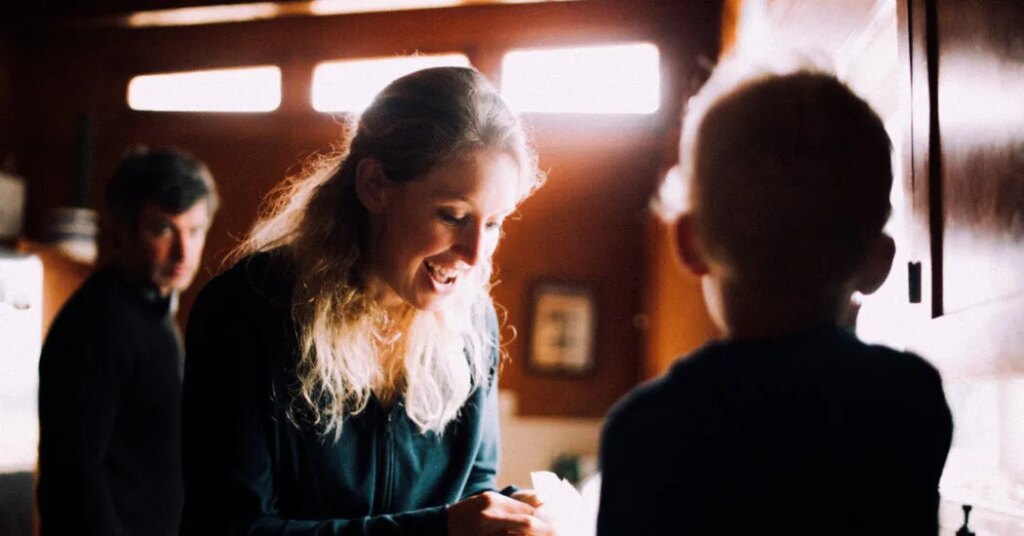
Another revealing moment occurs when Mr. Evans takes her to a photography studio. The idea is to capture Ms. Holmes’s face and body from dozens of camera angles to create a digital replica that he can show their two young children when she’s in prison. But when Ms. Holmes is asked to pose in front of the cameras, she suddenly breaks down. Through a flood of tears, we hear her say that the last time people in her entourage pushed her into the spotlight, it didn’t turn out well.
The scene may be poignant to viewers who aren’t well-versed in the saga, but I practically jumped out of my theater seat. Watch Mr. Morris’s promotional videos of Ms. Holmes, or her 2014 TED talk at the Palace of Fine Arts in San Francisco, or her dozens of public appearances as Theranos chief executive and see if you can find someone who reluctantly embraced the limelight.
The proof is in some of Ms. Holmes’s private texts from that period, which came out during her criminal trial.
On April 25, 2015, nine days after she was featured on “CBS This Morning,” Sunny Balwani, her then-lover and second-in-command, texted her that Ron Conway, a Silicon Valley angel investor, thought there was “too much hype around Theranos and you,” adding: “I am worried about over exposure without solid substance which is lacking right now.”
Ms. Holmes’s response was dismissive. “On outside they are jealous,” she texted back.
Two days later, Jim Cramer interviewed Ms. Holmes on CNBC’s “Mad Money” and compared her to Steve Jobs. Afterward, she texted Mr. Balwani: “Press strategy we talked about is Bulls eye. I can feel it. We are building a movement.”
Mr. Balwani, setting aside his earlier concerns about overexposure, texted back: “You were flawless in mad money. Just perfect.”
“Loved seeing this so much,” she replied.
Ms. Holmes is charming around Mr. Fielder, even flirtatious. But you catch fleeting glimpses of the stone-cold chief executive who hit back forcefully against my reporting and went after my sources in 2015 and 2016. When Mr. Fielder asks her yet again whether she’s sure she did nothing wrong, we hear her snap: “I did not.”
Her stubborn denials reminded me of the judge’s words when he sentenced her in November 2022. “What is the pathology of fraud?” Edward Davila of the U.S. District for the Northern District of California asked. “Is it the inability or the refusal to accept responsibility or express contrition in any way? Now perhaps that is the cautionary tale that will go forward from this case.”
In Mr. Evans, Ms. Holmes has found a kindred spirit. He refuses to entertain the possibility that his partner might be culpable despite having no firsthand knowledge of the events that led to her conviction (they met in late 2017, two years after the Theranos scandal exploded), and he is willing to forge dubious alliances to promote their narrative.
Halfway through the film’s two-hour-and-55-minute run time, we find out that Mr. Evans has become chummy with Ryan “Egypt” El-Hosseiny, an eccentric self-promoter who claims to have rebuilt Theranos’s blood-testing technology from trial exhibits and patents and proved that it works exactly as advertised. (Evidence presented at Ms. Holmes’s trial showed that the Theranos machine could perform only 12 blood tests and that the results were riddled with errors.)
Last year, Mr. El-Hosseiny erected billboards in Los Angeles, New York and Miami proclaiming Ms. Holmes’s innocence. On some, he appeared alongside Ms. Holmes, wearing sunglasses and an ostentatious, rapper-style necklace bearing the Theranos logo. Around the same time, Mr. El-Hosseiny was stationing himself outside The New York Times building in Manhattan in hopes of intercepting me. He even tried to come up to the newsroom with a cameraman in tow before being turned away by security.
Mr. Evans doesn’t seem troubled by Mr. El-Hosseiny’s antics. In fact, the two appear to be in frequent contact. In one of the film’s most entertaining sequences, Mr. Fielder catches them talking on the phone. When Mr. Evans hangs up, Mr. Fielder asks him whether being associated with someone like Mr. El-Hosseiny, whom Mr. Fielder calls a “kook,” is good for Ms. Holmes.
“Probably not,” Mr. Evans admits.
You come away feeling that Mr. Fielder is the one who has Ms. Holmes’s best interests at heart.
Mr. Evans is a big part of the film and he does not come off well. At her trial, Ms. Holmes tried to put the blame for what happened at Theranos on her ex, Mr. Balwani, who was convicted and sentenced to nearly 13 years in prison in a separate trial for his role in the fraud. The jury didn’t buy it. But what’s true is that the irascible Mr. Balwani was a terrible influence on Ms. Holmes.
Mr. Evans doesn’t seem much better. We learn that he and Ms. Holmes are working on “Theranos 2.0,” which would be laughable if it weren’t for the fact that they’re actively pursuing the idea. Ms. Holmes’s parents look on nervously as she and Mr. Evans discuss holding weekly calls with patent attorneys from prison and going “from idea to working prototype in under 365 days.”
Mr. Fielder asks Ms. Holmes’s father whether it’s a good idea for his daughter to be getting into business with a romantic partner again. “I trust Billy,” Mr. Holmes responds.
It’s hard to understand why. At one point, Mr. Evans invites the camera crew to film him naked in the shower. At another, he tells Mr. Fielder that he doesn’t care if Ms. Holmes’s digital replica is used to make pornographic content. We later learn that he has obtained power of attorney from Ms. Holmes and is controlling her X feed, writing expletive-laden posts that she would probably never write herself.
Mr. Evans comes off at times like an angry young man. He has purchased a gun that he carries at all times, and we see him practicing at a shooting range. In one disquieting scene, he threatens to ruin the lives of everyone he thinks has wronged Ms. Holmes.
“I’ve got vengeance in my heart,” he says, adding ominously: “I’m pretty strategic and well resourced. I know people who can do just about anything.”
Given my history with Ms. Holmes, I found those statements disturbing. At the very least, they provide insight into why I was never granted the same access as Mr. Fielder and Mr. Oppenheim. Mr. Evans and Ms. Holmes wanted a friendlier audience they hoped to sway.
But like the lab tests produced by Theranos, the result is not what they intended.
The post The Elizabeth Holmes Documentary, Through the Eyes of the Reporter Who Exposed Her appeared first on New York Times.