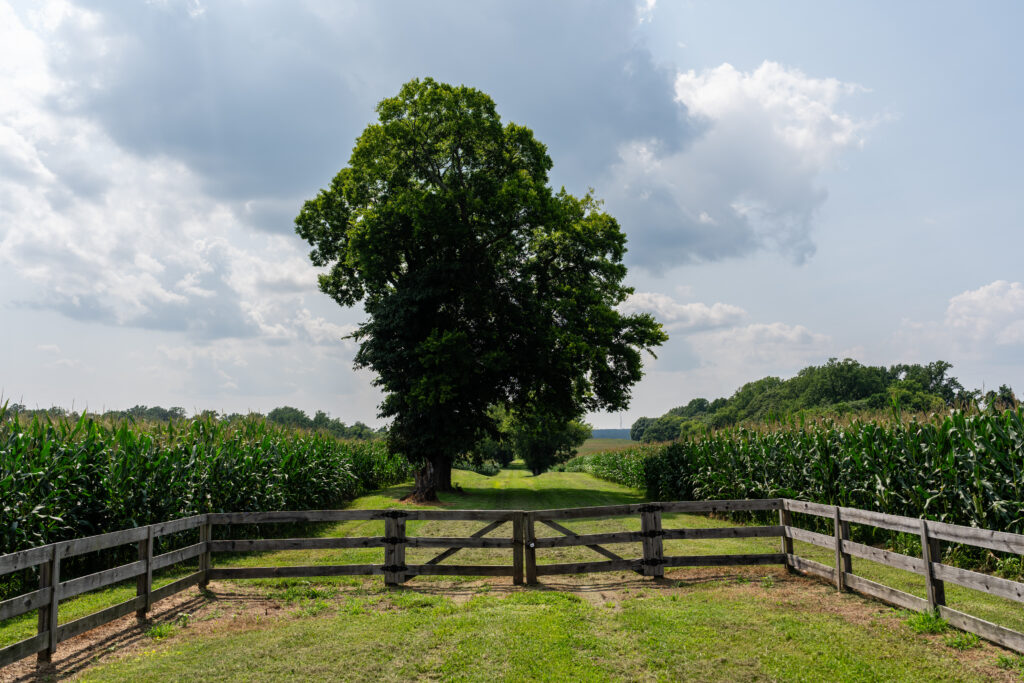
Just outside Richmond, along a two-lane road near a convenience store, cornfields stretch toward the James River. Thousands of years ago, Native Americans hunted and fished for shad and sturgeon here. It became the birthplace of Powhatan, the powerful Indigenous leader and father of Pocahontas.
Now, the roughly 520-acre property is slated for a sprawling housing and retail development.
But a coalition of tribes, historians and conservation groups is trying to stop the project, arguing that the land is a culturally significant and sacred place that could hold burial sites and undiscovered artifacts.
“It would be ruinous to lose the birthplace and boyhood home of one of our most significant and revered ancestors,” said Ashley Atkins Spivey, an anthropologist and citizen of the Pamunkey Indian Tribe who is among the leading opponents of the development. “For this place to just be destroyed for shops and homes would be devastating to us.”
The property, now called Tree Hill, is where tribal historians say Powhatan was born in the mid-1500s, and Indigenous peoples’ ties to the land date back 13,000 years. Sitting along Route 5 in Henrico County, overlooking the city’s skyline, the property later became a plantation where enslaved people lived and labored, and then an encampment for Union troops during the Civil War.
For the past two decades, Tree Hill has been owned by Gray Land and Development Company, known as GrayCo, and its land leased to farmers who grow crops on it. The property is set to be sold to Brookfield Residential, a major real estate company, said Gregg Hughes, president of Brookfield’s land and housing division.
Brookfield plans to build a mix of roughly 2,300 single-family homes, townhouses and condos, along with an estimated 1.1 million square feet of commercial, office and retail space. Construction is expected to start next summer and unfold over a decade, officials said. About 320 acres would be reserved as public green space. As part of the approved plans, Brookfield must set aside 7.5 acres as a commemorative site for Indigenous peoples.
The fight to protect the land is complicated by conflict among some of the groups that have rallied to the cause.
A coalition known as Protect Powhatan’s Birthplace, which includes six tribes, historians and preservationists, has splintered. Some in the group want the project stopped and the land sold to Natives. Others are resigned to the development occurring but are trying to push for the dedication of a larger swath of protected land.
The issue is further complicated by another group, the self-proclaimed Wolf Creek Cherokee, which is not a state or federally recognized tribe. Its leader claims the land is not actually Powhatan’s birthplace. However, many historians reject that assertion. The Wolf Creek’s leader argues that the facilities to be built on Tree Hill should not be for just a half-dozen tribes who have been talking to Brookfield for years about the development’s impact.
“You can’t say what Natives were there for thousands of years,” said Terry Price, Wolf Creek Cherokee’s chief, who lives next-door to Tree Hill. “There were Powhatan’s people there, but there were also other tribes who went through and lived there. You can’t prove and know who lived there.”
Experts disagree. They say there is strong evidence from English explorer John Smith, tribal leaders and historians that the land was known as Powhatan Village and that, at its peak, it was home to roughly 400 Indigenous people.
More broadly, those seeking to preserve the land say it is unique.
Edward DuBois Ragan, the historic preservation officer for the Rappahannock Tribe, said Tree Hill should receive the same consideration as the homes and birthplaces of prominent White leaders.
“If we were talking about the birthplaces of Thomas Jefferson or George Washington, we would not be having a conversation about development on them,” Ragan said. “We’d be talking about what we can do to preserve them. This is a quintessential American site.”
Spivey said she has persuaded two major conservation groups to consider helping local tribes buy the property, which is estimated to be worth about $30 million. Spivey said the estimate was done by a conservation group.
Heather Richards, vice president for the Mid-Atlantic region for the Conservation Fund, which has expressed interest in trying to help the tribes buy Tree Hill, said the property is “one of the last pieces of undeveloped land on the James River, and keeping as much of this as open space as we can is important.”
“We’re never going to look back 50 to 100 years from now and be sorry we did that,” Richards said. Human occupation on that site stretches far into the past “and we should honor that history,” she said.
But the land, Brookfield said, is not for sale. A representative for GrayCo did not return a call from The Washington Post seeking comment on whether it would consider another offer. Brookfield officials said they already have a contract with GrayCo to purchase the land.
Brookfield said it had an agreement in 2010 with a now-defunct group, the United Indians of Virginia, to create a “permanent, interactive settlement to commemorate” Powhatan and the “rich Native American heritage” in the area. Over the past year, Brookfield said it held more than a dozen meetings with tribal leaders to “uphold the intent” of the previous agreement, and although the talks were initially helpful, the tone has since changed. Brookfield said it believes there is currently no “meaningful dialogue” on the issues. The company says it remains “committed to building a Native American commemorative site that helps tell the story” of what came before.
Opponents of the planned development worry that the property’s full archaeological record has not been explored and that building on it could ruin precious artifacts or burial sites.
A few digs have uncovered thousands of arrowheads, pottery fragments and Native tobacco pipe stems, and some of those artifacts date back 1,000 years, according to experts at the Virginia Department of Historic Resources, which holds a collection of some of the items.
“There are only so many sites like this in Virginia, period,” said Jess Hendrix, the tribal liaison for the Virginia Department of Historic Resources. “They are a rare resource. Some have already been lost due to climate change, erosion or development.”
Brookfield said that if any archaeological work is done at the site, it will adhere to state guidelines and follow state laws if human remains are found.
For Indigenous peoples, the site’s location overlooking the James River gave them views of approaching allies and enemies, and access to land to grow crops and rich areas for hunting and fishing. Indians traveled for trade along the waterways in canoes dug out from massive tree trunks. Tree Hill also became a place of burials and ceremonies, experts said.
Known by his formal name in the Algonquian language, WaHōnSeNaKah, Powhatan probably spent the better part of his childhood and teenage years at the site before later moving to another area in the Tidewater region, tribal historians and experts said.
By the time the English arrived in 1607 to what is now Virginia, Powhatan had built a chiefdom of about 30 tribes and 15,000 Indigenous people through inheritance, conquest and marriage alliances. His leadership stretched about 6,000 square miles from modern-day Alexandria to the North Carolina border.
Powhatan was often called the “chief of chiefs,” with regional leaders paying tribute to him with animal hides, beads, shells and food, which he stored in warehouses. With his brother Opechancanough, his war chief, he could command nearly 1,500 warriors in times of battle. Powhatan, Joseph Kelly wrote in the book “Marooned,” “expected deference. He expected obedience. Both were given to him spontaneously.”
Experts said Powhatan probably wanted to trade with the English — food in exchange for more-sophisticated tools to butcher deer and to cut hides. The English also had copper, which was valuable. Powhatan used it to pay warriors, and Indians believed it had special significance and allowed them to be in touch with the spirits of those who had died, according to some historians and members of the Pamunkey Indian Tribe.
He probably saw the English as a lifeline, said William M. Kelso, a leading archaeologist on Jamestown, providers not only of copper, but also of “weapons to go after their enemies.”
When the Jamestown colonists struggled with disease and shortages, Powhatan supplied food, Spivey said. “They were on their way out and ready to call it quits, but he made the decision to help. He’s the reason that colony survived,” Spivey said.
Later, Powhatan ordered the capture of Smith. Historians say the three-day ceremony that followed was likely his attempt to turn Smith into an ally.
But Smith had a different description. He later wrote that warriors laid his head on two rocks and prepared to “beate out his braines” before Pocahontas — Powhatan’s daughter — rescued him. His life was spared, historians said, because Powhatan was offering Smith and the settlers food and safety if they recognized him as their leader.
Smith did not accept.
In one encounter, when Smith had come looking for food, Powhatan warned: “For many informe me your comming is not for trade, but to invade my people and possesse my Country.”
Years of battles, starvation, disease, enslavement and forced displacement left thousands of Indigenous people dead or uprooted. Many settlers also perished from illness and war.
The English captured Pocahontas and held her captive. She learned English, converted to Christianity, took the name Rebecca and married settler John Rolfe. She died in England in 1617, in her early 20s. Her father died a year later of unknown causes in Virginia’s Tidewater area, tribal historians said. His brother led further attacks, but the chiefdom was eventually defeated by English forces. An image of Pocahontas still adorns the Henrico County seal and flag.
About an hour from Tree Hill sits Werowocomoco, Powhatan’s capital village in Gloucester County. It was purchased more than a decade ago by the Conservation Fund as part of a 260-acre deal to ensure its permanent protection.
Supporters of preserving Tree Hill say it deserves comparable protection. This summer, Preservation Virginia named Powhatan’s birthplace as one of the state’s most endangered places.
Michael Clem, the eastern region archaeologist at the Virginia Department of Historic Resources, called Werowocomoco and Tree Hill “bookends to Powhatan’s life.”
Anne Richardson, who is chief of the Rappahannock Tribe and also involved in the coalition, said she feels a duty to the Tree Hill property.
“Once it’s destroyed, it’s gone. You can’t get it back,” she said.
By the 1700s, Tree Hill had passed to non-Indigenous owners and became a plantation. During the Civil War, cattle raised there were fed to hospitalized Confederates, and Union troops at one point occupied the house. On April 3, 1865, Richmond Mayor Joseph C. Mayo met Union leaders near an oak tree at Tree Hill and handed them a note surrendering the city. It became known as the Surrender Tree.
Kevin Brown, chief of the Pamunkey Indian Tribe, said he is surprised Tree Hill has not been developed already, given it is such a beautiful piece of land. But he said it should be saved — or at least more of it preserved — to recognize Powhatan and Indigenous peoples’ connections to it.
Allowing it to be developed would violate something sacred, he said.
“It’s like going to Mount Vernon and destroying that or building condos,” Brown said. “There are certain places you don’t commercialize.”
The post Pocahontas’s father was born here. A developer wants to build houses. appeared first on Washington Post.