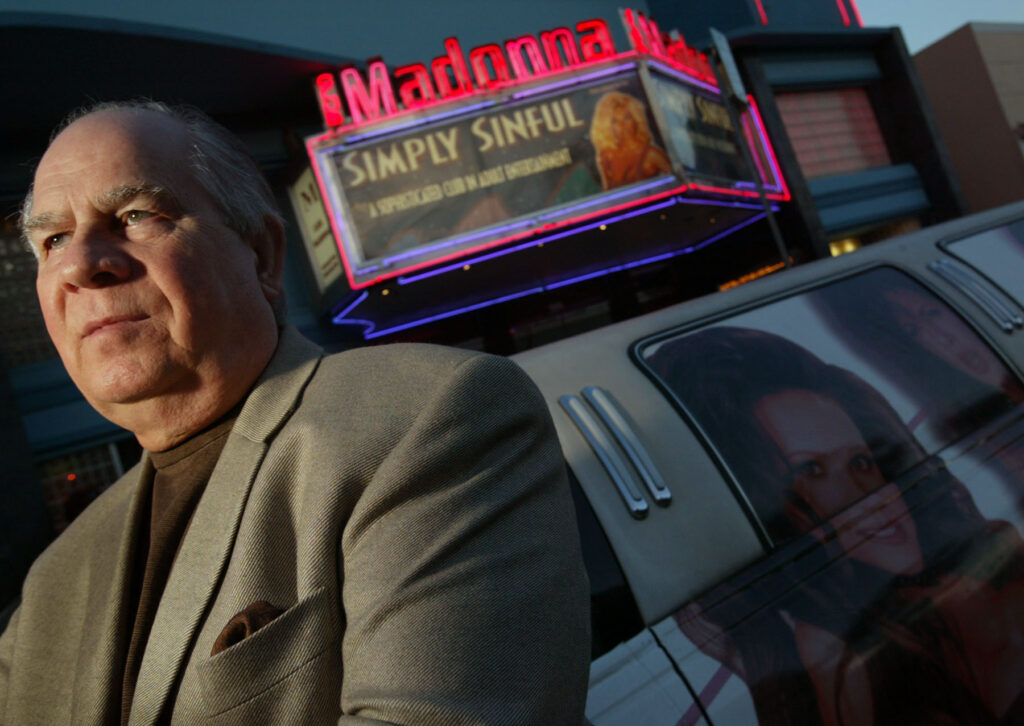
Leroy C. Griffith got his first taste of the entertainment business in the 1940s as a young “candy butcher,” hawking concessions from a tray hanging from his neck at the Grand Burlesque, his father’s theater in Poplar Bluff, Missouri.
From those modest beginnings, he would go on to open theaters across the country after leaving home at 17 and learning an important lesson about making money in entertainment: Sex sells.
Known as the “king of burlesque,” he promoted and profited off the art form during its mid-20th century heyday as America’s views on sex underwent a cultural revolution.
Mr. Griffith died at his Miami home on Oct. 3 at age 94 of complications related to Alzheimer’s, his family said.
But over the years, as the relatively tame feather dances and demure stripteases of burlesque evolved into more explicit acts and movies, Mr. Griffith evolved along with it.
“I built a brand new theater and played ‘The Sound of Music,’ and I lost money,” Mr. Griffith told the New York Times in 1970. “I switched to an adult policy, and the first week made $4,000.”
His “adult policy” helped him create a multimillion-dollar empire with theaters in more than a half-dozen states. He would buy struggling movie houses that were showing mainstream fare and switch its offerings to X-rated films. His businesses were shut down by authorities dozens of times. He was sued and jailed, and his theaters were picketed by anti-pornography groups.
In each case, Mr. Griffith fought for his right to show adult entertainment, basing his argument on the First Amendment and freedom of association.
“He started in burlesque and running burlesque houses, and he ended up running more modern-style strip clubs,” said Dustin Wax, executive director of the Burlesque Hall of Fame in Las Vegas. “He changed with the times.
“By the ’60s, you had topless go-go dancers, you had women in bikinis at the beach that were as revealing as anything you could see in the theater.”
Wax said producers like Mr. Griffith and the performers he hired “were constantly fighting against a kind of a moral code” that kept changing as society changed.
“I wouldn’t say that a burlesque house producer is a hero in the way that Martin Luther King, Jr., is a hero of civil rights, but they were fighting to not be fined, to not be arrested. They were fighting little fights, but those added up,” Wax said.
“Burlesque performers opened the door that the rest of us went through. Things that weren’t acceptable in 1950 were acceptable by 1960, and the things that weren’t acceptable in 1960 were acceptable in 1970.”
Mr. Griffith’s friends and family say he relished a legal fight when police or politicians challenged him.
“One of Leroy’s purposes in life, I believe, was to enforce First Amendment constitutional rights for freedom of expression,” said attorney David Shenkman, who represented Mr. Griffith in several of his legal battles with City Hall. “The city of Miami really tried hard to stop Leroy from doing what he wanted to do. He truly believed that entertainment was constitutionally protected. They tried to stop him with injunctions and lawsuits. We fought all of it, and we won most of it.”
Mr. Griffith also prevailed in a tiff with singer Madonna in 1994 when he renamed the historic Roxy Theater in Miami Beach to Club Madonna, an all-nude dance club. Her lawyers sent him a cease-and-desist letter.
“Madonna hired these very high-powered lawyers to represent her because she said his theater was injuring or impairing her reputation as a performer and a singer,” Shenkman said. “They were bombarding us with paper and everything, and it was kind of humorous. We showed that all kinds of businesses in South Florida had the name Madonna. The word goes back to the Bible. It was a word that was in the public domain.
“Leroy always stood up to people. If he felt that what he was doing was right, he wasn’t injuring anyone or doing any harm to anyone, and this was his business, then he would stand up, and he would come back at them. And we did, and she dropped her case.”
Mr. Griffith’s son, Charles, said his father sent Madonna 50 roses with a note saying, “Anytime you feel like suing me, please do, because the publicity was great.”
Mr. Griffith settled in Florida in the early 1960s at the apex of the Rat Pack era when Las Vegas showgirls and celebrities often visited Miami Beach. He was friends with Sammy Davis, Jr., and his waterfront home was used for location shots in two Frank Sinatra films.
A Notable Life
This article is part of A Notable Life, an obituary feature telling the stories of remarkable people every Saturday. Read more from the series here:
He called himself the ‘most violent drunk in baseball.’ Then he found redemption.
After her son came out, she helped propel South Carolina’s gay rights movement
Mr. Griffith was married four times. He is survived by his wife, Linda Griffith; his former wife, Juanita Landerville; his children, Charles Griffith, Cash Griffith, Kimberly Vandergriff and Vanessa Philman; five grandchildren and a great-grandchild. He was predeceased by son Sean Paul Griffith, who died in 2004 at 32 years old.
When Cash was 18 months old, his father rescued and resuscitated him when he fell in a swimming pool.
His oldest child, Charles, said he remembers meeting some of the burlesque performers from his father’s clubs. Tempest Storm and Blaze Starr would sometimes babysit him between shows. He said his father had celebrity friends but didn’t live a celebrity lifestyle.
“He didn’t drink, he didn’t smoke. He didn’t play golf. The only thing he liked to do was dice,” Charles said. “He’d talk and hang out and give a homeless guy his time, the same as he did with Sammy Davis Jr. or whoever they met.”
But mostly, he liked to work, Charles said.
Mr. Griffith supported Charles when his eldest child was convicted of first-degree murder and sentenced to life in prison for the shooting death of his 3-year-old daughter, Joy.
The toddler had been in a coma for three months after an accident in a reclining chair that trapped her head and cut off oxygen to her brain. The accident left her in a vegetative state, and Charles, overcome with grief and saying he wanted to end her suffering, killed her in her hospital bed in 1985.
He was sentenced to life in prison but was released 10 years after the conviction was set aside, and he pleaded guilty to second-degree murder.
“He came to visit me in prison. He had a lawyer working on my case,” Charles said. “He made sure I had my $25 canteen money every month. He bought the cemetery plot for my daughter, and then he got the one next to her for me when I asked him.”
Mr. Griffith’s last club, Club Madonna, is still open for business. It was briefly shut down in 2013 after police said a 13-year-old girl was forced to dance there. Mr. Griffith said he and the club manager were out of town at the time and were unaware of the girl’s appearance.
In 2018, Mr. Griffith booked Stormy Daniels to perform at Club Madonna during her “Make America Horny Again” tour. Daniels is an adult performer who was paid $130,000 during the 2016 presidential campaign to stay silent about an alleged tryst with President Donald Trump.
“I got her at the right price,” Mr. Griffith told the Tampa Bay Times. “She does a whole show herself. She does a meet-and-greet afterward, takes photographs afterward. She does a good job.”
Charles said his father kept going to the club even after his wife took his car keys away from him: “He was still taking an Uber to go down to the club. I think he was a showman in his heart all the time.”
Mr. Griffith’s body was donated to the University of Miami for Alzheimer’s research, Charles said.
Grieving a loved one? Tell us what made them special.
The Post is publishing reader-submitted obituaries as part of a weekly feature, What We Remember.
The post The ‘king of burlesque’ built an X-rated empire of theaters and clubs appeared first on Washington Post.