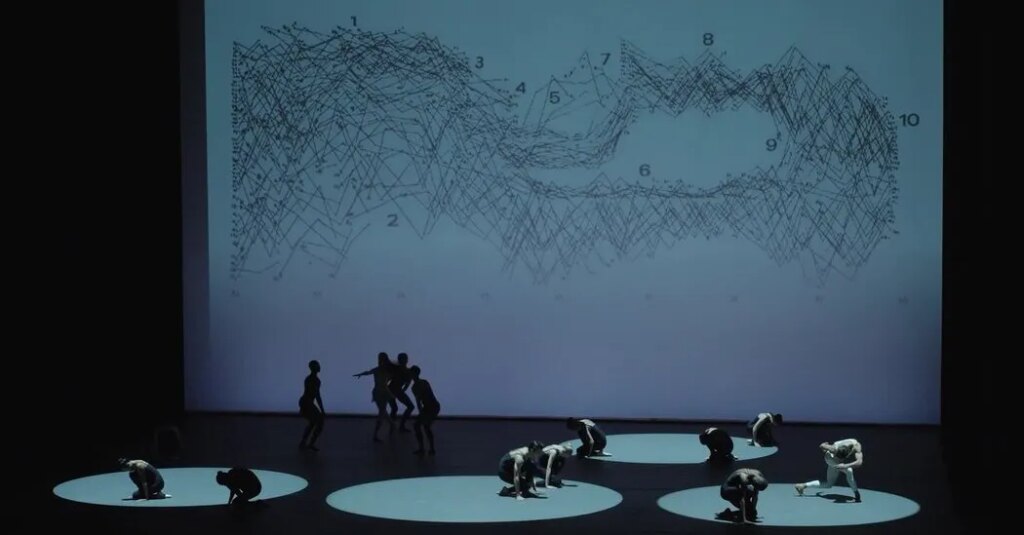
Bleeps and squeaks pop and hiss on a darkened stage. With little warning, dancers, like nimble moon walkers, spring to life in spotlights that form miniature tableaus. These circular frames, galaxies in miniature, pop up to reveal small clusters of dancers bending and reaching in agitation or spinning like steam bubbles rising in a beaker.
A ballet stage is conventionally thought of as a site for pretty dancing, but in George Balanchine’s “Pithoprakta” (1968), originally performed by Suzanne Farrell, Arthur Mitchell and 12 others at New York City Ballet, it is also a vital laboratory for movement. “Pithoprakta” may be nearly 60 years old, but it’s a succinct example of how timeless and contemporary a Balanchine ballet can be.
Driven by Iannis Xenakis’s modernist score that plucks and creaks in a shadowy galaxy, the ballet features two transcendent leads, Mira Nadon and Davide Riccardo, and an eerie and at times disembodied corps de ballet.
Revived by Farrell this season, “Pithoprakta” is a wrenching, urgent work that pushes ballet’s otherworldly quality to a darker dimension, both uncanny and mystical. This is no place for chiffon. It’s not polite. Created just before the first moon landing, the ballet has a celestial atmosphere, which, in tone and temperature, chills to the bone. Is it a glimpse of outer space or a truer reflection of fraught life on earth?
While using a base of classical technique, Balanchine experiments with the ways in which dancers can stretch or crumple, be tied down by gravity or flung into the air, loose and free.
Often the corps de ballet, wearing black unitards by Holly Hynes that desexualize their forms, serve as a frame. Here, as they circle around Nadon, they swirl like furies. Their bodies, distant and impassive on the outside, seem poised for action as their pattering, jabbing footsteps embed the sonic landscape into the visual one. (The backdrop is a rendering of a section of the score by Xenakis.)
Nadon, the heartbeat of “Pithoprakta,” is part spirit, part siren — not the greedy, seductive Siren of Balanchine’s “Prodigal Son” but one removed from the material temptations of earth. In space, or Balanchine’s version of it, the air is dense as Nadon, with the sense that time is running out, moves with off-balance daring. Her legs and arms invade the air around her. She expels her energy into a split and then gathers it up, serenely pulling it back inside of herself.
Here, the corps de ballet is her backdrop, pawing like stylish cats, striking angles with elbows and even patting the floor as she rules the stage, casting spells with undulating arms.
They bounce like molecules …
But nothing can invade Nadon’s space even as bodies, including Riccardo’s, roll across the stage toward her feet. She steps over him, jutting her hips, tossing a leg into the air with constant shifts of weight, never flinching even as he lurches for her ankles.
Later there is a sense of panic as Riccardo, his arms stretched like the wings of a plane, circles Nadon, who, flipping her body over and back in acrobatic walks, finally falls across his arm into a backbend. Suddenly, the corps de ballet sprouts up like weeds. In silhouette, they form outlines of anguish.
“Pithoprakta,” was filmed before its premiere, but Mitchell wasn’t there. (He was founding Dance Theater of Harlem around that time.) Balanchine told Farrell to dance her part without Mitchell, which led to a choreographic disconnect between the two dancers in the actual ballet. They rarely touch. Here, Riccardo paints a force field around Nadon, forming an oval with his arms to trace her moving body, from one outstretched leg to the other.
Throughout “Pithoprakta,” Balanchine uses the pointe shoe as a percussive instrument. As Nadon reaches her arms high — in search of escape? of air? — she rocks back and forth as her widely spaced feet seem to nail her body onto the stage. Though there is tension and the sense of her body trapped on a high wire, she is in control. Riccardo is not. He spins around her, but it’s desperate — he is fading and as Nadon’s arms stretch toward him in the enclosing darkness, he is sucked out of the universe.
The enigmatic end, with Nadon alone and kneeling, is sinister yet porous. Nadon winds her wrists and extends her fingers like a crown before her hands cover her eyes and flutter, casting a shadow on her chest. Is “Pithoprakta” a feminist statement? Many Balanchine ballets are. Nadon’s autonomy is her superpower. She doesn’t need a partner. As a whisperer of the universe, she flies solo.
Videos via New York City Ballet.
The post Watch These Ballet Dancers Crack Open a Celestial Realm appeared first on New York Times.