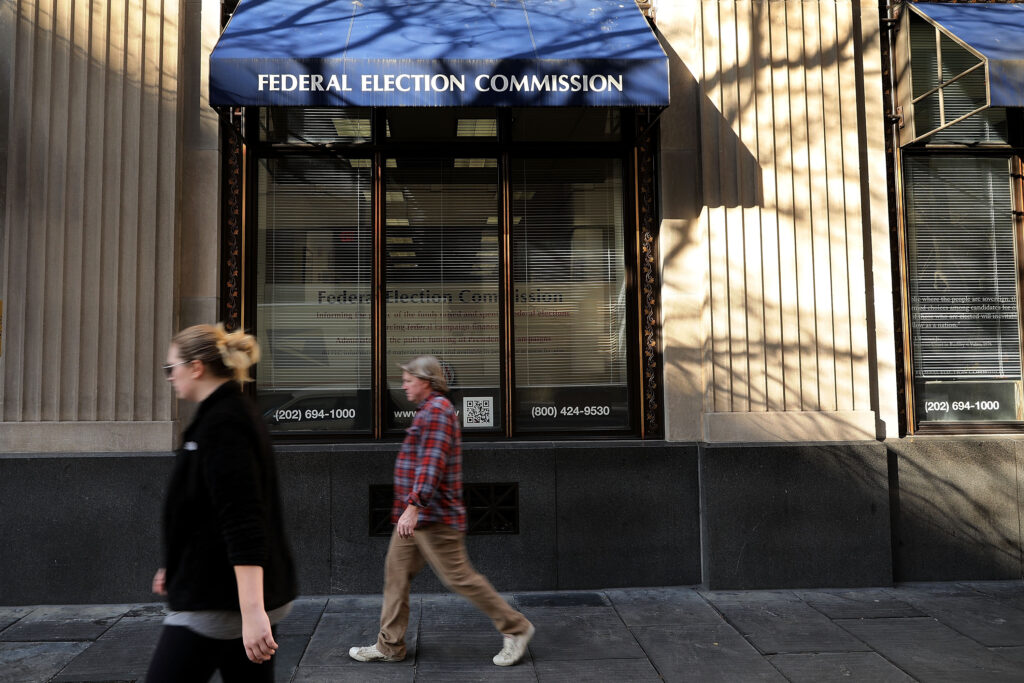
The Federal Election Commission, the agency tasked with enforcing campaign finance law, has been unable to perform most of its duties for the past year and a half because it lacks enough members to hold a vote.
Without a quorum, the agency has been unable during the 2026 midterm election cycle to advise campaigns on the rules for raising and spending money or open investigations into potential misconduct.
The six-seat commission fell below the minimum four members required to vote in April 2025, after President Donald Trump fired the Democratic chair and two Republican commissioners resigned. The FEC, created in 1974 as a response to the Watergate scandal, has lost its quorum four times; three have been during Trump administrations.
Since October 2025, the commission has been down to two members, both Democrats: Shana M. Broussard, the acting chair, and Dara Lindenbaum. Trump nominated two Republicans, Ashley Stow and Andrew Woodson, in February, but the Senate has not acted on them. A spokesperson for Senate Rules Committee Republicans, asked whether the nominations could be moved before the current Congress ends in January, did not respond.
With a record amount of money flowing through federal elections and changes to campaign finance law, the lapse has left elections without a cop on the beat at a crucial moment.
“What that really means for the typical voter is that they are being asked to participate in the democratic process with no assurance that the rules are being followed, and no assurance that they’re getting the transparency they have a legal right to,” said Saurav Ghosh, director of the federal campaign finance reform program at the independent watchdog Campaign Legal Center. “So, it’s fundamentally a diminishment of their rights to have a fair and transparent election.”
Critical work is stalled
In the months before the FEC lost its quorum, it had 21 reports of potential violations pending. According to its most recent quarterly report, the backlog has grown to 157.
Allegations the commission investigates include pay-to-play corruption, in which individuals or corporations give money to gain favorable treatment from elected officials; the use of straw donors to hide funding sources and exceed spending limits; and campaigns making excessive payments to family members.
During the fiscal year 2025, commission lawyers reported in August, the agency collected $1.05 million in civil penalties. In fiscal year 2026, it collected $0.
The Supreme Court this year removed limits on the amount of money political parties may spend in coordination with candidates. But the FEC has been unable to issue guidance to campaigns on the change — a problem, Broussard told The Washington Post, for political committees trying to follow the law.
Potential violations go uninvestigated
Campaign finance watchdogs and journalists may use public documents to identify potential wrongdoing. But the FEC’s investigative work, which includes the authority to issue subpoenas, is often needed to glean the full picture.
Caitlin Sutherland, executive director of Americans for Public Trust, said the organization is still waiting for the resolution of complaints she filed during the 2022 midterm election cycle.
“It has been a problem for a while, and it’s obviously concerning in 2026, particularly as we file complaints, alleging violations of campaign finance law, when there’s no governing body to take the next step and launch an investigation, and then actually hold folks accountable,” said Sutherland, a former research director for the Senate Republicans’ campaign operation.
In one unresolved complaint, Sutherland’s group alleges that independent Senate candidate Dan Osborn of Nebraska directed hundreds of thousands of dollars in campaign funds to family members and their companies, exceeding legal limits. Family members may be paid for legitimate campaign work, but only at fair market value.
“The complaint is baseless,” a spokesperson for Osborn’s campaign said. “All family members employed on the campaign provide valuable work to the team and are paid market value.”
In another complaint, the Campaign Legal Center flagged a $250,000 donation by the GEO Group’s PAC to American Liberty Foundation PAC, affiliated with House Judiciary Chairman Jim Jordan (R-Ohio).
GEO, a private business than operates detention centers and prisons, is among ICE’s largest contractors; Jordan’s committee oversees immigration enforcement.
GEO didn’t respond to requests for comment. The company told the independent Project on Government Oversight, which was first to report the donation, that the filing was incorrect. GEO said a company account, not its PAC, gave the money to the American Liberty Action Fund, a nonprofit led by Jordan’s former chief of staff, not the American Liberty Foundation PAC. Donations by nonprofits are exempt from disclosure.
The Campaign Legal Center is “unusually optimistic” the FEC would find a violation, Ghosh said. “Federal contractor violations are one of the rare areas where it’s so black and white that the FEC actually does enforce the law.”
Stuart McPhail, director of campaign finance litigation at Citizens for Responsibility and Ethics in Washington, said the organization continues to file complaints with the FEC when evidence warrants, “partly because that lets [campaigns] know people are watching.”
“But the lack of quorum,” he said, has definitely meant that certain kinds of complaints where we couldn’t potentially bring them ourselves are are being left by the wayside.”
Complaints against Trump are unresolved
The Campaign Legal Center has also filed complaints against Trump and MAGA Inc. The center alleges that Trump’s repeated claims that he controls the super PAC clearly violate rules that bar federal officeholders from raising and spending soft money. A spokesperson for MAGA Inc. did not respond to a request for comment.
If and when the FEC is restored to a quorum, Broussard said, some complaints might have to be dismissed under the statute of limitations. The commission would be unable to impose penalties or collect fines. But it could still require the organizations to take actions, such as updating filings.
The post U.S. campaign finance watchdog is sitting out the midterms. Here’s what that means. appeared first on Washington Post.