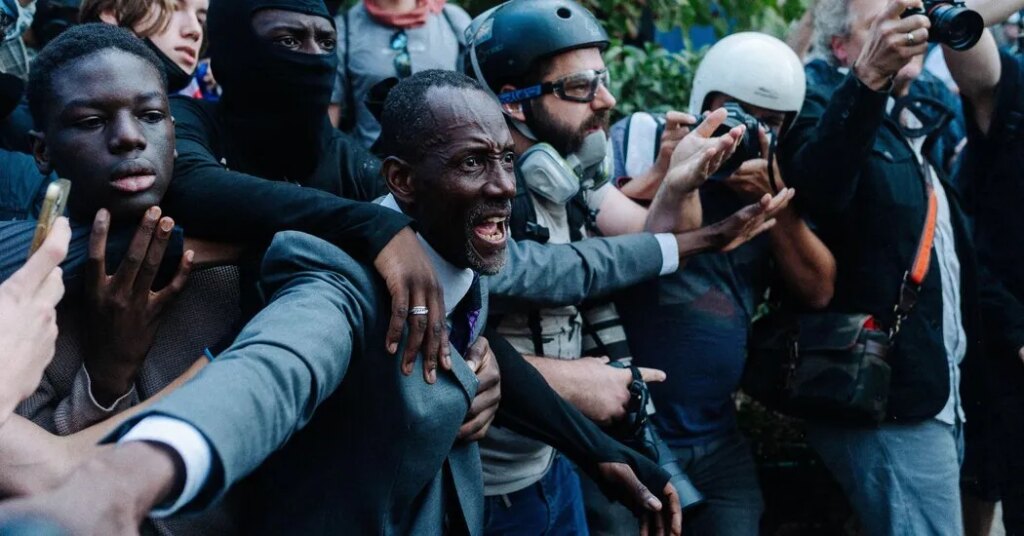
During a student demonstration this month in eastern Paris this month, a row of riot police officers pushed their shields against a group of young male protesters.
Wedged between the boys and the police was a tall man, dressed in a gray suit and lavender tie. He spread his arms wide, shielding the boys, and screamed, “Stop!”
That was Bally Bagayoko, the mayor of St.-Denis Pierrefitte-sur-Seine, one of Paris’s most populous and diverse suburbs, known for a basilica and the national stadium, as well as for high rates of poverty and crime.
Mr. Bagayoko has become a household name in France since students started to blockade their schools roughly a month ago, calling for better conditions — protests that were set to be amplified by nationwide rallies on Saturday.
Footage of Mr. Bagayoko at the protests has featured regularly in social media and television news programs, to both applause and condemnation. His supporters have called him Spiderman, a comic-book superhero who has become a symbol of youth protests across the world. Others, including right-wing politicians, have accused him of inciting violence and have called for him to be removed, particularly after he said that “violence at some point can be legitimate,” though “every time it can be avoided, that’s better.”
For Mr. Bagayoko, 53, the backlash is a sign that his political opponents see his far-left party as a threat in next year’s presidential election. His party leader, Jean-Luc Mélenchon — buoyed by votes from cities, like Mr. Bagayoko’s, with higher numbers of immigrants — could make the runoff.
“They believe a victory could come from the working-class neighborhoods embodied by this atypical mayor,” Mr. Bagayoko said in an interview, speaking about himself in the third person. “So they have to smear him. They have to disqualify him.”
Critics say Mr. Bagayoko inflames division and should take the blame for acts of vandalism by protesters at school blockades that he has attended. Valérie Pécresse, the center-right head of the regional authority that contains St.-Denis, suggested that he should pay about $110,000 to repair a damaged gate at a school in his city.
“Let the mayor take responsibility for his actions,” Ms. Pécresse said on social media.
The criticism of Mr. Bagayoko started the night of his unexpected election in March.
He was part of a wave of new mayors of color elected in the sprawling suburbs north of Paris. Mr. Bagayoko’s victory attracted particular attention because St.-Denis Pierrefitte-sur-Seine is home to roughly 150,000 citizens, more than any other area on the edge of Paris.
Hours after his win, Mr. Bagayoko was interviewed live on national television. A clip of the interview was truncated and misleadingly described by far-right politicians and journalists. He said he was now the mayor of “la ville des rois,” or “the city of kings” — France’s former kings and queens are buried in the city’s basilica. But the incorrect descriptions said he had called it “la ville des noirs,” or “the city of Black people.”
Then, on national television, the founder of a far-right media outlet, Frontières, falsely claimed that drug dealers had pushed for Mr. Bagayoko’s election. “Whose pockets are you in, Mr. Mayor?” the founder asked.
The following week, CNews, a television channel known for broadcasting far-right views, discussed Mr. Bagayoko’s election and his proposal to ban the police from using rubber bullets. A guest on the channel, noting that humans were “part of the great ape family,” compared the mayor with a “hunter-gatherer” leader “whose role is to establish authority.”
The next day, a host on the channel described Mr. Bagayoko’s intention of asserting control over the police as “very tribal.” The Paris prosecutor’s office opened an investigation into the channel for “public insult based on origin, ethnicity, nationality, race or religion,” an accusation that CNews rejected.
Throughout it all, Mr. Bagayoko remained calm and kept smiling. As a Black man, he said in an interview, “No one would have forgiven me for losing my temper on a TV set.”
The onslaught made clear to him, he added, that France has yet to truly accept that citizens of an African background, like Mr. Bagayoko, are full members of French society. Black French, often descended from immigrants from France’s former colonies, are underrepresented in positions of power.
“France still has a problem with its own children,” he said. “Because I am French.”
Unlike many Black leaders in France, Mr. Bagayoko has made the issue a focus. Since his election, he has organized two large rallies to denounce racism in France, and in August, he helped start an initiative to make the issue part of the debate in the coming presidential election.
Rokhaya Diallo, a journalist, filmmaker and prominent antiracism activist in France, said, “Tackling systemic racism in France is very taboo.”
“We don’t see many Black, proud politicians who are not afraid of naming racism,” she added.
Mr. Bagayoko is also facing two judicial investigations. The first concerns whether he, earlier in his career, was given a patronage job at the city’s transportation agency, an accusation he has denied.
The second concerns claims that he incited violence after his comments last month about the legitimacy of violence during protests.
Nonetheless, Mr. Bagayoko’s popularity — and social media following — has surged, with supporters comparing him with Zohran Mamdani, the left-wing mayor of New York.
“He’s our Mamdani. He represents the same hope for people,” said Maxime Beauchamps, 21, a communications student who joined those surrounding Mr. Bagayoko at a recent rally, thanking him and asking for selfies and hugs. The crowd at several points chanted: “Bally, président! Bally, président!”
Many said they saw him as a role model. “He shows us that just because we come from working-class neighborhoods or from ‘disadvantaged backgrounds,’ as they say in sociology, it doesn’t mean we can’t succeed,” said Aya Guetib, 17.
‘We Are Fully French’
Born in 1973, Mr. Bagayoko grew up in a housing project in St.-Denis. He was the second of eight children to parents from Mali, which was ruled by France for much of the 20th century.
Since their father worked long hours as a mechanic, Mr. Bagayoko and his older brother helped their mother raise their siblings in their crowded apartment, according to a younger brother, Yaya Bagayoko. He would go over his siblings’ homework and attend their school meetings, and he registered them for basketball camp in the summer so they were not hanging out in their neighborhood and getting into trouble, said Yaya, 50.
“Bally has always been the rock in the family,” Yaya added. “He can be super nice, but with us, he was pretty strict.”
Mr. Bagayoko earned a bachelor’s degree in geopolitics and a master’s in science and technology. His thesis, he said, was on the mind-set of people living in working-class suburbs like St.-Denis.
He played semiprofessional basketball, and coached children in the sport in St.-Denis.
In 2001, the Communist mayor of St.-Denis, Patrick Braouezec, recruited Mr. Bagayoko to his electoral slate. Mr. Bagayoko was elected to the City Council, swiftly becoming deputy mayor and remaining a fixture in city politics ever since.
Ms. Diallo, the filmmaker, said: “There is no way you can do anything in St.-Denis without knowing him. He’s part of the local fabric.”
In 2017, Mr. Bagayoko joined the far-left France Unbowed, attracted, he said, by the party’s criticism of police violence, racism and Islamophobia.
After his election to the mayoralty in March, he made youth-focused policy a key part of his mandate.
The city expanded a free school lunch program, offered free school supplies to elementary-school students and began a free bike program for 15-year-olds to make commuting to distant high schools easier.
After the protests started last month, he was among the first politicians to join student blockades, including at his own alma mater in St.-Denis.
While others criticize the students for vandalizing their schools, Mr. Bagayoko’s position is that the real violence is performed by the state.
It is a form of systemic violence, he contends, to offer a subpar education — missing teachers, overcrowded classrooms, decaying infrastructure — to children from already underprivileged backgrounds. That, he says, breaks a fundamental promise of the French Republic of equality for all citizens.
“We grew up with an ideal, which is to say that the Republic must be fair to everyone, and it isn’t,” he said.
He also accuses the police of using disproportionate force against student protesters, saying officers were more aggressive against those from working-class neighborhoods.
“There is a contempt directed at these kids from working-class neighborhoods,” he said.
Mr. Bagayoko expresses ambivalence about his role within the French state.
In his office, he has kept a portrait of President Emmanuel Macron on the floor, instead of on the wall, as it is in most public offices in France. He said this summer that booing the national anthem was understandable, when “France dishonors itself through its international actions,” including by not going far enough in its criticism of Israel. And when he wades into protests with students, he makes a point to not wear his three-colored sash — the symbol of elected officials in France. It makes him feel separated from people, he said.
But he has been clear to hold a French national flag when marching in protests, surrounded by young people who, like him, are the children of immigrants.
The message he is sending, he says, is, “We are fully French, regardless of what some people might think.”
Giulia Imbert contributed reporting.
The post The 53-Year-Old in a Suit Who’s the Face of France’s Youth Protests appeared first on New York Times.