The online campaign to unmask Jane Doe began with pleas on X.
“Please help me discover the Cornell girl,” Aidan Thompson, a 23-year-old man who regularly praises Hitler and disparages women on the social media platform, wrote in one of the first posts. “I have a good lead, but I need your help.”
Within hours of Mr. Thompson’s post, another user had offered a bounty of $5,000 for the name and photos of the woman who had sued Cornell University under the pseudonym, claiming she had been gang raped at a fraternity party. Within a day, commenters were circulating a woman’s name and images of her from a social media account.
On the fringes of the internet, bigots, attention-seekers and trolls have long seized on polarizing legal cases to air anger and disgust at women — and boost their following.
Now they were coming for Jane Doe.
A little more than a week after Mr. Thompson’s post about the former Cornell student, more than 11,000 accounts had made almost 25,000 posts that purported to name her, according to an analysis by an online analytics company, Gudea, conducted at the request of The New York Times.
The analysis showed that the posts had begun on X and spread to Bluesky, 4chan, Discord, Telegram, Rumble and other platforms, their numbers growing by the hour.
Many of the posts included hateful or antagonistic language. Some used misspelled words, such as “sIut” instead of “slut,” in apparent attempts to evade the platforms’ text filters, or added videos of far-right influencers like Nick Fuentes, the white nationalist and antisemite, to drive engagement. Often they traced similar themes: Jane Doe had actually consented to the sex; the men she accused were the true victims.
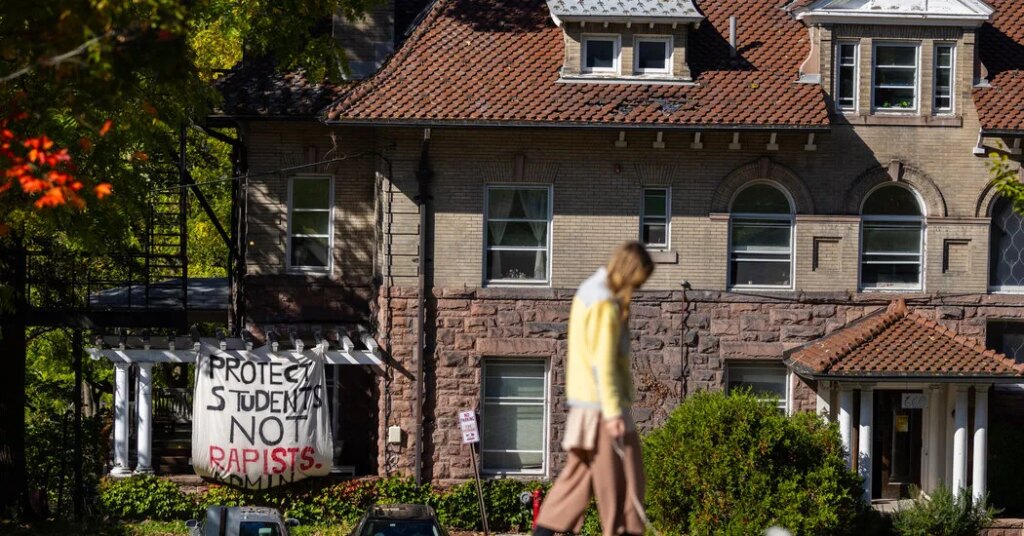
The former student’s lawsuit, filed on Sept. 16, named seven members of the Chi Phi fraternity and said they had sexually assaulted her at a party on Cornell’s campus in Ithaca, N.Y., in October 2024.
All of the men have denied wrongdoing. None have been charged with a crime.
Details that emerged after the lawsuit — including that Jane Doe had willingly drunk alcohol on the night of the party and said she had initially agreed to sex with two of the men — have touched off anger and debate over questions of consent and accountability on college campuses, but also about who deserves anonymity in sexual assault claims.
A lawyer for Jane Doe, Thomas Giuffra, said she had initially wanted to file her lawsuit using her real name but that he had advised against it. He added that the harassment she was facing had taken a severe toll.
“The backlash of trying to identify her and the threats have made this much more difficult for her,” he said. “It’s scary.”
After her lawsuit gained attention, the men she accused also became targets of online harassment. In one Instagram video, a woman posted their names and photos and invoked a female serial killer who had murdered seven men in Florida, saying she hoped they got what they deserved. The video was viewed more than 240,000 times.
Separately, after Jane Doe’s lawyers mistakenly identified the wrong man as one of her assailants, the family of that man, an active-duty Marine, received so many death threats that law enforcement officers had to be stationed outside of their home.
Still, it is common practice in the justice system for courts to permit people who say they were sexually assaulted to pursue civil claims anonymously, to ensure their safety and protect them from stigma. That anonymity, however, is not guaranteed. Judges must decide on a case-by-case basis whether an accuser’s request for privacy outweighs the public’s right to transparency, and the court has yet to rule on that question in Jane Doe’s case.
In the meantime, the online vitriol directed at the former Cornell student could have a chilling effect on other women who are weighing whether to come forward with claims of abuse, advocates for sexual assault victims said.
Catharine MacKinnon, a feminist legal scholar whose work helped establish federal Title IX protection for college students facing sexual harassment, said that an online push to identify someone who had filed an anonymous sex assault claim amounted to an attempt to silence that person.
“It’s to communicate to every woman to whom this has happened that this is what is waiting for her — public shaming, stigma and a spoiled identity,” Dr. MacKinnon said. “This is why people say it takes courage to come forward.”
The people posting about Jane Doe online saw things differently. She had tied the names of seven men to an alleged sexual assault, exposing them to rancor and embarrassment.
Now it was her turn.
An Opportunity
Mr. Thompson, the right-wing provocateur, had been involved in controversy before.
In 2024, he resigned as treasurer of the Kansas Young Republicans amid criticism over his interactions with Mr. Fuentes. (The same group was later embroiled in a scandal after leaked texts showed some of its members participating in a racist, misogynist and antisemitic group chat.)
Since then, interspersed with shirtless selfies, Mr. Thompson has posted a steady stream of racist, homophobic, antisemitic and misogynist content on X.
“Hitler? Hitler, can you can hear me? Yes, there’s a problem. We need you Hitler. You’re our only hope,” he posted on Sept. 20, above a photo shared by a Texas state senator depicting a multicultural group gathered to watch a college football game.
“Hard not to hate women as you sleep with more of them,” Mr. Thompson posted four days later.
Most of these posts received only modest engagement. But the Cornell case, he told The Times in an interview, presented an opportunity.
Fifteen hours after sending the call out for Jane Doe’s identity, he shared a woman’s name and photos, calling it “BREAKING NEWS.”
“They have a right to face their accuser,” he wrote of the seven men, “and we have a right to publish her identity if we discover it.”
This time, his post ricocheted across X, shared by users and amplified by the platform’s own recommendation algorithm. It has since accumulated more than 19 million views.
A spokeswoman for the platform, which is owned by Elon Musk’s SpaceX, did not respond to requests for comment.
In the interview, Mr. Thompson described himself as a “white male” who has had “histrionic women lambasting” him “as like a Nazi” his “entire life.” He defended the men in the Cornell case, saying that their names and photos had been widely circulated, and adding that they had already been “adjudicated guilty by the public.”
“A lot of parties are incentivized to boost this,” Mr. Thompson said, comparing himself to Stephen Miller, the Trump administration official who, as an undergraduate student at Duke University, made a name for himself defending lacrosse players at the school who had been wrongly accused of rape.
“I’m not lacking in self-awareness,” Mr. Thompson added. “I understand that I’m dramatically opportunizing off of this.”
Mr. Thompson said he had used information included in Jane Doe’s legal complaint to try to ferret out her identity.
His “BREAKING NEWS” post was followed by a torrent of messages directing anger and hate at the woman he named. Some called her a whore. Others made vulgar comments about her body. Still others went further.
One series of posts on X included not only a name, but also an address, phone numbers and information about the woman’s apparent relatives. The posts, which violated X’s rules on sharing private information, racked up more than 1.4 million views, before being removed a few days later.
Savanah Hernandez, a commentator for Turning Point USA, who has more than 700,000 followers on X, shared a woman’s name and photo and wrote that the accuser “was so embarrassed about everyone at Cornell knowing she was such a huge HOE.”
She deleted the post not long after, but then wrote of the men: “I do think if they’ve been named, so should she.”
‘Don’t Blame Me’
Soon after Mr. Thompson claimed to have unmasked Jane Doe, Michael Tracey, an independent journalist with more than 350,000 followers on X, was preparing a post of his own.
Mr. Tracey, who had earlier gained notoriety for questioning the veracity of a prominent Jeffrey Epstein accuser, had recently fixated on people who file anonymous legal complaints making what he called “reputation-destroying claims” about others.
By Oct. 2, Mr. Tracey announced to his followers on X that he, too, had confirmed Jane Doe’s identity.
His post on X listed the name and photo of the woman Mr. Thompson had identified.
Separately, on Substack, Mr. Tracey posted a screenshot he said had come from a state court website that also listed the name in relation to the Jane Doe case.
Because the name had been revealed on a public docket, he said, it was fair game.
“Don’t blame me — the New York court system just posted it,” he wrote.
But it appeared Mr. Tracey had been duped.
The site he referred to had no connection to the New York State court system. Instead, registration records show, it appeared to have been created by a 33-year-old man in Michigan who described himself on social media as a “digital creator.” That man did not respond to requests for comment, and the site is now offline.
Amid cascading criticism, Mr. Tracey deleted the posts with the woman’s name later on Oct. 2, arguing that “the principle has been served.”
“I don’t believe she’s the main ‘villain’ here,” he wrote in another post on Substack, saying he was instead calling out “sleazebag lawyers.”
In an interview, Mr. Tracey defended his initial decision to connect a name to Jane Doe, claiming it was in the public interest. He said he had not relied on the third-party website, and had instead verified her identity through other means.
“There are situations where you report on the information of somebody that they or others would like to not see reported,” he said. “That is what I did, but apparently that’s doxxing or that’s some great offense against humanity if you do it with respect to a litigant in a civil action that’s had all these far-reaching reverberations.”
Before he deleted his posts, though, others on social media had already begun citing them as their own justification to attach a name to the woman.
One streamer on Rumble, a right-wing version of YouTube, soon broadcast the name to followers, using a screenshot of Mr. Tracey’s post on X. In the days that followed, right-wing influencers on YouTube amplified the name to still more viewers, decrying the amount of harassment facing the men.
On Instagram, the same name was soon automatically labeled a “popular” search subject.
A spokeswoman for Meta, which owns Facebook and Instagram, said such posts were prohibited by company policy and that the social network had removed some of the material. The company also removed the name from the ranked results on the platform’s search function.
YouTube, too, took down videos that claimed to identify the woman, saying they violated its harassment policies, a spokesman said.
Representatives for Rumble did not respond to a request for comment.
For his part, Mr. Tracey, having removed his posts about Jane Doe’s identity, said he and his family had themselves become victims of online mobs.
“There are maniacs on the internet,” Mr. Tracey said. “So, yes, I’m aware that anybody who’s involved in a matter of public controversy can probably expect to receive some deranged messages from people on the internet.”
Real-World Consequences
As the online furor mounted, it appeared that at least some people on the internet had indeed learned Jane Doe’s true identity.
On the evening of Oct. 6, a man called the police and said he had shot his mother and was going to kill his sister next. He gave as his location the address of Jane Doe’s family home, police records show.
An officer sped to the house, approached a truck as it was backing out of the driveway and drew his gun. He ordered the two men inside — Jane Doe’s loved ones — to the ground.
More officers arrived, and they soon determined that the call was a hoax. When they entered the house, they found the former Cornell student inside.
She told them she had been inundated with phone calls and messages threatening her and her family’s lives. She said she was panicking because her phone would not stop ringing.
As the police were interviewing her, a man called their department again, said he had an assault rifle and that he was heading toward the house with plans to kill everyone inside.
It would be a good idea, the police told Jane Doe’s family, if she just turned off her phone.
Georgia Gee, Kirsten Noyes, Kitty Bennett, Duy Nguyen and Dylan Freedman contributed research. William K. Rashbaum contributed reporting.
The post When a Social Media Mob Came for Cornell’s Jane Doe appeared first on New York Times.