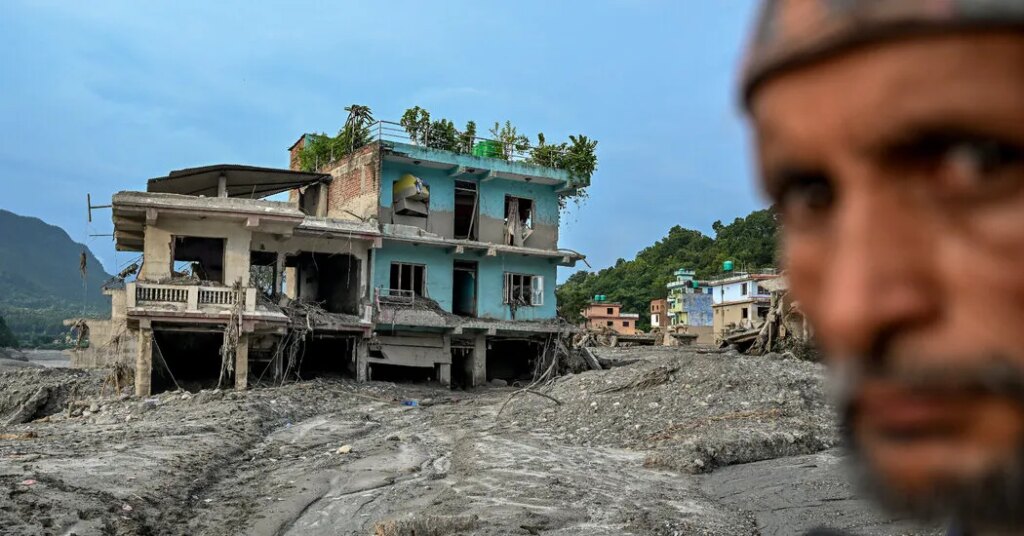
At 9:10 a.m. on Aug. 26, a school staff member burst into a classroom in the town of Nuwakot, Nepal, shouting that a wall of water was coming down the valley from the mountain above. Rajendra Dawadi, the school’s principal, ordered the roughly 900 students then on campus to run for higher ground, put the students who had just arrived back on their buses and told the drivers to leave. By 9:23, about 13 minutes after the first warning, the school was gone, swept away along with the rest of the valley floor. Every student survived.
Most of the people in the valley were not so lucky. High above the school, a mass of rock and glacier ice, by some estimates as much as seven billion cubic feet, broke from the north face of Langtang Lirung, a mountain peak near the Nepal-China border, and thundered downhill. It is most likely the largest such collapse ever recorded in the Himalayan mountains.
More than 7,000 people are dead or missing, many probably buried under feet of debris. As the country mourns them and begins to rebuild, it’s also coming to terms with the fact that such a disaster could easily happen again.
Climate change is causing glaciers across the Himalayas to retreat and permafrost to thaw, making these mountains more dynamic and less stable. What if the communities living in them could be warned long before the next glacier collapses? That’s the opportunity we see: International scientists could use artificial intelligence to monitor vast quantities of satellite images and then send out an alert to evacuate when the warning signs are there. Building such a system is a way for wealthy countries to help remedy a problem — the increase in climate disasters — that they have created by burning an overwhelming share of the fossil fuel humanity has used to date.
You might think that the best option would be for communities at risk of glacial collapse and flooding to retreat and relocate. But the river corridors most exposed to these hazards are Nepal’s best sites for producing hydroelectricity; at least a dozen hydropower projects were damaged or destroyed in this one event.
Nepal cannot easily forgo the revenue and electricity these rivers offer. Its per capita electricity consumption is among the lowest in the world, and hydroelectricity remains the best opportunity to support economic growth with clean energy. The country is already racing to develop other sites, with a goal of increasing the 4,300 megawatts of installed capacity today to 30,000 megawatts by 2035. But it can no longer plan as though these valleys are safe. Every dam, tunnel and workers’ camp built below a glacier is now a wager against the stability of the mountain above it, and the odds are changing.
Here the international scientific community may have something concrete to offer. Satellite radar had recorded Langtang Lirung’s slow-motion instability for months: Data going back to January show the slope creeping downhill and accelerating in the weeks before it failed. But no one looked at the data until it was too late.
Spotting that kind of signal in one mountain, after disaster strikes, is one thing. Doing it continuously, across the thousands of glaciers and rock slopes scattered through the Himalayas, is a different scale of problem. It’s also exactly the kind of problem new artificial intelligence tools are suited to. Machine learning can now sift through enormous volumes of satellite imagery automatically, day after day, flagging the handful of slopes accelerating among thousands that are not.
It will take a big effort by glaciologists and geomorphologists around the world to design and test such a system, but deployed at scale, it could give communities in Nepal not 13 minutes, but hours or days. It could give agencies time to plan evacuations rather than improvise them. And such a system could be used to address similar risks in other Himalayan countries including China, India, Pakistan and Bhutan.
Climate risk is not Nepal’s to solve alone. Its contribution to the greenhouse gas emissions warming the planet is negligible, yet the mountain communities living beneath these unraveling massifs are among the poorest people on earth, suffering a disproportionate share of the consequences. Climate finance funds, such as the United Nations Fund for Responding to Loss and Damage, established in 2022 after the torrential floods in Pakistan, were designed with exactly these disasters in mind. Contributions from wealthier nations could be used to make Nepal more resilient, but the fund is woefully underfunded and slow to process claims. New money is needed for development of monitoring systems, disaster planning and, in the most exposed valleys, new roads and escape routes that let people get away from the river.
The heavy monsoon rains will return next summer, and the glaciers above these valleys will keep retreating as global temperatures rise. The protections Nepal needs will take years to build, and the countries most responsible for the warming can afford to pay for them. The question is how many disasters Nepal will endure before they do.
Bibek Raj Kandel is an adviser to Nepal’s minister of energy, water resources and irrigation. Daniel Schrag is a professor of geology at Harvard University and a professor of public policy at the Harvard Kennedy School.
The Times is committed to publishing a diversity of letters to the editor. We’d like to hear what you think about this or any of our articles. Here are some tips. And here’s our email: [email protected].
Follow the New York Times Opinion section on Facebook, Instagram, TikTok, Bluesky, WhatsApp and Threads.
The post The Glaciers Are Collapsing. We Deserve a Warning. appeared first on New York Times.