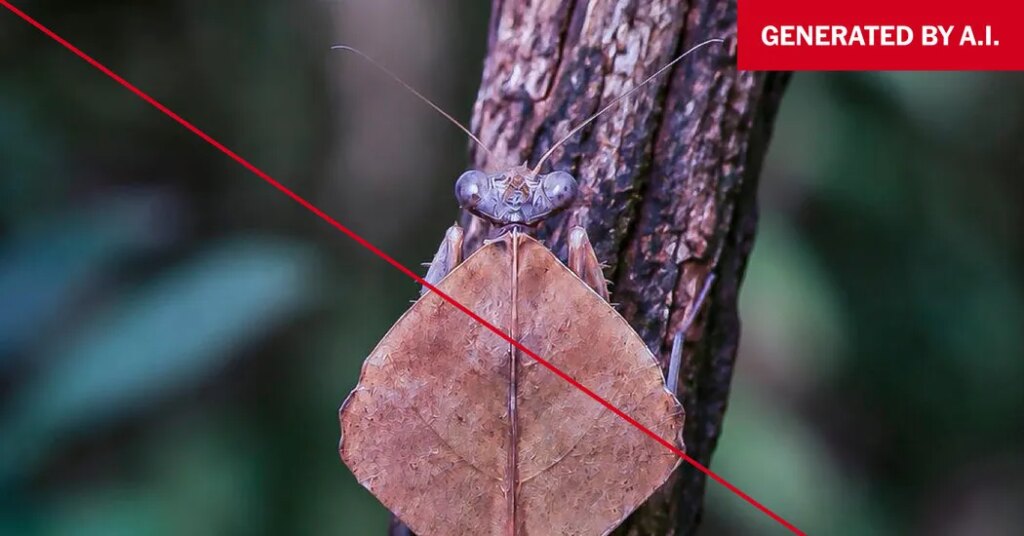
The bug looked like a new species. It had the classic mark of the dead-leaf mantises — a flattened shield, brown and crinkled to mimic forest-floor detritus — but the camouflage was almost too good, as if it were wearing an actual leaf. It was unlike any specimen Kris Anderson had ever seen.
Mr. Anderson has seen plenty of specimens. He has thousands pinned in drawers in his Las Vegas home, legs out, wings spread to reveal a stained-glass geometry of veins.
Every evening after his workday as a director of a counseling center, he spends two and a half hours poring over the 500 or 600 mantis pictures that enthusiasts have uploaded to the citizen science website iNaturalist, where anyone can submit photos of wildlife to help map biodiversity. To Mr. Anderson, most are junk — blurry shots of common species. But every so often there is something worth writing up: a mantis never before documented on Aruba, or a rare behavior, like three females seemingly eating each other.
For a few seconds, the mantis he saw on June 17 seemed like a taxonomic jackpot. Then he realized he’d been duped. This mantis was fake, a product of artificial intelligence.
It was yet another instance of a sprawling problem. The algorithms that make certain scientific tasks easier are also producing a crisis of clutter. Scientific journals are inundated with A.I. slop, bibliographies fattened with nonexistent articles. Peer reviewers who are supposed to catch such shoddy work sometimes outsource the job to algorithms, too.
In response, groups founded to democratize science are establishing new checks and balances. This fall, the preprint server arXiv — a free online repository that quickly disseminates research papers, with less vetting than traditional journals — started limiting submissions to mitigate the tsunami of A.I.-aided results. Citizen science forums like iNaturalist are considering similar safeguards. Last spring, OpenStreetMap, a communally created digital atlas, embedded a “read me” file for automated programming agents making tweaks in its crowdsourced code: a honey pot for machines. In August, eBird, Cornell’s archive for ornithological sightings, announced a new warning system to flag over-edited or artificial birds.
“A.I. systems could, and do, make good contributions when deployed in the right way,” said Mikel Maron, an OpenStreetMap volunteer. “The trouble is, it’s so easy, whether generating code or generating data, that it creates a large volume of noise, which has the potential of overwhelming humans’ ability to sort through the contributions.”
At stake is a delicate symbiosis. Citizen science is an alliance between experts and amateurs. Researchers get help collecting and analyzing vast data sets; laypeople get to shape and access knowledge that might otherwise be locked away. This isn’t mere infotainment. SafeCast, an international nonprofit, uses this approach to monitor and distribute radiation and air quality data. Citizens of the Reef tracks coral — and by extension, ocean — health.
A.I. is enhancing those efforts, allowing a volunteer without much coding experience to quickly troubleshoot data visualization issues, say, or pinpointing details that deserve attention in vast libraries of images.
“It’s mind blowing to me how much possibility there is for accelerating scientific discovery across all domains,” said Lucy Fortson, a University of Minnesota astrophysicist and co-founder of the citizen science platform Zooniverse. “Yes, apply this stuff! But don’t forget that human quality of being able to notice something odd, of having context of the real world.”
The erosion of those instincts is what some researchers worry about. Alexander Lees, an ornithologist at Manchester Metropolitan University, remembers when colleagues sent him an image of a threatened willow tit in Scotland — a plausible and exciting enough finding that it took some convincing to make them realize the picture was a fake. Those hoaxes are still rare on iNaturalist and eBird. More common are well-meaning volunteers using models to clean up photos without noticing that the bot has added wing-stripes, or swapped out yellow for red.
“If there’s a lot of these photos out there, they will pollute the database of what real animals look like, and they will confuse models you want to identify real species,” Dr. Lees said. “You’re essentially giving them training data of things that do not exist.” The concern is that generative models would complicate the use of their precursors, the pattern-recognizing networks that power identification apps
This is, to Mr. Anderson, a new manifestation of an old issue: The mantis order is neglected, taxonomy is constantly changing and the corpus that iNaturalist’s pattern-recognition software uses to suggest species names is “a minefield of erroneous data.” Years ago, he corrected every mistake he saw. Eventually, he stopped; otherwise he’d do nothing else. Now, he does so only if he’s writing a paper based on that uploaded photo.
“We really rely on experts like Kris Anderson to generate the identification,” said Scott Loarie, executive director of iNaturalist, pointing out that the pattern-recognition models are only as good as the human community inputting information.
Hence the worry about A.I. images becoming more sophisticated. The first algorithm-manipulated mantis Mr. Anderson spotted, in March, was “all Frankenstein-looking,” he said. “It was fantastical. It had three antennae, and the legs were all misplaced.” The next one had him briefly fooled, until he noticed something odd about the wing-fold and a strange texture on the thorax.
After he contacted the person who uploaded it and flagged it to iNaturalist, the posting was taken down. “Such images may be especially dangerous because they are capable of passing initial review by non-specialists and may persist within biodiversity databases for extended periods before detection,” Mr. Anderson wrote in a paper about the situation.
To some academics, his report, too, deserved caution: He’d published it in Soothsayer, a mantis research journal he runs himself, without formal, anonymized peer review; he’d founded it out of frustration with the slowness of academic publishing.
The venue didn’t bother Julio Rivera, a research associate and mantis specialist at the Montreal Insectarium. “There is important stuff in those publications,” he said. Science is communal. Mr. Anderson had published his findings for others to examine, challenge and build upon — if they weren’t too busy wading through A.I. slop.
The post It Looked Like a New Species. The Trouble Was, It Didn’t Exist. appeared first on New York Times.