The U.S. government seized a tanker on Wednesday in the Caribbean Sea that was carrying oil from Venezuela. It was an escalation in a monthslong pressure campaign by President Trump against Nicolás Maduro, the autocratic leader of Venezuela, whom U.S. officials would like to see abdicate. The United States will likely seize more tankers with Venezuelan oil soon, officials say.
What was the tanker?
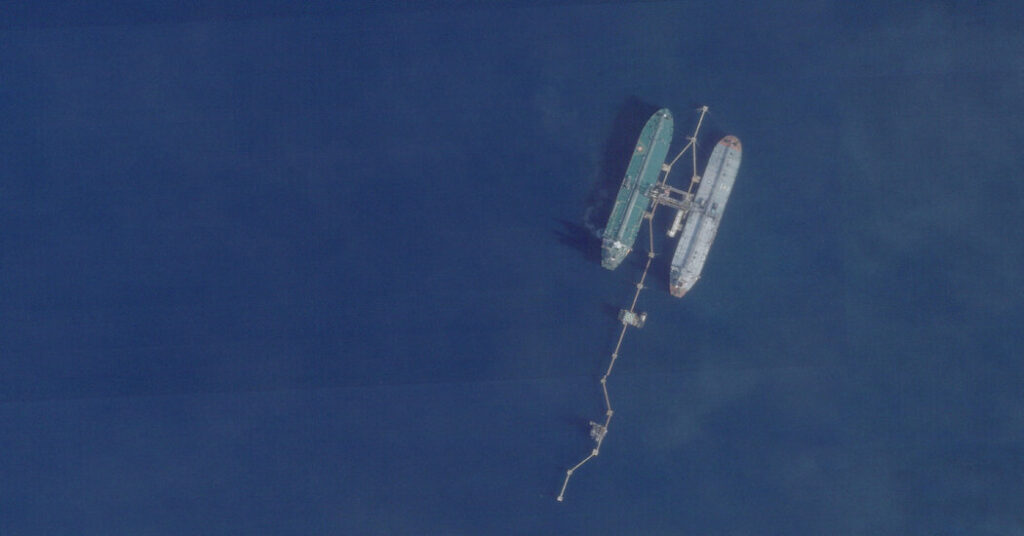
The ship is called the Skipper, and it was carrying Venezuelan oil from Petróleos de Venezuela, the state-owned oil company known as PDVSA, a U.S. official said.
It had been linked to the smuggling of oil from Iran, the official said, a country that has been heavily sanctioned by the United States. The U.S. government has seized several vessels suspected of transporting Iranian oil in recent years. The Skipper was sailing under the flag of Guyana, even though it was not registered to the country, said the official, who agreed to speak on the condition of anonymity to describe sensitive information around the seizure.
The tanker may have been trying to conceal its whereabouts by broadcasting falsified location data, according to a New York Times analysis of satellite imagery and photographs.
Data provided by TankerTrackers.com suggests that the ship often carried oil from countries under U.S. sanctions. The vessel’s tracking data shows multiple trips to Iran and Venezuela over the last two years.
The ship took Iranian oil to Syria in 2024, and it transported nearly two million barrels of crude oil from Iran to China between February and July of this year, according to the tracking website. Iran and Syria are among four countries the United States lists as state sponsors of terrorism, a designation that triggers strict U.S. sanctions.
In 2022, when the ship had another name, it was placed under sanctions by the Treasury Department, which said the vessel was part of “an international oil smuggling network that facilitated oil trades and generated revenue” to support the Iran-backed militia group Hezbollah in Lebanon and the elite Quds Force of the Islamic Revolutionary Guards Corps, which is part of the Iranian military.
Who seized the tanker, and on what legal authority?
The seizure was a joint operation by law enforcement agencies and the U.S. military. It involved the F.B.I., the Department of Homeland Security and the Coast Guard, and was supported by the Pentagon, said Attorney General Pam Bondi.
On Wednesday, she posted a video on social media showing armed U.S. security personnel rappelling from a helicopter onto the deck of the tanker. The Times could not independently verify the video.
Ms. Bondi said the tanker had been used to transport “sanctioned oil” from Venezuela and Iran. The U.S. agencies were acting on a warrant issued by a federal judge roughly two weeks ago that was based on the ship’s record of smuggling Iranian oil, not because of links to the Maduro government, the U.S. official said.
Edward Fishman, a former State Department sanctions specialist who has written a book on economic warfare, said the handful of U.S. seizures of oil tankers around the world in recent years have all involved suspected links to financing for the Islamic Revolutionary Guards Corps, which the first Trump administration designated a foreign terrorist organization.
“The link to terrorism is the one with the strongest track record,” he said.
What will happen to the ship and to the oil?
U.S. officials have given only brief answers to these questions. Karoline Leavitt, the White House press secretary, said that the Trump administration was seeking the legal authority to seize the oil from the Skipper.
“There is a legal process for the seizure of that oil, and that legal process will be followed,” she told reporters on Thursday.
On Wednesday, when asked about the ship’s oil, Mr. Trump said, “Well, we keep it, I guess.” He declined to say who owned the tanker. “It was seized for a very good reason,” he added.
What pressure does this exert on Venezuela?
Venezuela is a large exporter of oil, and the sales account for most of the country’s export income. The government depends on oil revenues to import basic needs for the country, such as food and medicine.
China buys about 80 percent of Venezuela’s oil. The United States used to be the biggest buyer, and it still imports some oil, but the commercial relationship has degraded because of political tensions.
Venezuela also exports oil to Cuba, but the amount has dropped in recent years as Venezuela’s economy has stagnated. Those exports are an important source of energy for Cuba, whose communist government maintains a close security and economic relationship with Venezuela. Cuba’s economy has been hobbled for decades by U.S. sanctions.
In recent months, to pressure Mr. Maduro, the Trump administration has been building up a large armed force near Venezuela. The U.S. military has attacked at least 22 boats, killing at least 87 people, in nearby waters, and has claimed that the boats were carrying drugs and that they posed an imminent threat to Americans. The administration says the United States is in an “armed conflict” with drug cartels, and it accuses Mr. Maduro of being the leader of a cartel network in Venezuela who must be brought to justice.
Congress has not authorized the U.S. military to take part in any such armed conflict. Legal experts say the attacks on civilians in boats are illegal, and that the administration could be committing war crimes.
Secretary of State Marco Rubio and other top Trump aides have been pushing for months to oust Mr. Maduro. Mr. Rubio, as a senator, supported a U.S.-backed effort in the first Trump administration to depose the Venezuelan leader, which ultimately failed.
Christiaan Triebert and Riley Mellen contributed reporting.
Edward Wong reports on global affairs, U.S. foreign policy and the State Department for The Times.
The post What to Know About Trump’s Seizure of an Oil Tanker Near Venezuela appeared first on New York Times.