Progressive and socialist candidates have seemingly made inroads into mainstream politics, with self-identified socialists winning several Democratic primaries this year and a popular democratic socialist leading New York City. And polls show that the concept of socialism, once deeply unpopular in the United States, has gained some momentum.
But those polls also show that support is still limited. Understanding the shifting support of socialism is complicated by disagreement about what the term even means.
Most Americans dislike socialism, but it is becoming more popular.
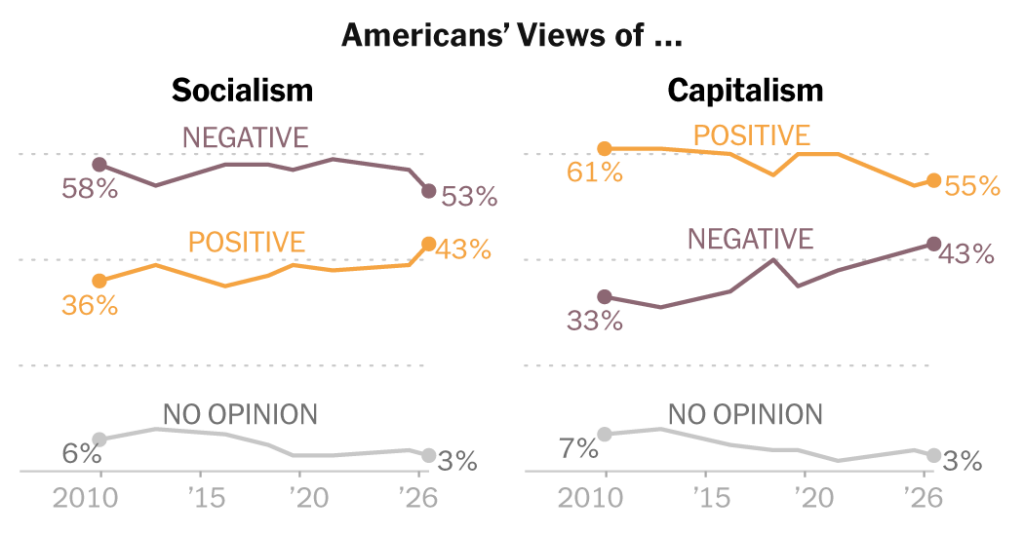
Americans are becoming more open to socialism, but they have not broadly embraced it. In August, positive impressions of socialism topped 40 percent for the first time since Gallup began tracking that figure in 2010. In contrast, negative views of capitalism have sharply increased.
Views of socialism remain deeply divided along party lines. A New York Times/Siena poll in September found that a majority of Democrats viewed the concept favorably. Overall, just under 30 percent of registered voters had a favorable view of socialism.
However, Democrats are not the only group driving the increase in support. In the Gallup poll, favorable views of socialism among independents increased by eight points over the last year.
The definition of socialism is fluid.
Understanding support for socialism can be complicated because it means different things to different people. As The New York Times said in 1983, “Few political definitions have engendered so much dispute as the meaning of the word Socialist.” (Even within The Times, socialism has evolved — the current style guide does not recommend capitalizing the word.)
During the Cold War, Soviet-aligned states referred to themselves as socialist, leading Americans to treat the term as synonymous with communism. Now, the term is often also used to refer to the welfare and social programs that are prevalent in Western Europe and Scandinavia.
In 1948, when Gallup asked Americans to describe their understanding of socialism in their own words, about one-third defined it as government ownership or control; by 2018, just 17 percent defined it that way.
In practice, Americans have varying ideas about what constitutes socialism. Most Americans agree that free health care for all is socialism; more say public schools and libraries, both of which are taxpayer-funded services provided through the government, are not socialism than say that they are.
And some politicians and pundits use socialism as a catchall term for policies and concepts they don’t like. When Vice President JD Vance was asked to define the word at a recent event, he offered a basic definition of it, and then said “what it actually means in the American context is you want to replace American workers with foreign workers, and you want boys to play in girls’ sports.”
Are socialist policies popular?
Because terms like socialism and capitalism carry political baggage, how people respond to these labels in polls may be a reflection of political identity rather than policy preferences.
Many policies that could be considered part of a socialist platform perform better in polls than socialism does on its own. Two-thirds of Americans favor having a national health plan; before 2016, less than half did. A majority of Americans said they wanted the government to cover the cost of college tuition for all students. Paid family leave has long garnered broad support. And 64 percent of Americans in a 2025 poll favored government-provided preschool care programs.
Support for wealth redistribution, a key tenet of socialism, has increased since 1978, when the long-running General Social Survey began polling Americans on their views about the idea. Overall, a majority now believes the government should reduce income differences by raising taxes or giving assistance to the poor.
Does the ‘democratic socialist’ label matter?
Not all of the politicians who are described as socialists are affiliated with the Democratic Socialists of America, and some of them do not even identify as socialists.
In fact, some of the most well-known democratic socialists are not always thought of that way. Less than two-thirds of Americans identified Senator Bernie Sanders, who ran as a democratic socialist in the 2016 presidential election, as a socialist. Only a small majority used that label for Mayor Zohran Mamdani of New York City and Representative Alexandria Ocasio-Cortez, both of whom are members of the D.S.A.
The question is whether an association with the word “socialism” — whatever it might mean — matters at the ballot box.
When asked if a candidate’s D.S.A. affiliation mattered, just under half of voters in the Times/Siena poll from September said it did not matter either way. Still, voters were about twice as likely to say that they would not vote for a democratic socialist (29 percent) than that they would (14 percent).
Democrats are more likely than independents or Republicans to say they would support a democratic socialist candidate or that it does not matter. But even among Democrats, socialism is at the root of a persistent and heated debate about the future of that party.
Broader frustration with the system may be driving up support.
A softening view of socialism has gained ground as voters have expressed increasing disenchantment with the political and economic system. About two-thirds of voters in a Times/Siena poll from May said that the system needed major changes or to be torn down entirely, up from 59 percent in October 2024.
And in a reversal from 2024, Democrats are now more likely than Republicans to say they want the system torn down entirely.
Those deeply disillusioned voters were more likely to view socialism positively than voters who said the system just needed to be changed, suggesting that Americans’ deep and growing frustration may be driving some voters to consider socialism.
The post How Americans Feel About Socialism appeared first on New York Times.