From the age of 12, Nilima Sheikh regularly traveled with her parents and sister several hundred miles north from their home in New Delhi to the mountains of Kashmir. She was asthmatic. Her parents, who were both doctors, carried medicine in case it was needed because they insisted she should not forgo the hikes. In her memory, the verdant Kashmir Valley shimmers as an earthly paradise, as it has over the centuries for emperors, poets and countless visitors.
“I had in my mind that I wanted to do large works on the theme of Kashmir, but I felt I hadn’t enough knowledge,” Sheikh said in an interview. Trained as a historian, she plunged into the subject in 2003, producing, over the next 11 years, a suite of 10-foot-tall, double-sided scroll paintings she titled, “Each Night Put Kashmir in Your Dreams.”
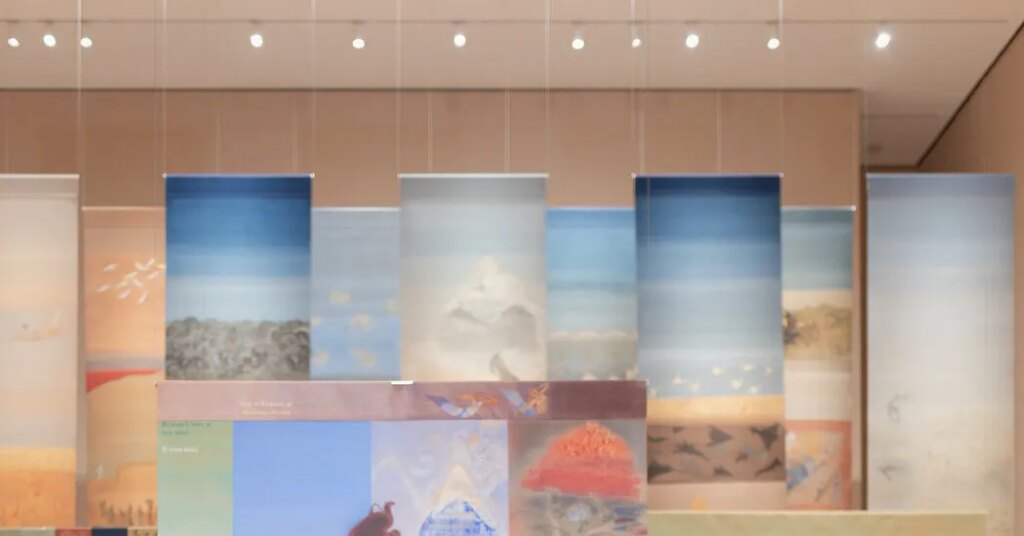
Five of these paintings star in her marvelous first show “Nilima Sheikh: Fractured Skies,” in a 26-foot-high lobby gallery at the Museum of Modern Art. Modern Kashmir’s beauty is represented alongside the violence between Hindus and Muslims that has convulsed the region since Indian partition and independence in 1947. The delights and atrocities are depicted with equal delicacy and tenderness, in a style that descends from Indian and Persian miniature painting and includes allusions to Italian primitives, Chinese landscape artists, 19th-century Kashmir map shawls and the demons depicted in late-14th- and early 15th-century Turkey by a mysterious artist or artistic circle known as Siyah Qalam (“The Black Pen”).
Elegant in her bearing and manner, so soft-spoken that one at times must strain to hear her, Sheikh, 80, is exceptional among Indian modernist artists in her unflinching focus on divisive social and political issues. Walking through the gallery during the installation, dressed in a kurta and pants, with her steel-gray hair pulled back, she pointed out one painting, “Son et Lumiere,” in which she had depicted a group of picnickers alongside a decapitated man from whose neck blood is spurting, and the flowers and other offerings that have been placed on a grave garden. Beauty and death go hand in hand.
Over the last year, Sheikh made another suite of vertical panels on canvas, “Shahid/Witness,” and all 10 are on view for the first time. In each, the sky is marked by a portent: In “Hospital,” warplanes fill the air over the hospital beds of Kashmiri casualties; they resemble the white cranes that hover above in “Migrants,” another work nearby. Other panels depict a street lynching, floods caused by climate change (including a melting glacier that anticipated the recent disaster in Nepal), and animals fleeing a forest fire. The backs of the panels are colored with indigo and decorated with stenciled patterns and texts.
“She remains within the painterly tradition, but early on moved away from easel painting, which was the mode of men,” said Roobina Karode, chief curator and artistic director at the Kiran Nadar Museum of Art in New Delhi, who organized the show with Cara Manes, an associate curator with MoMA. “I can’t think of any artist who has pursued the scroll format as creatively.”
Manes said, “You encounter the narrative in parts as you move your body around them.”
A recent series of paintings, “Home, Land” was provoked by the 2018 gang rape and murder of an 8-year-old girl from the nomadic Bakarwal tribal community of Muslim herders in Kashmir. The girl, Asifa Bano, was abducted while she was grazing her horses, and tortured and killed in a Hindu temple.
“I painted these for her,” Sheikh said. “The Bakarwal people are being thought of as ‘other’ even in Kashmir. Their land is being coveted. This was done to frighten them off. The people who did it were celebrated.” In Sheikh’s paintings, beautifully colored with mixed tempera on handmade paper, she portrays the pastoralists as small figures in the gorgeous mountainous landscape they have inhabited for centuries and where their existence is now threatened. (One of the paintings in “Shahid/Witness” also represents Asifa surrounded by a group of assailants.)
The fractures of modern India have marked Sheikh’s life. A few years before Indian independence, her parents, of Hindu heritage, moved from Lahore (which was incorporated into Pakistan) to New Delhi, where she was born. In a large scroll painting from 2001, not in this exhibition, she portrayed the forced migrations of Hindus and Muslims during partition, a traumatic event she said was almost never addressed by Indian artists. “I would fault our art history for that,” she said. Indian artists appropriated the formalism of European modernist painting without a bridge to connect it to the events around them. “One needed to make a language, find a language,” she said.
Sheikh studied art in the city of Baroda (renamed Vadodara) in the western Indian state of Gujarat and where she has lived ever since. There, she was mentored by the renowned artist K.G. Subramanyan, whom she credits with encouraging her to incorporate craft into art.
“Indian modernists avoided work that is called decorative or illustrative,” she said, “but my interest has been in opening up these categories.” She uses stencils frequently in her paintings to depict recurring patterns, such as chinar trees and marquetry designs, and to transcribe texts that she often includes. The borrowed words are “extending the meaning,” she said. “For me, looking has to be from several vantage points.” She is frequently inspired by writers such as Agha Shahid Ali; a poem of his provided her with the line, “Each night put Kashmir in your dreams.”
In 2002, a wave of anti-Muslim pogroms convulsed Gujarat, which the state government, led by Narendra Modi (now the prime minister of India) failed to suppress and, according to some human rights groups, enabled. With her husband, the prominent artist and poet Gulammohammed Sheikh, who is from a Muslim background, Nilima Sheikh left Vadodara temporarily, moving first to New Delhi and then to the mountains of northern India. “We were among the privileged,” she said. “We had other homes to go to.” But they never seriously contemplated relocating. “My husband, besides being an artist and a pedagogue, is also a poet and writer in Gujarati,” she said. “For me, home is in many places. He is connected to the land in a way I am not. It is where his creativity has come from.”
Those nightmarish days suffuse her portrayals of Kashmir and paintings which memorialize the abused, the dispossessed and the oppressed. After the Gujarat terror, her sympathy changed to empathy. “It gave me another understanding of a violated land, of living under restrictions,” she said. “I could understand the idea of things being threatened which one had taken for granted all one’s life.”
Nilima Sheikh: Fractured Skies
Through June 13, 2027, Museum of Modern Art, 11 West 53rd Street; 212-708-9400, moma.org.
The post Kashmir’s Beauty and Violence Captured in an Exquisite Debut at MoMA appeared first on New York Times.