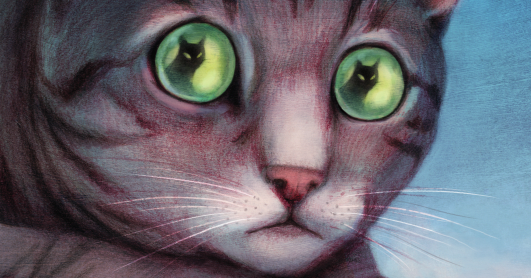
LICORICE, by Kara LaReau; illustrated by Kelly Murphy
“Are you a Dog or a Cat?” a colleague asked me, not long after I’d started at the Book Review.
“Like, do I prefer dogs or cats? We had both, growing up,” I said. “When my son’s older, we’ve promised to get a shelter dog.”
“No, that’s not what I mean. Which one are you?”
“Oh,” I said. “A Cat, I guess.”
“But you’re a Doggy Cat,” she said. “Basically private but sociable. I’m the same way. People think it’s just Cat or Dog. No: There are Dogs, Cats, Doggy Cats and Catty Dogs.”
She was right. Soon I realized that people in my immediate family, who’d always identified as Dog, were clearly Doggy Cats. One proud Cat was, upon reflection, a poorly trained Dog. My brother, frequently mistaken for Cat, was Catty Dog. My son, from birth, was an unusually pure strain of feline.
The children’s author Kara LaReau knows Cats. And cats. And “Licorice,” her middle grade retelling of Daphne du Maurier’s classic 1938 Gothic novel, “Rebecca,” works exceedingly well.
I’ve loved “Rebecca” since first reading the nameless heroine’s iconic first line when I was 12: “Last night, I dreamt I went to Manderley again.” It’s had the same hold on me that it’s had on generations of readers — and as I’ve aged, I’ve come to love that what seemed like a love story was in fact (spoiler) a twisted psychological drama featuring at least three psychopaths and more thorny dynamics than there are brambles around Manderley’s burned-out shell.
Anyone seeking to borrow du Maurier’s indelible atmospherics is haunted, appropriately enough, by twin specters: Hitchcock’s 1940 film adaptation (near-perfect, give or take a little Hays Code soft-pedaling) and the novel “Mrs. de Winter,” by Dame Susan Hill, a histrionic 1993 “sequel” that purists prefer to forget.
LaReau’s solution is simple and elegant: cats.
Kitty, a timid and traumatized shelter kitten, is adopted — to everyone’s surprise — by the most desirable of prospective owners, a boy named Max Winters.
“Sometimes I dream about the house at 5 Manderley Lane, dreams that make my legs kick and my whiskers twitch,” the book begins.
At the overwhelmingly large house, Kitty meets the imperious parrot Duchess, as well as other pets. But one absent figure is the most present of all: Max’s last cat, the gorgeous, adventurous, proud Licorice. Kitty is tormented by her inky hairs on Max’s bed, and by Licorice’s omnipresent smell. “The scent was smoky and almost spicy, and as soon as I caught it, it lingered,” she says.
Kitty’s fears are magnified by those around her.
“She’s no Licorice,” dismisses Max’s friend Josh.
“Some might say Licorice was too extraordinary for this world,” the fanatically devoted Duchess remarks as she gives Kitty a wild-eyed tour of Licorice’s former domain.
Anyone who knows “Rebecca” will recognize stand-ins for the keeper of the first Mrs. de Winter’s legacy, Mrs. Danvers; the dissolute Jack Favell; even Beatrice, Frank and Ben. Most of all, they will recognize Kitty’s intimidation: How can she ever compete with Licorice, and can Max ever come to love her?
It’s never too early for kids to learn about what’s been termed “Rebecca Syndrome” — being haunted by a predecessor — and, perhaps more to the point, to learn how much of it is in your mind.
“Rebecca,” of course, is wish fulfillment for anyone who’s insecure, which is what makes it both so satisfying and so sinister. And “Licorice” has a slightly sunnier outlook.
But there is real darkness here, too — and true suspense. One thing that struck me as particularly faithful to the original book is the ambiguity of Max’s character (although, don’t worry, he’s considerably less complicated than his grown-up model). Why is he so aloof? Why so secretive?
Like the best kids’ fiction, “Licorice” isn’t patronizing: It hints at these unsettling questions while answering them in a way that’s digestible to a child. Kitty is a frightened, feral pet in need of a home, wanting only to love and be loved in return. Licorice, for all her breeding, is a predator, fundamentally independent, untamable and unownable.
There are no dogs in this universe, besides a poodle who’s returned to the shelter by a family; this isn’t their world. LaReau is clearly a cat person — “I’ve always had a cat in my life,” she begins her note to reviewers — but the decision surely runs deeper than that.
I looked through my copy of “Rebecca” and found the quote I’d been racking my brain to remember:
“Why did dogs make one want to cry? There was something so quiet and hopeless about their sympathy. Jasper, knowing something was wrong, as dogs always do. Trunks being packed. Cars being brought to the door. Dogs standing with drooping tails, dejected eyes. Wandering back to their baskets in the hall when the sound of the car dies away.”
Cats, we like to think, have it all figured out, aren’t nearly so dependent. But at the end of the day, isn’t everyone a mix of Cat and Dog?
LICORICE | By Kara LaReau | Scholastic | 224 pp. | $18.99
The post ‘Rebecca,’ With Cats as the Leading Ladies appeared first on New York Times.