In the final hours of his presidency, Joseph R. Biden commuted the sentence of Leonard Peltier. Peltier, 80, had been convicted of killing two F.B.I. agents on the Pine Ridge Indian Reservation in 1975 and had been serving two consecutive life sentences.
Supporters of Peltier — a member of the American Indian Movement, or AIM, at the time of the shootings — had long advocated for his release. They provided evidence suggesting that Peltier, a former mechanic and a citizen of the Turtle Mountain Band of Chippewa Indians, had not shot the agents, and that testimony had been coerced. (He did admit to taking part in the shootout but not to the killings.)
In an archival interview that appears in the documentary “Free Leonard Peltier” (on Netflix), Peltier is asked if he believes that he was convicted because of his membership in AIM, which advocated for Native American civil rights and tribal sovereignty.
“Yes, definitely,” he replies.
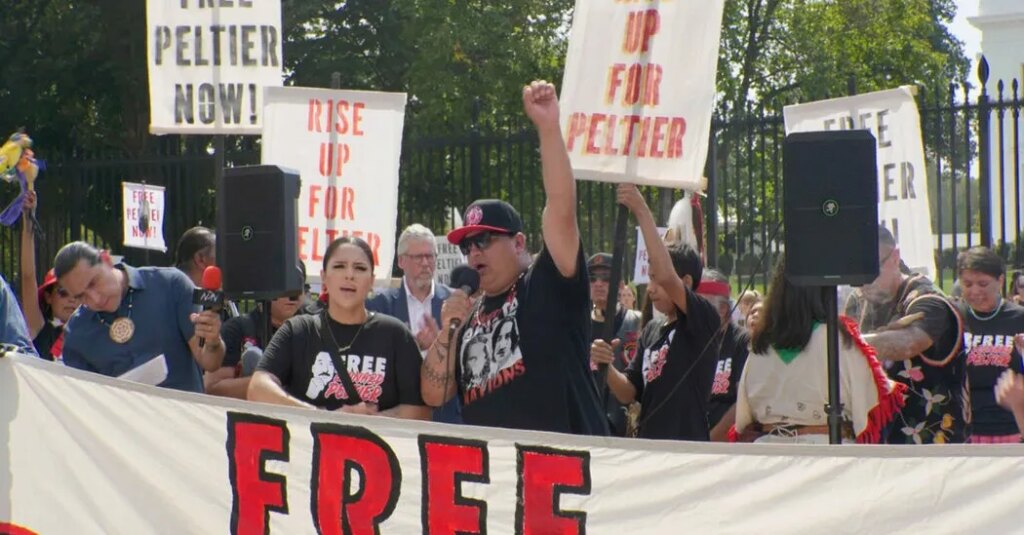
Directed by Jesse Short Bull and David France, “Free Leonard Peltier” traces this narrative, beginning with the history of broken treaties between the U.S. government and Indigenous Americans. In interviews, historical video and new footage showing contemporary activists advocating for Peltier, the film makes a damning argument for Peltier’s innocence and a strong argument about the broader practice of ignoring, scapegoating and demonizing AIM members and other Indigenous people. It’s comprehensive and harrowing, and presents a strong case.
One of the filmmakers’ more unexpected choices is the use of generative A.I., with which they created “archival” video where none exists. In his 2020 documentary “Welcome to Chechnya,” France used A.I. and machine learning techniques to obscure the faces of subjects whose lives would be in danger if their identities were known.
Here, the A.I. is used for a different purpose — to devise scenes they couldn’t afford to shoot as re-creations. Peltier also was in prison for most of the production, and he wasn’t permitted to sit for interviews. So the filmmakers, with Peltier’s permission, turned to A.I. trained on his voice to create audio, using his words and writing.
In both cases, the filmmakers disclosed the use of generative A.I. to audiences, following best practices set out by the Archival Producers Alliance, an industry group seeking to protect the integrity of genuine archival footage. Yet while the voice generation works well, the recreated footage occasionally feels more like it’s drawn from a high-definition video game, and I’m not sure that it strengthens the film the way the creators might hope.
Yet “Free Leonard Peltier” remains powerful for the story it tells, and especially for what happened right before its premiere. Peltier’s sentence was commuted on Jan. 20, 2025; one week later, the film was set to play the Sundance Film Festival. A new ending was in order.
That kind of serendipity could have made the film feel superfluous, or at least disjointed, but it mostly seems like an unexpected moment of joy in a much broader history of devastation. Peltier may not be in prison anymore, but his story remains a symbol of a much larger failing.
The post Documentary on Leonard Peltier Uses A.I. to Mixed Effect appeared first on New York Times.