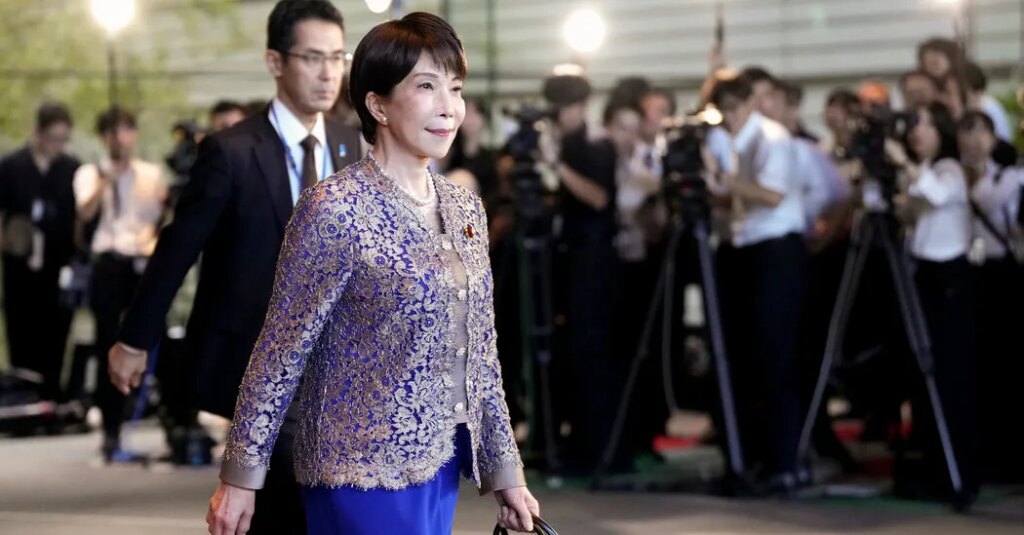
Japan’s prime minister, Sanae Takaichi, stood at a lectern in Parliament this week fielding questions about the budget, Russia, an emerging political scandal and nuclear de-escalation.
Then came an inquiry about her schedule. Ms. Takaichi, the first woman in Japan’s history to serve as prime minister, seized the moment to make a point. She said her daily agenda was far busier than her male predecessors because she spends at least three hours on makeup, bathing, cooking and other chores.
“Finding the time to sit down and focus with a truly clear head is a challenge,” she told the room of lawmakers, a vast majority of them men. “I feel that, compared to a male prime minister, I might be spending an extra three or four hours on these tasks.”
Ms. Takaichi’s remarks have prompted debate in Japan, where women still shoulder a disproportionate share of household chores and face pressure to conform to rigid expectations known as midashinami, or looking presentable in public. These guidelines include wearing makeup (but not too much) and high heels while avoiding short skirts and low-cut tops.
Some of Ms. Takaichi’s supporters praised her remarks, saying she had helped bring attention to the extra effort women invest to succeed at work and the role they play in running households.
“Are they saying she should show up to the Diet barefaced?” Kotoe Hashimoto, a conservative writer, said on X, using the name for Japan’s parliament.
But some lawmakers and commentators criticized Ms. Takaichi, a staunch conservative, saying she was promoting stereotypes about women.
Yoshiko Kira, an opposition lawmaker in Japan’s Senate, said in an interview that Ms. Takaichi was reinforcing gender norms and undermining efforts to improve women’s rights in Japan.
“I find it deeply unsettling that the prime minister would speak as if these specific expectations regarding appearance and demeanor are simply ‘the natural order of things’ — as if they were immutable, foundational premises that cannot be challenged,” she said.
Ms. Takaichi’s remarks came during a routine budget hearing on Wednesday in response to a question about a recent report that argued Japan’s prime ministers spend too much time dealing with legislative procedures.
The report, by NXJI Research, found that Japanese leaders can spend up to seven hours a day answering questions from lawmakers. The prime minister, the report found, is expected to attend parliament sessions on average about 72 days each year, compared with 50 days in Britain and 13 days in Germany.
Ms. Takaichi, a self-described workaholic who gets “zero to three hours” of sleep a night, responded by describing the demands of her schedule. She said she “found it quite difficult to carve out time to sit down and think strategically about the direction our country should take or the kind of nation we aim to be.” She said she takes home a “mountain of paperwork” each day.
She went on to describe how her all-male team of aides has had trouble adapting to her schedule, not even setting aside time in her diary for makeup before television appearances.
“They haven’t quite gotten used to the fact that I am a female prime minister rather than a male one,” she said, eliciting laughter from lawmakers.
Ms. Takaichi has made a point of modeling traditional values while in office. She has spoken about caring for her ailing husband, cooking meals and cleaning her residence.
By some estimates, Japanese women take on more than three-quarters of household chores. That burden is exacerbated by the fact that many Japanese workers are expected to routinely work overtime — as much as 22 hours per month — according to recent surveys.
While Ms. Takaichi receives support in her official duties, she is not given a staff of butlers, chefs and gardeners, as in the White House.
According to an interview this year with Ms. Takaichi’s husband and former lawmaker, Taku Yamamoto, the official residence has limited domestic help. In the interview, published by the monthly magazine Bungeishunju, Mr. Yamamoto said that a cleaner comes to the residence once a week, but there is no cook. He sometimes orders pizza, he said, making sure to get the delivery person’s name so the order can get through security.
“Access to the building is so strictly controlled, it’s like being in a prison!” he told the magazine.
In Japan, it is relatively uncommon for families to hire domestic help; only about 2 percent of households employ housekeepers, according to the Ministry of Economy, Trade and Industry.
Ms. Takaichi, who vowed to “work, work, work, work and work” upon her election last year, has frequently highlighted her grueling schedule to reinforce an image of a down-to-earth leader. Her comments in July about her sleep schedule prompted debate in the country over work-life balance. At the time, she recounted that she spent a holiday weekend ironing undergarments, sewing fraying skirts and reinforcing loose jacket buttons.
Ms. Takaichi rose to power in Japan’s male-dominated political system and has embraced some policies that critics say erode women’s rights. As prime minister, she supported legislation aimed at preserving the male-only lineage of Japan’s imperial family. She also opposes changing a longstanding law that requires married couples to share a surname.
She has sometimes been subject to sexism, including commentary on her wardrobe, hair and makeup.
Midashinami is such a large part of the culture in Japan that schools do routine checks on hair, nail and skirt length and workplaces enforce strict rules. While there are expectations about grooming for both women and men, in practice women often face more scrutiny.
Tokyo’s governor, Yuriko Koike, has apologized several times over the past few years for forgetting to wear lipstick at news conferences. Japan was abuzz earlier this year when a television anchor for NHK, the public broadcaster, rushed to the studio after an earthquake and appeared on the air wearing glasses and seemingly no makeup.
Some companies have worked in recent years to ease the burden on women. Japan Airlines last year relaxed its dress code, allowing flight attendants and ground staff to wear sneakers instead of high heels.
Outside a subway station in Tokyo this week, women expressed mixed views about Ms. Takaichi’s comments. Some said they were baffled how she could spend so much time on makeup and bathing.
Rina Sumi, 22, who works part time at a cafe, said that Ms. Takaichi’s remarks “weren’t appropriate in this day and age.”
“Why bring up her gender like that — as if it were an excuse?” she said.
Mika Okado, 27, a nurse, said she spends an hour each day getting ready, including preparing a bento box for herself. She said she surprised by Ms. Takaichi’s ability to devote so much time to her routine, adding that she admired her frankness.
“In a way, it’s actually quite refreshing — she’s speaking without overthinking it,” she said. “There’s a certain human quality to the fact that she isn’t calculating every move or anticipating how it might be perceived.”
The post Japan’s Leader Says She Loses Hours to Makeup and Chores. Opinions Abound. appeared first on New York Times.