Senator Susan Collins, the Republican incumbent in Maine, and Troy Jackson, the Democratic challenger, faced off on Thursday evening for the fourth and final debate in one of the most closely watched Senate races of the cycle.
In her closing pitch to voters, Ms. Collins focused on portraying herself as independent from the Trump administration, looking to address her biggest vulnerability in a state where many voters are incensed with the president. Mr. Jackson tried to fortify his opponent’s connection to President Trump and vowed to be a voice against him — and for Mainers — if he is elected to the Senate.
Polls show the candidates running neck and neck with 19 days until Election Day. Here are five takeaways from the debate.
Collins, the independent?
Ms. Collins has survived in the Senate for nearly 30 years with her reputation as an independent-minded Republican who delivers for Maine, a brand well suited for a state where about a third of voters are not affiliated with either party.
The election will answer the question of whether she still has that standing, or whether her votes to support Mr. Trump in key moments have convinced Mainers otherwise.
On Thursday, she arrived on the debate stage armed with examples of what she described as bipartisanship and independence, such as her votes in favor of the three liberal justices, all appointed by Democratic presidents, on the Supreme Court.
Her approach appeared to backfire at one point during the debate, when a moderator asked about a time when she voted against the Republican Party and, as a result, changed an outcome. She described trying to organize a group of senators to vote against the confirmation of Pete Hegseth for secretary of defense. That effort ultimately failed.
Jackson, the fighter?
Ms. Collins looked to turn Mr. Jackson’s attacks on their head by arguing that he would be an “automatic vote for the Democratic Party.”
Mr. Jackson, a former Republican, responded by pitching himself as a fighter on behalf of working people — at times against his own party, but largely against the Trump administration.
He said a Democratic governor had vetoed 40 of his bills, and he criticized the Democratic Party for being “too close to corporate PAC money.” But he spent much of the debate selling himself as part of a Democratic majority that could sweep into power and serve as a check on the Trump administration.
“Our democracy is going to look not at all like it is, or what it should be, if we don’t flip the House and Senate and get a Democratic majority that holds Donald Trump accountable,” he said. “The Republicans have totally given up their willingness to do that.”
Collins said she did not regret voting for Robert F. Kennedy Jr.
Ms. Collins was pressed on her votes to confirm specific members of the Trump administration, such as Health Secretary Robert F. Kennedy Jr.
She articulated her disapproval on his outlook on vaccines, but applauded his focus on chronic diseases and ultraprocessed foods. When pressed, she said she did not regret her vote for him. She was also clearly prepared to defend the secretary’s advocacy for heating assistance for low-income families, a key benefit for residents of Maine’s northern climate.
“I agree with him on some issues, disagree with him on others,” Ms. Collins said.
A Mount Rushmore in Maine?
“If Maine had a Mount Rushmore, who should be carved on it?”
That was the last question of the night from Phil Hirschkorn, a political reporter with News Center Maine.
For Ms. Collins, the answer was one of the heroes of Maine history: Joshua Chamberlain.
Mr. Chamberlain rose to the rank of brigadier general in the Union Army, and was a recipient of the Medal of Honor for leading a bayonet charge at the Battle of Gettysburg. Perhaps more famously for some Mainers, he served four one-year terms as governor of Maine and was also a graduate, professor and president of Bowdoin College, in Brunswick.
Mr. Jackson chose Frances Perkins, the advocate for workers rights who served as labor secretary under President Franklin D. Roosevelt.
Each candidate’s answer tapped into a theme of their respective campaigns. Ms. Collins chose a steady and long-serving force in the state’s history. Mr. Jackson chose a populist and progressive leader who, like him, argued that government must do more to improve the lives of everyday Americans.
‘Oh, shut up’
This is not the first debate between the Senate candidates in Maine to grow testy. But it was the first time one contender told another one to shut up on live television.
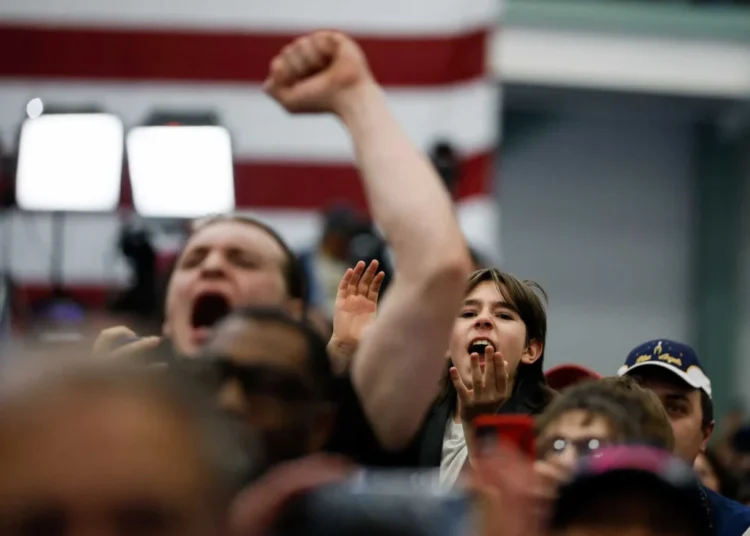
It was also the first debate to be staged in front of a live audience — and the decision came with some consequences. A protester in the audience, at Husson University in Bangor, interrupted the proceedings, yelling: “A.I. data centers are destroying our climate. They’re poisoning our water.”
Ms. Collins quickly quipped that the demonstrator was “obviously one of Troy’s supporters.” Mr. Jackson, visibly irked, replied in his vintage Maine accent: “Oh shut up. I don’t even know that kid.”
“Oh, right,” Ms. Collins replied sarcastically.
The post ‘Oh, Shut Up’: 5 Takeaways From the Senate Debate in Maine appeared first on New York Times.