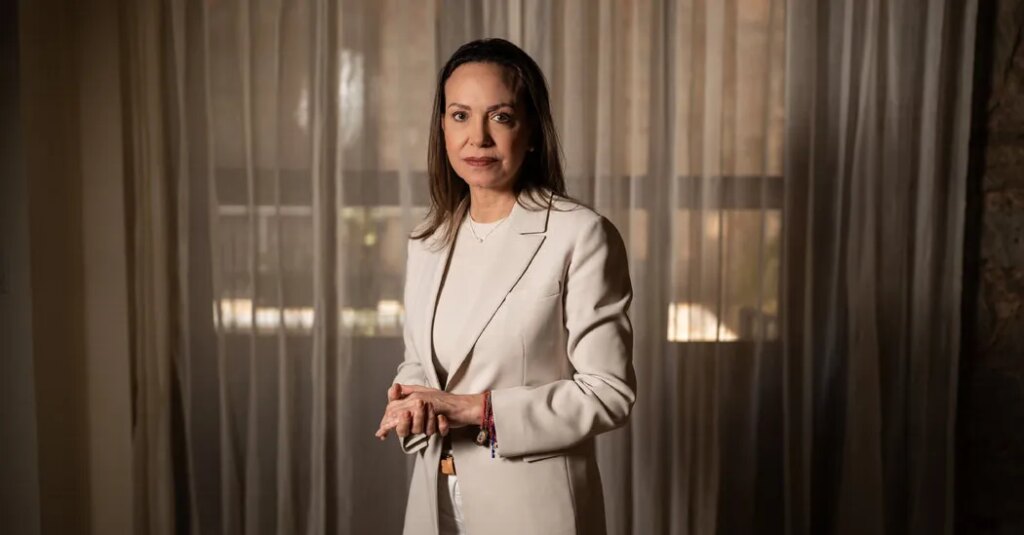
Venezuela’s exiled opposition leader, María Corina Machado, said in an extensive interview this week that Washington’s new oil partner in Venezuela, Alejandro Betancourt, was responsible for “obscene corruption” and would not be a viable business associate were she to take power.
It was the first time that Ms. Machado had weighed in publicly on Mr. Betancourt, who recently entered into a lucrative deal with the Trump administration to control roughly a fifth of Venezuela’s oil reserves.
The agreement put Mr. Betancourt, a wealthy businessman targeted by corruption investigations, at the heart of Washington’s Venezuela strategy and the Trump administration’s transformation of the country into an effective vassal state.
The conversation with Ms. Machado took place after months in which the U.S. government has kept her at a distance — passing her over in favor of an autocratic leader, Delcy Rodríguez, to lead the country in January and striking closed-door deals with embattled figures like Mr. Betancourt.
Mr. Betancourt made a fortune through no-bid contracts for power plants, which involved overbilling state entities, according to an independent Venezuelan energy auditor.
Ms. Machado, a former legislator who has led the opposition for the last three years, has not been allowed back into her country, even amid Washington’s enormous control over Venezuela and repeated statements from Secretary of State Marco Rubio that the ultimate goal is a democratic transition.
In the interview, held in Panama, where Ms. Machado is staying temporarily, she said the United States had not included her in current negotiations between the Venezuelan government and a different faction of the opposition, which are taking place this week in Caracas, the capital.
She declined to discuss her current relationship with Mr. Rubio, whom she has known for years, or to say whether they had spoken recently.
A State Department spokeswoman said that Ms. Machado’s party had been invited to participate in the Caracas negotiations.
“The United States does not facilitate the return of opposition figures,” the spokeswoman said. “Maria Corina has every right to enter her country whenever she wants to return.”
Mr. Betancourt’s company was chosen because of its successful track record, according to an administration official who requested anonymity to describe private discussions.
The official said the deal would be subject to strict audits.
Representatives for Mr. Betancourt and Ms. Rodríguez did not immediately respond to requests for comment.
Frustrated that she is stuck abroad, Ms. Machado vowed to return to Venezuela and rally supporters for a future election. She said she would arrive “sooner than you would expect,” repeating a promise she has made several times this year.
A poll Bloomberg News published this week said 52 percent of respondents would support Ms. Machado in a presidential election, while 19 percent would back Ms. Rodríguez.
Asked why the Trump administration would want her return, given the potential benefits of having a compliant Ms. Rodríguez in power, Ms. Machado said she believed the Trump administration ultimately wanted democracy.
“Yes, some deals are being made now,” she said, “but it’s a fraction of what will be made once we have security, stability, and legitimacy in Venezuela.”
The New York Times has reported that the relationship between Ms. Machado and the Trump administration reached a high-tension point after devastating twin earthquakes struck Venezuela in June. Ms. Machado pressed the administration to help her go back to Venezuela, but the administration feared it would destabilize the country.
In her interview, Ms. Machado also discussed how she would handle major questions if she won an election.
What about the fate of newly minted deals involving oil and other resources?
“I want to be very clear now if these contracts that are being signed, these deals that are being signed, comply with Venezuelan law, they will be respected,” she said.
Mr. Betancourt, however, was not a serious partner, she added, having reaped benefits from energy contracts while failing to fix the country’s electric grid. She called him “one of the main ‘responsables’ for what our people are suffering right now.”
And what about the fate of Ms. Rodríguez, whose government is accused by the United Nations and federal prosecutors of major human rights violations?
“In our constitution and international treaties there are crimes that are not subject to amnesty or forgiveness,” Ms. Machado said.
She declined to say whether Ms. Rodríguez could face prison time.
Ms. Machado said she envisioned creating an independent truth commission to gather the testimonies of victims of human rights abuses and grant reparations.
Then ordinary courts with special jurisdiction assigned by a new law would try and punish those responsible for the crimes.
“People demand justice,” she said, “and that’s absolutely legitimate.”
And how might Ms. Rodríguez be swayed to leave, especially if she fears the courts in Venezuela?
“Well, there are options,” Ms. Machado said, “but certainly the fact that the U.S. currently has top members of the regime facing justice in the United States makes very clear what’s the alternative.”
Ms. Machado, a longtime opposition member, rocketed to prominence three years ago after winning a primary, and then rallied millions of Venezuelans to vote for her movement in a 2024 presidential election.
Despite collecting tally sheets showing that the candidate she backed had won, President Nicolás Maduro claimed victory. Thousands of Venezuelans took to the streets to protest, state forces arrested more than 2,000 people and over two dozen people died amid the unrest.
Ms. Machado went into hiding inside Venezuela, living alone in secret locations for more than a year.
In the interview, she said she changed locations 14 times during that period to avoid state capture. Then she won the Nobel Peace Prize, escaping Venezuela by boat to try to make it to the ceremony, she has said, and was injured on the journey.
Soon after, she gave her Nobel Prize to Mr. Trump, who had coveted the prize for himself. Ms. Machado had pitched the administration on the idea that she represented stability for the country.
Then on Jan. 3, the Trump administration sent U.S. forces to capture Mr. Maduro.
That day, Mr. Trump posted a message saying that Ms. Machado did not have enough support inside the country to become its leader. Instead, Mr. Maduro’s vice president, Ms. Rodríguez, would become the interim president, essentially providing continuity to Venezuela’s autocratic government.
“I learned as the rest of the people did,” Ms. Machado said of what happened on Jan. 3. “In real time, people calling me from Venezuela.”
Mr. Maduro is in a New York prison facing drug trafficking and torture charges.
The United States said it would take over Venezuela’s finances, and that change would happen in three phases: stabilization, economic recovery and transition to democracy.
Mr. Trump has said since then that Mr. Rodríguez has been “doing a great job.” This week the U.S. lifted sanctions on her brother, the head of the legislature.
Reflecting on the three-phase plan, Ms. Machado said: “I understand the logic and the rationale,” for going slowly.
But, she continued, “I believe it could have been done, certainly, without her” — Ms. Rodríguez — “because she’s part of the criminal system. But it is what it is, and here’s where we are. And as I said before, it’s in the interest of the Venezuelan people that this works.”
Ms. Machado said she has made seven recent attempts to enter Venezuela, including twice after the June earthquakes. All her attempts have been blocked in various ways. In one instance, her plane to Curaçao, an island not far from Venezuela, turned around midair, she said.
The Wall Street Journal reported that in that case Dutch officials, who handle Curaçao’s foreign affairs, withdrew permission for her plane to land after learning that U.S. officials did not approve of her return.
Asked this month if the U.S. was blocking Ms. Machado’s entry, Mr. Rubio said:
“We’ve never asked anyone not to let anybody else in anywhere in the world.”
Ms. Machado is walking a difficult line, trying to stay in the good graces of the Trump administration, while showing Venezuelan supporters that she has their interests in mind — and is still relevant to the conversation.
Criticizing Mr. Betancourt might make it less likely that Mr. Trump will help her. But it could play well inside the country.
“Venezuela will be free,” she said. “We’ll bring our children back home. We will build democratic institutions that will last for generations to come, we will have open markets, that will offer unparalleled conditions for international investment and will turn our country into a source of stability for the whole region. That is going to happen.”
Genevieve Glatsky contributed reporting from Bogotá, Colombia.
The post Venezuela’s Opposition Leader Calls Trump’s New Oil Partner Corrupt appeared first on New York Times.