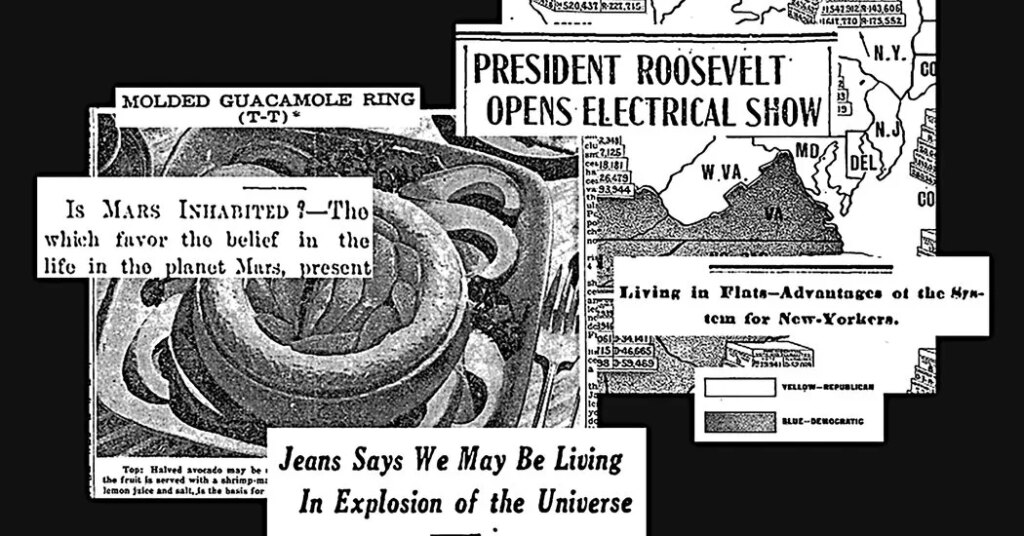
It feels as if they’ve been around forever. But for everything, there’s a first mention in The Times. Here are 15 surprising debuts, from bicycles to the Big Bang, apartment houses to vaccines. Oh, and maps in color, too.
How the editors missed Ms.
It took just two consonants and a period to create an honorific that didn’t define women by their marital status. This was an elegant solution to a vexing problem, but it would take many decades for The New York Times to consider “Ms.” a proper form of address, which the paper finally did in 1986 — 15 years after the debut of Ms., the magazine. Yet the salutation was first proposed at the turn of the 20th century, by a newspaper in Springfield, Mass.
“There is a void in the English language which, with some diffidence, we undertake to fill,” declared a 1901 editorial in The Sunday Republican, suggesting “Ms.” as “a more comprehensive term” for women than “Miss” or “Mrs.,” one that “does homage to the sex without expressing any views as to their domestic situation.”
The item drew a small flurry of press attention, as the lexicographer Ben Zimmer later detailed, but “Ms.” didn’t take hold. Then in the early 1960s, a 22-year-old civil rights worker named Sheila Michaels noticed it on a piece of mail — her roommate’s subscription to a Marxist journal — and began to quietly lobby for its use.
Her efforts didn’t amount to much until late in the decade when she and others were invited to discuss the women’s movement on WBAI, the progressive New York City radio station. During a lull in the conversation, she began to expound on the virtues of “Ms.” As it turned out, a lot of women had tuned in.
When Gloria Steinem and her colleagues were mulling names for the feminist magazine they were hatching, “Ms.” was the clear winner, and by 1972 the American Heritage School Dictionary had adopted the word. Throughout the ’70s, newspapers around the country followed suit, if it was a woman’s preference.
But not The Times.
“Ms.” was a passing fad, the paper’s top editors declared, pooh-poohing those who pressed for its use, including many female staffers. The ongoing prohibition led to tortured renderings like “Miss Steinem of Ms. magazine” whenever Ms. Steinem appeared in a news story, which was often.
Meanwhile, female staffers began to investigate gender inequities at the paper. “Ms.” was the least of it. Women’s salaries were considerably lower than those of men in comparable jobs, and women were woefully underrepresented in the newsroom and management. In 1974, they filed a class-action suit.
Four years later, the case was settled out of court with the paper’s promising to hire and promote more women. But it would be eight more years before Miss Steinem of Ms. magazine would be accorded the courtesy title she and thousands of women used daily. On July 19, 1986, the paper announced to its readers it would start using “Ms.” because “it has passed sufficiently into the language to be accepted as common usage.”
The Times did so the next day, in a front-page story about a landmark Supreme Court ruling that sexual harassment was sex discrimination. The case involved a bank employee, Mechelle Vinson, and her male supervisor. It was the first case of sexual harassment ever considered by the court, and Ms. Vinson was the first woman to receive the honorific in The Times.
Gloria Steinem sent flowers. — Penelope Green
Martians land in print
The first one landed on Sunday, Aug. 12, 1877, in the dense verbiage of Page One. It was an adjective: “Martian forests.” The nouns would soon follow.
That Mars should produce Martians had become increasingly obvious to observers on Earth. Even to early telescopes it was large (arguably the second-nearest planet), always fully illuminated by the sun and colorful, mostly red, but sometimes showing hints of white or even blue or green. By 1800, astronomers had worked out that, like Earth, Mars had polar ice caps, was tilted on its axis and thus offered seasons, had an atmosphere of sorts, and rotated roughly every 24 hours. It was Earth’s twin, plain as Martian day.
In 1871, in a popular British literary magazine, Richard A. Proctor, a respected astronomer, reflected at length on the possibility of life on Mars. He envisaged “Martial oceans” and “Martial seas,” as well as Martial valleys, poles, winds, skies and mornings, and supposed that “Martialists” might be 14 feet tall and busily at work building roads, canals and bridges.
“Martialist” soon evolved into “Martian” and, in 1877, an adjectival form reached The Times, in an excerpt from a new article by Proctor taking issue with the idea that Mars’s ruddy color could be explained by “the red leaves of Martian trees,” as a French astronomer had proposed.
Two months later, an Italian astronomer identified “canali” on the planet — which, in English and French, became “canals.” Lo, the Martians — now rapidly colonizing the publishing landscape as nouns — had shovels as well as oars. They were engineer-navigators, farmers with boats and epic irrigation schemes. The Times noted the discovery, and the nouns, casually in 1882: “Of course, the Martians are a sea-faring people,” a point so self-evident by now that it was relegated to Page 8.
The Times gave voice to the occasional skeptic — the “so-called canals” (1893) were “a delusion” (1909) — but considered Martians without fear or favor. “The straight lines on Mars and on Venus may not be canals,” according to the paper in 1904, “but since we do not know what they are we might as well give up being dogmatic as to what they are not.”
But the crash was coming. On Jan. 23, 1916, a story in The New York Times Sunday Magazine — “Canals of Mars Called an Optical Illusion” — reported that, viewed at higher resolution, the spidery network of Martian lines was an array of unrelated dots. The canals were a “fallacy,” The Times reported. The first close-up photograph of Mars, transmitted by the Mariner 4 spacecraft and published on the front page on July 16, 1965, did “not show any of the controversial canals.” The planet was dry, its atmosphere thin, the magnetic field weak. On July 21, 1976, NASA’s Viking 1 lander settled on the front page with “spectacular photographs of a rocky, wind-scoured desert plain.”
A half-century later, the search for life on Mars continues, although expectations are smaller; the discovery even of fossil microbes would be considered world-changing. — Alan Burdick
Correction No. 1, a head-scratcher
On Monday, Oct. 6, 1851, in its 16th edition, the fledgling New-York Daily Times covered a fire that, upon further review, appeared not to have happened.
Here is the entire article:
FIRE AT STUART’S SUGAR REFINERY. — Yesterday morning, about 10 o’clock, a fire was discovered in the rear of Messrs. R. L. & A. Stuart’s Steam Sugar Refinery, corner of Reade and Greenwich-streets, but by the prompt action of the employees of the establishment, they soon succeeded in extinguishing the flames, with trifling damage.
The next day, The Times regretted the error.
CORRECTION OF A FIRE. — In consequence of being wrongly informed, we yesterday noticed in The Times, that a slight fire occurred in the extensive steam sugar refinery of Messrs. R. L. & A. Stuart, which was mistaken for the fire in Robinson-street, a report of which will be found in our columns of to-day. The immense buildings of the above firm are all fire proof, and they are guarded night and day by watchmen employed exclusively for that purpose.
It was The Times’s first formal correction, one of thousands it has run in an effort to set the record straight and demonstrate integrity in the face of failure.
How the paper made this first, baffling mistake is lost to history. Nor do we know who alerted the paper to it. But the correction itself offers a few clues, as well as some intriguing rhetorical dodges — “In consequence of being wrongly informed,” for starters, with its notes of both apology and blame-avoidance. Notice, too, the downgrading of the nonexistent fire to “slight,” a modifier that didn’t appear in the original article. The implication: small fire, small mistake.
The “extensive steam sugar refinery” in question spanned the block from Reade Street to Chambers Street, not far from the Times building at 113 Nassau Street. One can only guess how The Times mistook a fire on Robinson Street (now Park Place) for a supposed blaze three blocks north, or why it described the refinery employees’ prompt action when there had been no emergency. But in the correction’s assurance that the refinery’s buildings are “all fire proof” and “guarded night and day by watchmen,” we detect the influence of a ticked-off reader.
Perhaps that reader was Robert Leighton Stuart, sugar refiner.
The threat of fire was a constant source of terror in those days. Just six years earlier, the Great Fire of 1845 wiped out hundreds of buildings in Lower Manhattan. The erroneous report of a fire at the refinery might have been embarrassing to Mr. Stuart and alarming to his insurer.
Henry Jarvis Raymond, The Times’s founding editor, was likely acquainted with Mr. Stuart, a prominent member of society. When The Times began publishing, Mr. Raymond was himself prominent (he was elected speaker of the New York State Assembly that January), and the two men later served together on at least one committee and attended the same events supporting President Lincoln.
As a matter of journalistic pride, we prefer not to believe that Mr. Stuart bullied or sweet-talked Mr. Raymond into saying there hadn’t been a fire when there had. More likely, Mr. Stuart marched over to The Times building and banged on the editor’s desk as he shouted, Our buildings are ALL FIRE PROOF and they are GUARDED NIGHT AND DAY!
Of course, we could be wrong. — Mike Wilson
‘Wedding’ takes on greater meaning
Major societal shifts are often chronicled on the front page of The Times; this one happened on Page 12 of the national edition. It was Sunday, Sept. 1, 2002: the first time an openly gay couple’s union was published under “Weddings/Celebrations.”
The couple was Steven Goldstein and Daniel Gross, who had lobbied for the change in a personal three-page letter to the new executive editor, Howell Raines. Goldstein and Gross were planning a Jewish wedding ceremony in Montreal, followed by a civil union in Vermont, and they wanted this to be announced in the newspaper.
They detailed their credentials — degrees from Yale, Brandeis, Harvard and Columbia; a Fulbright scholarship and work on Capitol Hill; parents with pedigrees — and noted Raines’s celebrated history covering the civil rights movement. The letter, Gross said in a recent interview, was “high energy and high chutzpah.”
It came two years before Massachusetts became the first state to sanction same-sex marriage, and more than a decade ahead of the 2015 Supreme Court ruling that marriage for same-sex couples was a constitutional right.
Bob Woletz, who ran the wedding pages for decades, said he had been quietly advocating the inclusion of same-sex announcements for several years. Allan Siegal, the assistant managing editor in charge of standards, had formed a committee to study the issue. Then Sept. 11 happened, followed by wars in Afghanistan and Iraq.
Approximately no one in Times leadership was thinking about this when Goldstein and Gross’s letter arrived that summer. But Raines, now 83 and retired, said he recalled “specifically sitting at my desk and making the decision immediately: Let’s publish it.”
“I remember distinctly my discussion with Al was, ‘Do these people meet the normal criteria that we use for conventional marriages?’ And he said they did in every way,” Raines recounted. “It seemed to be just an obvious decision. I was frankly a little surprised it hadn’t been made before.”
I went to college with Gross and was tapped to write the announcement, which was unusual — editors typically avoid asking writers to cover anything to which they have a personal connection. (The couple later asked me to read the write-up aloud at the Vermont ceremony; we were all in tears.)
A media frenzy ensued. Gross and Goldstein appeared on CNN and the “Today” show. Newspapers in Turkey and Italy were among the many to cover the couple; one outlet ran the story with an image of two random men in skimpy bathing suits. Reporters wanted to know everything about the couple’s relationship — even though, as Gross said, “the revolution was not us.”
Gross and Goldstein split up in 2015. — Jodi Rudoren
Finally, a Pulitzer for a woman
Anne O’Hare McCormick was 37 when she had sobering words for the women of her high school alma mater, a Catholic convent in Ohio. Women writers, she told them in a 1917 yearbook essay, “languish over the Society column of the daily newspaper’’ and “only a determined few” join the reporting staff or “achieve the dignity and influence of an editorial writer.”
Twenty years later, through force of will, intelligence and a lustrous, authoritative prose, Ms. McCormick was among those few. In 1937 she became the first woman to win a Pulitzer Prize at The New York Times, for her columns on world affairs. One year earlier she became the first woman on The Times’s editorial board.
She interviewed Adolf Hitler, Benito Mussolini, Josef Stalin, Winston Churchill and Franklin D. Roosevelt. She filed from the Nuremberg trials, the wreckage of post-World War II France and a mountain outpost during the 1940s Greek Civil War.
She had little training as a journalist, but she was married to a rich importer-exporter and accompanied him on business to Europe. In 1921 she wrote to The Times and asked if she might submit some articles from her trips.
One of her first pieces, in 1921, described Pope Benedict XV in a golden chair amid waving peacock feathers that “hedged him in and brushed him aside, so that the man inside the Pope did not matter at all.’’ She wrote, “It was the Papacy one saw moving in the hush, swallowing up good Popes, bad Popes and indifferent Popes, and surviving them all.’’
Mussolini’s first remarks to the Italian Parliament that year, she wrote in the same article, amounted to “one of the best political speeches I have ever heard, a little swaggering but caustic, powerful and telling.’’
Her most explosive interview was with Hitler in 1933, his first year as Germany’s chancellor: He was “a rather shy and simple man,’’ and “especially when he loses himself and forgets his listener in a flood of speech, it is easy to see how he sways multitudes.’’
Times readers were outraged. Ms. McCormick was asked to follow up with a more critical piece, and she did. But as she wrote to Arthur Hays Sulzberger, who would become The Times’s publisher: “What I tried to do in my German dispatches was to indicate facts as they are in Germany and not as we’d like them to be.’’ — Elisabeth Bumiller
Hola, guacamole
Americans have long loved their avocados, especially mashed up into guacamole: The relationship goes back at least seven decades, as recipes in The Times attest. In 1952, the food-news staff’s home economist, Ruth P. Casa-Emellos, offered the paper’s first recipe, which, following the tastes of the era, transmogrified the dip into a gelatin ring mold with sugar and lots of mayo. (The word “guacamole” is derived from the Aztec word āhuacamōlli, or avocado sauce. A 14th-century version mixed avocados with tomatoes, salt and chili peppers — a combination that is still considered authentic.)
For most of those seven decades, it was not a contentious relationship. Times food writers regularly rolled out fairly classic recipes, and presumably readers whipped up guacamole in their (avocado-colored) kitchens and passed it around their (sunken) living rooms.
Guac entered the Oxford English Dictionary in 2013, the year Melissa Clark, a veteran Times food writer, published a recipe she had adapted from ABC Cocina, Jean-Georges Vongerichten’s Latin fusion restaurant near Manhattan’s Union Square. The dish contained something that Ms. Clark acknowledged seemed radical, fresh green peas, even if peas in guacamole weren’t actually that unusual. They were a go-to, low-cost ingredient, particularly in the ’60s and ’70s when avocado prices were soaring.
Then on July 1, 2015, The Times’s main Twitter account tweeted out Ms. Clark’s recipe with this come-on: “Add green peas to your guacamole. Trust us.”
Pea Gate was upon us.
“No. Just no.”
“Literally no.”
“One does not mix mustard and Twinkies because they are the same color.”
The Republican Party of Texas waded into the scrum, and supercharged it: “The @nytimes declared war on Texas when they suggested adding green peas to guacamole.”
Even President Obama objected: “respect the nyt, but not buying peas in guac. onions, garlic, hot peppers. classic.”
And in a bit of bipartisan parity (perhaps the last gasp of comity in that department), Jeb Bush, then campaigning for the Republican nomination to succeed Mr. Obama, agreed: “You don’t put peas in guacamole.”
Ms. Clark was stunned by the opprobrium.
“It’s such a smart recipe,” she said. “It keeps the color from going brown, and there’s precedent for using peas in times of old when you couldn’t easily get avocados. Also it’s just really good.” She added, “The funny thing about Obama’s tweet is that he was shaming us, but garlic is not traditional, ever, in guacamole.” — Penelope Green
When the Big Bang made it big
In the beginning, before the Big Bang theory of the cosmos blossomed into canon, before it even was called, at first dismissively, the “big bang,” there was, on Christmas Eve, 1930, “a great explosion of the universe” on the front page of The Times.
The previous evening on London radio, James Jeans, a prominent British physicist and astronomer, noted that the universe was expanding: The oldest, most distant galaxies were racing away from our own at millions of miles an hour. What’s more, George Lemaître, an astronomer and Roman Catholic priest well versed in Einstein’s new physics, had a provocative theory: The universe began as a primordial atom containing all the matter in the cosmos that burst apart with vast radioactive energy.
This universe “has properties similar to those of a soap bubble,” Jeans reported; as soon as it “comes into existence it starts swelling and must continue expanding indefinitely.” He added: “The whole universe must be expanding — I might almost say exploding — at a really terrific rate.” Lemaître’s cosmos was not timeless: It had a birth date — “a day without yesterday,” he said — roughly 10 billion years ago. (Astronomers now put the universe at perhaps 13.8 billion years old.)
In 1949, Fred Hoyle, a British astronomer, championed a rival idea of a “steady state” cosmos — infinite, eternal and generating new matter as it evolved — and dismissed Lemaître’s theory as a “big bang.”
“The hypothesis that all matter of the universe was created in one big bang at a particular time in the remote past,” Hoyle said, was “an irrational process that cannot be described in scientific terms.” (He later insisted he was being evocative, not derogatory.)
The Times introduced the phrase on New Year’s Eve, 1956, in a story involving a physicist who had successfully turned helium into carbon. This transmutation, the headline noted, “Is Hailed as Helping to Explain Origin of Universe.” A subhead added: “‘BIG BANG’ THEORY HIT.”
The phrase kicked around in lowercase for two decades, with The Times noting on Dec. 20, 1961, that the idea was “more widely endorsed by astronomers and cosmologists.” In 1964, the discovery of the cosmic microwave background — a pervasive fog of low-level radiation left over from the starting fireworks — effectively sealed the case. Big Bang, capitalized and minus scare quotes, burst into The Times on March 20, 1977. — Alan Burdick
New to market: apartments
In the post-Civil War years, when New York City was booming, Manhattanites were wary of a new kind of housing — the apartment — that was poised to invade the island. French flats, as apartment houses were known, were common in Europe, but to Americans they were suspect: bohemian habitats for artists and bachelors and, to quote Edith Wharton’s “The Age of Innocence,” for “dressmakers, bird-stuffers and ‘people who wrote.’” The Times was bullish on them, however, and began to work on its readers.
“One of the delusions of the Anglo-Saxon is that he must have his own separate house,” the paper noted on July 18, 1869, in its first story on the subject, headlined “Living in Flats: Advantages of the System for New Yorkers.” “Among the continental peoples there is much more good sense in the matter.”
The Stuyvesant Apartments, the first apartment “house” designed for the city’s middle class, was then being built on East 18th Street off Irving Place. The article extolled the economic and labor savings of this novel form of living, and dismissed outright the possibility for sketchy neighbors, even though the five-story Stuyvesant had a few artist studios tucked away on its top floors. The article pointed out that, in cities like Paris, flat dwellers were typically “of the most respectable sort,” including bankers, minor nobility and diplomats. The paper was correct: The Stuyvesant’s future tenants included George P. Putnam, the publisher, and Elizabeth Custer, the widow of Lt. Col. George Custer.
Land values, and therefore house rents, were soaring, and New Yorkers of “moderate means” had better wise up and embrace vertical living, according to The Times. Single-family houses had “become like carriages and footmen, luxuries for the rich.”
At least one reader disagreed: “After reading your article on ‘Flats’ in yesterday’s paper, I feel induced to say through your paper that I believe the ‘flat’ system of living will never be accepted in this country.” (The reader was a commuter living in Mount Vernon, and he encouraged “young married men” to behave as he did and leave the city.) — Penelope Green
Before states went red: the first color voting map
On July 26, 1908, readers of The Times were treated to an election map rendered in vivid yellow and blue.
In this map, states that voted for the Democrat in the previous presidential election are blue, and those that went Republican are yellow. With William Howard Taft, the Republican, and William Jennings Bryan, the Democrat, on the campaign trail, the colors helped readers see where each candidate might best focus his efforts. (This was nearly a century before red and blue came to universally signify Republicans and Democrats.)
The map also included complex pyramid shapes displaying 20 years’ worth of presidential election data, in chronological order from top to bottom. Such a densely packed graphic scheme might well confound readers today, but at the time the pyramids likely came off as intuitive. Readers would have been used to seeing pyramids and other architectural visualizations used to display population data and various statistics.
Today, The Times might display the same kind of historical data using a Sankey diagram.
But the newspaper also still uses some of its original mapmaking tricks. In 2024 maps, the hatch lines across Arizona and Nevada mark states that flipped parties — a technique that descends directly from the horizontal lines in the 1908 map drawn across Colorado, Idaho, Montana and Nevada for the same purposes.
The worn map shown here is the one copy in existence. Only its innovations survive. — Tim Wallace
1852’s vaccine debate
The first “vaccine” in The Times, on Aug. 14, 1852, came with a manslaughter charge, as it was not a vaccine at all.
An outbreak of smallpox was underway in and around New York City. In Newark, a local man, Frederick Buhr, wanted his two young children to be vaccinated, and he enlisted a self-described doctor, Attila Keleman. Proper vaccination, devised in 1796 by the English physician Edward Jenner, rendered people immune to smallpox by injecting them with cowpox, a similar but far less dangerous virus.
But Keleman merely “pretended” to vaccinate, The Times reported, and used an older, riskier method called variolation: He injected Buhr’s children with live smallpox, taken from a child who subsequently died of the infection. The Buhr children, a 13-month-old girl and an older boy, soon died of smallpox, too. Keleman was charged with manslaughter.
Variolation was known to work sometimes — but when it didn’t, even those patients who survived could spread the disease and exacerbate an outbreak. Indeed, weeks earlier, Newark passed an ordinance, evidently prompted by Keleman’s work, requiring people who opted for the method to leave Newark until they recovered from smallpox. “It is said that he has extended this dreadful contagion not only through the city to some extent, but also in the neighboring villages,” The Monmouth Democrat wrote of Keleman on Aug. 19, 1852, adding: “Dr. Keleman was a tailor two years ago in Newark.”
The ordinance was among the first to embrace vaccination as a public health measure. The following year, Britain passed the Vaccination Act, which made smallpox vaccination mandatory for infants born in England and Wales. Opponents of such strictures formed anti-vaccination leagues in the U.K. and, in 1879, the Anti-Vaccination Society of America. But by 1895 in the United States, several state courts had ruled that school boards and local governments could bar unvaccinated children from enrolling.
On Nov. 22, 1892, The Times ran an obituary of Keleman, “one of the oldest physicians in the city.” He emigrated from Hungary in 1840 with a medical degree, “started a large sanitarium on upper Broadway” — probably one of the many hydropathic centers catering to wealthy clients — and in 1879 received an honorary degree from Eclectic Medical College of the City of New York, an institute for alternative medicine. Until his last days, The Times reported, “he had always enjoyed the most perfect health.” — Alan Burdick
An untimely obituary
When a weeping blonde arrived at The Times’s headquarters on New Year’s Day in 1980 and in tremulous tones announced the death of her husband, Alan Abel, possibly the editors should have been a bit less credulous. Mr. Abel, then age 50, was a notorious prankster, having snookered the press for more than two decades.
His first major masquerade, which began in 1959, was an organization known as the Society for Indecency to Naked Animals, or SINA, whose mission was to “clothe all naked animals that appear in public, namely horses, cows, dogs and cats.” SINA famously picketed the White House to persuade Jacqueline Kennedy, the first lady, to put underpants on her horses. According to the many, many press reports it garnered, the group boasted some 50,000 members who rallied to a marching song, “Wings of Decency,” and deployed an emergency “clothes mobile” to patrol the streets of New York, dispensing decorous garments to critters in the buff.
The Times, among other outlets, covered SINA’s adventures with a surprising lack of irony. “Pickets Ask First Lady to Clothe Her Horses,” read a headline on March 6, 1963. (Mr. Abel was outed by Time magazine later that year.)
Mr. Abel went on to produce ever more elaborate shenanigans, aided by his wife, Jeanne, and a gang of actors and accomplices. Pranks included a presidential campaign for a Jewish grandmother from the Bronx named Mrs. Yetta Bronstein, whose platform included a promise to put truth serum in the Senate water cooler and whose campaign slogan was: “Vote Yetta, Watch Things Get Betta.” Other highlights of his long career: a school for beggars led by a character named Omar, who appeared on the “Today” show; and a green card marriage for Idi Amin, the murderous Ugandan dictator, in a ceremony at the Plaza Hotel before a roomful of aghast reporters along with officials from the C.I.A., the F.B.I. and the State Department.
Yet The Times listened to the weeping blonde, confirmed the death with several of Mr. Abel’s accomplices and took the bait, publishing his obit on Jan. 2, 1980 (“Alan Abel, Satirist Created Campaign to Clothe Animals”). It reported his death of a heart attack in Utah, where he was purportedly scouting a location for a movie (“Who’s Going to Bite Your Neck, Dear, When All of My Teeth Are Gone?”). The next day, Mr. Abel revealed his hoax at a news conference at the Biltmore Hotel in Manhattan. The duped obituarist, Walter Waggoner, attended, rather grumpy, and was reported to have said, “As far as I’m concerned, Abel’s dead, who are you?” The correction ran on Jan. 4.
Waggoner’s editor, Sydney Schanberg, the Pulitzer Prize-winning reporter who covered Cambodia’s fall to the Khmer Rouge in 1975, was more sanguine. “Everybody’s asking, ‘Is this the first time this has ever happened to us?’ I don’t know. I kind of doubt it. It’s never the first time for anything.”
Mr. Abel finally died, for real, on Sept. 14, 2018. The headline: “Alan Abel, Hoaxer Extraordinaire, Is (On Good Authority) Dead at 94.” — Penelope Green
A peloton in petticoats
Throughout the last quarter of the 19th century, The Times was positively giddy about the bicycle, a contraption that replaced the awkward velocipedes, a generic term for all manner of human-powered vehicles, some of which were made of wood and known as bone-shakers. The bicycle was something else altogether: “a mustang of steel who knows his rider and never needs a lasso,” as one writer enthused in 1878.
The paper’s first mention of the gizmos was in 1869 and involved a patent infringement. But much of the paper’s coverage focused on “wheelwomen,” or female bicyclists: their clothes, their clubs, their races. Wheelwomen raced horses, men and each other. Competitions lasted hours — and often days — during which contestants sometimes fainted, as one favored rider did during a six-day event at Madison-Square Garden in 1889. (An advertorial a few months later proposed “pure whiskey” as a remedy.)
An ad for “lady cyclist detectives” in “The Lady Cyclist, an English wheelwoman’s paper,” delighted one reporter, who noted that such a job would “be free from the humdrum routine of the office.” And there was the curious case of the woman who had a compulsion to leap off her bike for no reason, and wrote in to inquire what she might do about it. “I resist this impulse as strenuously as possible,” she said, “but the result is always the same — willy-nilly, I spring to the ground.” The reporter suggested she see a doctor.
But what really confounded and divided the public was what was proper for a woman to wear astride her bike. Many column inches were devoted to the topic. Bloomers and knickerbockers caused much hand-wringing, despite their benefits. (One noted tailor made bloomers with ample pockets, to hold combs and revolvers, and fasteners at the edges, to “keep the mice out.”)
In 1895, in Little Rock, Ark., a woman was arrested for riding her bike in bloomers. A testy judge dismissed the case, declaring, “Women have a constitutional and God-given right to ride a bicycle, and they are bound to have some comfortable and appropriate dress therefor.”
The headline read, “Mrs. Noe’s Bloomers Vindicated.” — Penelope Green
The iceman leaveth: the first electric refrigerator
In 1905, none but the most affluent American families had electricity at home, and those who did used it only for lighting. But it was already possible to envision the convenience of a wired kitchen — at least for anyone who attended the gleaming Electrical Show that year at Madison Square Garden (the old MSG, the Beaux Arts palace that once stood northeast of Madison Square Park). There on display were electric stoves and ovens, coffee urns, kettles, “laundry irons” and more.
A short article in The Times on Dec. 16, 1905, describing a meal prepared with these ultramodern appliances, noted that “dishes which should be served cold” were chilled in an “electric refrigerator.” The phrase was new to The Times and to the times: Until then, “refrigerator” was just another word for an old-fashioned icebox, insulated but not electric, and it would be nine more years before any electric fridge was available for purchase (the first was the DOMELRE).
But when the show was over, Times editors seemed to lose interest in the electric refrigerators, leaving it to advertisers to herald the arrival, in the 1920s, of the Frigidaires, Kelvinators and GE Monitor-Tops that would soon stand in American kitchens. — Mary Duenwald
The post First Time for MartiansVaccineGuacamoleCorrectionPulitzerApartmentRefrigerator in The Times appeared first on New York Times.