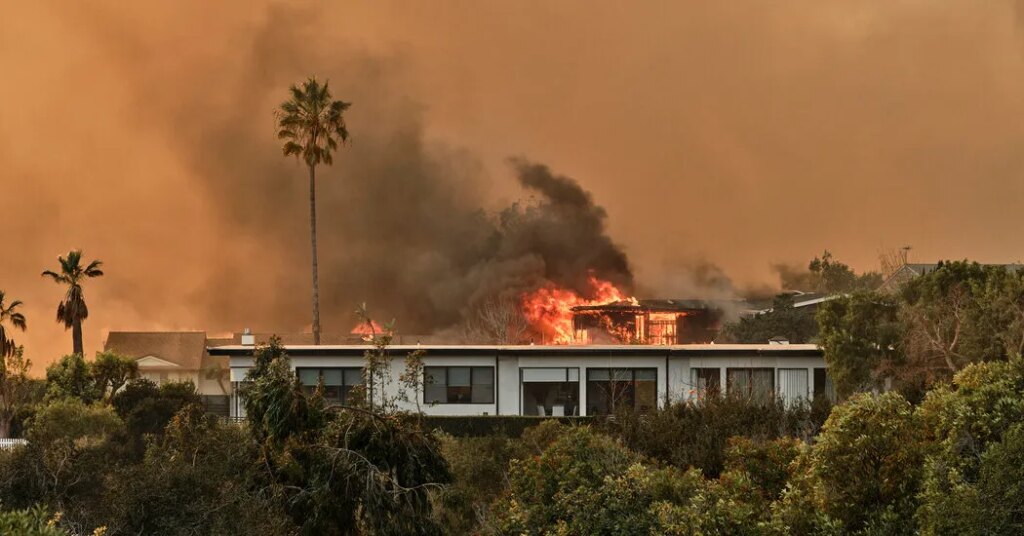
The first Santa Ana winds of the season are arriving this week in Southern California. The National Weather Service issued a series of red flag warnings for Thursday, Friday and Saturday, a signal that weather experts and emergency officials are worried that fires could start more easily and spread quickly if they do.
Predicting how a wildfire will behave is notoriously difficult, but some companies that provide climate risk assessments to real estate sites and other businesses are trying to do just that. Alongside the number of bathrooms, bedrooms and size of the kitchen, you might see a number that tries to convey how likely a house is to burn in a wildfire. Here’s what to know about what fire risk scores can tell you, and what they can’t.
No simple rules
A fire’s growth and behavior depend on complex factors like wind, what’s burning, how fuels are spaced out and how much moisture is in the plants, air and soil. Hussam Mahmoud, a civil engineer at Vanderbilt University, said wildfire was “one of the most complicated hazards to model.”
Wind is particularly important: It drives fire spread, and it’s difficult to model at hyperlocal scales and when conditions are changing rapidly. And, as weather patterns change as a result of climate change, historical information can become less reliable as a predictor of the future.
Modeling wildfires to predict their behavior becomes even trickier in urban or suburban areas. That’s because scientists are still figuring out how fires spread in built environments, and some experts have doubts about the utility of parcel-specific fire risk scores. Dr. Mahmoud thinks a new suite of risk scores based on urban fire behavior will need to be developed for accurate risk assessments.
“There’s more developed science for the wildland side because it’s been done for the last 20, 25 years,” said Michael Gollner, a mechanical engineer who runs the Fire Research Lab at the University of California, Berkeley. “The urban side is very fresh and new, and we’re still figuring it out.”
Dr. Gollner’s group is working to fill that knowledge gap, even setting whole houses on fire in a controlled laboratory environment. There’s room for fire models to improve, especially at the ultrahigh-resolution scale of single homes, he said. Fire risk modeling at the scale of a county or larger has limited accuracy for individual homeowners.
But even with current limitations on modeling, he thinks risk assessments are “critically important.”
A signal, not a certainty
Ultimately, modeling limitations make it challenging to give residents precise, actionable predictions during a wildfire. But that doesn’t mean the scores have no value.
“What we have to communicate is, ‘This is an area that could experience a wildfire,’” Dr. Gollner said. He said that some residents, even in places where major fires seem unlikely, might need help recognizing that “if it happened on a bad day with just the right conditions, it could burn through the community.”
Most experts agreed that the value of the ratings is that they provide a basic, binary sense of fire risk: In a worst-case scenario, could a house burn? Is there any risk at all?
That’s how Ed Kearns, chief science officer for the risk-modeling company Third Street, suggests buyers interpret fire risk scores.
Homes in Third Street’s scoring are generally assigned a number from one to 10, with 10 representing the highest risk. Scales start at one because “we don’t want anybody to be complacent,” Dr. Kearns said. “We’ll never say ‘zero.’”
“The most significant thing to look at is whether the score is a one or above a one,” Dr. Kearns added. “If you have a two or above, that means it’s time to dig deeper.”
Dr. Gollner agreed that focusing on whether a home bears any risk, rather than trying to read too much into a score, was most important.
And fire risk scores don’t capture everything. It’s important to know about work the community may have done to mitigate fire risk, such as clearing nearby vegetation, or to make fire evacuations go smoothly, such as adding extra roads. “You don’t see that from a number,” Dr. Gollner said. Instead, talk to the neighbors.
Home buyers can refer to other resources, like state or county fire records, U.S. Forest Service guidelines for making a home fire-resilient, and community wildfire action groups like FireWise, which might have neighborhood-level fire history.
And, Dr. Gollner said, don’t forget the basics. Modeled fire risk can be a good starting point, but in terms of what homeowners can do, real-world fire risk comes down to a home’s construction, parcel size and defensible space. Focus on whether a home is fire-resilient, with features like a metal roof and sealed ventilation, and how far it is from neighboring homes.
If many homeowners take those precautions, that could help reduce the odds that the whole neighborhood burns down. “If you want to prevent communities from burning down, it’s making sure the houses don’t ignite and spread,” Dr. Gollner said.
Above all, he said, be ready, even if you think your risk is low. Install Watch Duty, a wildfire alert app; rehearse evacuations; and leave early if there’s a fire.
“Wildfires are very fast events,” he said. “Are you concerned about losing the house? Or are you concerned about losing your life?”
The Israeli private eye at the heart of a climate hacking scandal
For decades, an Israeli private investigator named Amit Forlit has operated on the edges of international intrigue while rubbing elbows with powerful figures.
Mr. Forlit claims to have served in Shin Bet, Israel’s internal security agency. He dated a prominent Israeli businesswoman and social-media figure who photographed him at exclusive parties. And he may or may not have inspired a hacker-for-hire character in a 2022 novel about murky financial shenanigans involving Argentine debt.
These were mostly bit parts in other people’s dramas. Until now.
Today Mr. Forlit, wearing an ankle monitor while remaining in the New York City area, awaits trial in a globe-spanning hacking case. Prosecutors with the Justice Department have charged him with overseeing an operation that aimed to discredit American environmentalists, allegedly on behalf of a huge oil company. He has pleaded not guilty. — Karen Zraick and Gabby Sobelman
In one image
Sick corals placed in direct contact with healthy ones of the same genetic makeup recovered quickly
Some tiny coral nubbins in a lab in California underwent striking transformations when they were in touch. Ghostly, heat-shocked coral regained its color in a matter of weeks, not the months it might take in the wild. Results published this week in the journal Science Advances point to intriguing new possibilities for treating reefs that are devastated by marine heat waves, which are becoming more frequent because of climate change.
More climate news from around the web
-
The planet’s widest glacier is melting “more aggressively” than previously projected, according to new research by a team of glaciologists, CNN reports. The effects on global sea level rise could be bigger than current estimates. (The Times visited Thwaites earlier this year, reporting on Antarctica’s weather, wildlife and more.)
-
The World Bank has a new map illustrating where people are exposed to climate hazards and where they lack the resources and services that help them cope. The tool reports climate hazard exposure and socioeconomic vulnerability separately, or you can see where the two overlap.
-
Tucson, Ariz., has seen the most warming in the United States, with temperatures increasing by 5.1 degrees Fahrenheit on average since 1970. That’s double the national average, according to an analysis of the fastest-warming congressional districts released Wednesday by Climate Central, a science communication nonprofit. Human-caused climate change accounts for more than 90 percent of the warming in each district, and all U.S. congressional districts have warmed since 1970, the analysis found. Less than half of U.S. adults believe they have personally experienced the effects of global warming
Read past editions of the newsletter here.
If you’re enjoying what you’re reading, please consider recommending it to others. They can sign up here.
Follow The New York Times on Instagram, Threads, Facebook and TikTok at @nytimes.
Reach us at [email protected]. We read every message, and reply to many!
The post Understanding a Home’s Fire Risk appeared first on New York Times.