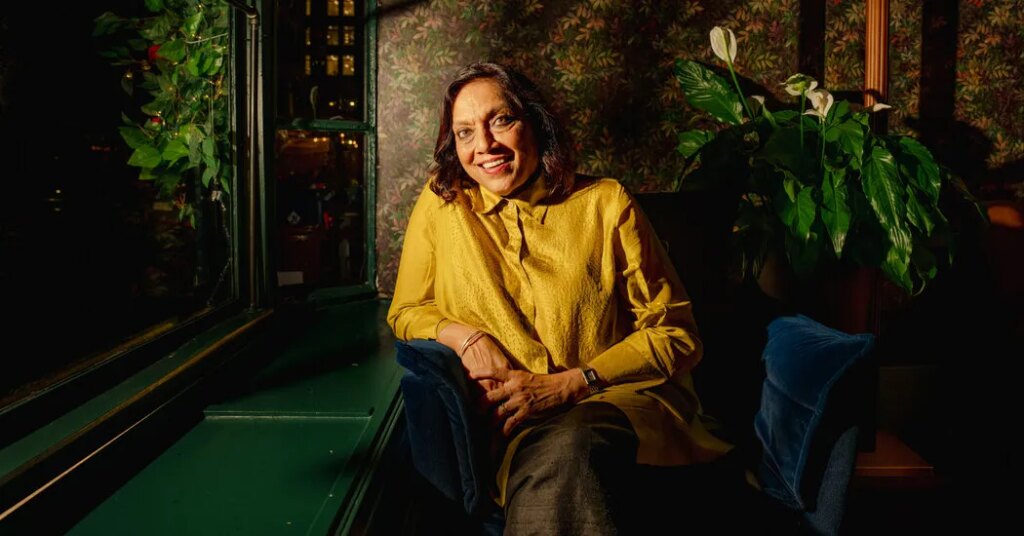
Around 8 p.m. on Wednesday, the filmmaker Mira Nair slipped discreetly into an upscale Indian bistro near Gramercy Park in Manhattan and was met with boisterous applause and cheers.
That was, in part, because she was the co-host of the evening, gathering almost 70 authors, filmmakers, artists and writers at the recently reopened Passerine to celebrate the Hindu festival of Diwali, and had arrived later than the guests.
But also because the Oscar-nominated filmmaker, as the mother of Mayor Zohran Mamdani of New York City (who did not attend), has inadvertently become one of most recognizable matriarch in the South Asian diaspora and a kind of figurehead.
Nair “gave a community its reflection,” said Alvina Patel Buxani, a co-owner of the restaurant.
In years past, Nair lit up her Upper West Side apartment with candles and created elaborate rangolis (traditional floor art created using colorful powders) on the sidewalk outside her building, and invited family and friends over for a feast to celebrate the Hindu festival.
Last year, Diwali occurred about a week before New York’s mayoral election, and Nair celebrated the festival by accompanying her son on a campaign stop in Jackson Heights, where they distributed traditional Indian sweets to the community.
But this year, “my mother passed away two months ago,” Nair said, a loss that has left her feeling more “withdrawn.” And, traditionally, when someone dies, Hindu households tend to tone down the festival cheer. So no candles, no rangoli.
Instead, she was co-hosting this dinner with the award-winning novelist Salman Rushdie and the former Vanity Fair editor in chief Radhika Jones that served as a fund-raiser for the literary nonprofit Asian American Writers’ Workshop.
“Everybody’s going through a lot of difficult things in the world right now — that’s an understatement,” said Jones. “One of the things that always makes me feel more hopeful about the direction of the world and our country and our city is to come together with people in conversation. It’s that simple.”
There was definitely plenty of that, and spirited intellectual conversations about topics ranging from A.I. to the future of democracy were complemented by spicy margaritas and generous pours of wine. The room was a mix of “people who have been celebrating Diwali their whole lives and people for whom this is their first time celebrating Diwali,” said the comedian and actor Aasif Mandvi.
The crowd included Francesco Clemente, the Italian painter, and his wife, Alba Clemente, the actress; Mala Goankar, the financial executive and wife of the rock musician David Byrne; Tamron Hall, the broadcast journalist; Bibhu Mohapatra, the fashion designer; and Racquel Chevremont, an art curator and “Real Housewives of New York” star.
“Let’s be real, it’s not just, you know, aunties and uncles getting together,” Mandvi said. “We’ve got the 1 percent of the most accomplished South Asians in the country here.”
As guests made their way through a three-course dinner that included samosas served with yogurt and a strawberry chutney; a beef potpie; spiced chicken; and a sticky date cake, Rushdie, Jones and Nair got up one by one to give brief speeches that touched on not only the significance of the festival but also the importance of artistic expression.
Jones, in her speech, noted that growing up half-Indian and Catholic in Cincinnati meant that her family’s “Indianness, our participation in Indian holidays and diaspora activities, was sporadic.”
Diwali “was the one time when we really got together as a community.” The joy she felt in those moments, “the kind of falling away of differences and the togetherness,” she added, “is the way that I feel in this room tonight.”
Rushdie, an ardent supporter of free speech who lived for decades under the threat of assassination from the Iranian government and was stabbed in 2022 by a man who was enraged by his novels, nodded to the democracy protests currently erupting across India, driven by a youth organization called the Cockroach Janta Party. The organization, which started as a joke and has blossomed into a legitimate pressure on the current government, is fighting for school reforms and fair elections.
Within that political context, “I would feel wrong not to say — celebrate the cockroach,” Rushdie told the room, adding that it was not a sentence one would usually utter inside a restaurant.
In her speech, Nair, who grew up in India, was also inspired by the movement there, referring to herself as “mama cockroach.”
“I am so deeply energized by the cockroaches of our country,” she said, “the cockroaches of today and the cockroaches of tomorrow, because this is what Diwali is also about — to light a lamp for change.”
For anyone familiar with Nair’s work, that sentiment was not surprising. She has long used her films, like “Monsoon Wedding” and “Mississippi Masala,” to examine the diaspora experience as well as socioeconomic and political systems. Her Oscar-nominated film “Salaam Bombay!” gave viewers a close-up of the children living in the Indian city’s slums, and she is now working on a film about the 20th-century Hungarian-Indian painter Amrita Sher-Gil. And Nair’s husband, Mahmood Mamdani, who was also at the dinner, is a Columbia University politics professor who was involved in student protests against Israel’s war in Gaza.
Later in the evening, when Nair had stepped away to the restroom, Maneesh Goyal, co-owner of Passerine, told the guests that it was Nair’s birthday on Thursday and instructed everyone there to sing “Happy Birthday” when she walked back in.
The crowd obliged, enthusiastically. “Now that’s community,” said Dennis Williams, an executive at Skydance.
At one point, Rushdie, Jones and Nair, along with Goyal and Buxani, stepped outside to take group photos. They bumped into Wallace Shawn, the actor, and his partner, Deborah Eisenberg, the author, who happened to be walking by.
“Wally!” Nair shouted and hugged him. She invited the couple into the party for a drink and they both declined, saying it was getting too late. It was a little after 8:30 p.m.
“Is it bedtime?” Rushdie asked, half-joking.
The post Inside Mira Nair’s Diwali Dinner appeared first on New York Times.