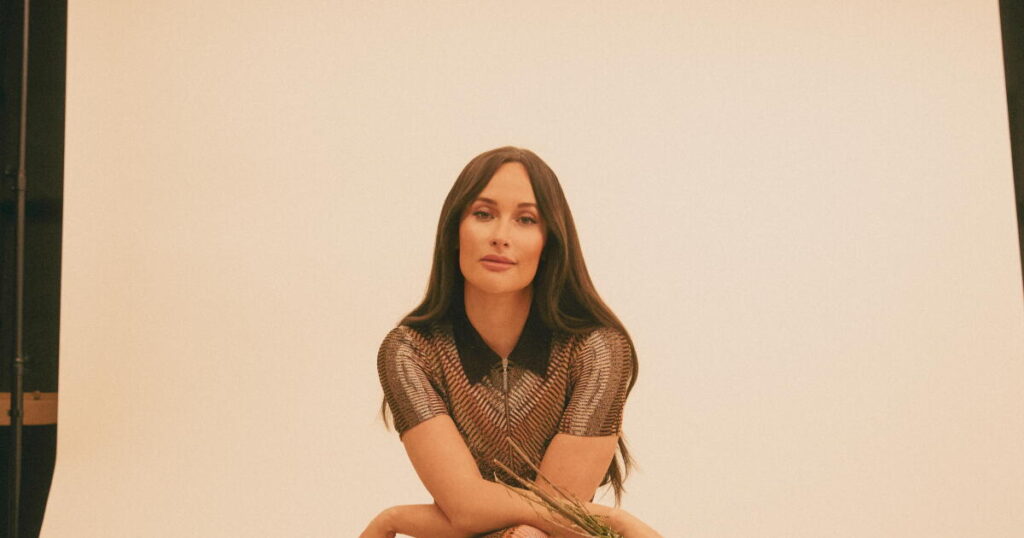
On her current arena tour, Kacey Musgraves has dressed up as a Ronnie Dunn drag king, bringing the country legend himself onstage (“You look damn good, that’s all I’m saying,” he told her). Each night, Musgraves floats over the audience, cozily nestled in a giant set of disco ball Truck Nutz. She brought out James Talarico, the Democratic Texan U.S. Senate hopeful, and roasted former Trump Department of Homeland Security official Kristi Noem with withering panache.
“This tour has truly been the funnest one that I’ve ever been part of,” Musgraves said, on a Zoom call from the road a few days before her Middle of Nowhere tour stops in Los Angeles on Sunday and Monday at the Crypto.com Arena. “I feel at my most comfortable. I’m gonna be really sad when this one’s over.”
After her Grammy-conquering 2018 LP “Golden Hour,”Musgraves released an operatic divorce record, then a well-therapized pastoral folk album. Her 2026 LP “Middle of Nowhere,” by contrast, is back in a classic mode of artful, often hilarious bangers about the loneliness of small town life and dating at the edge of 40. The lusty, dancehall-ready single “Mexico Honey” scored her first solo top 40 hit, and she just released her first single in Spanish, a version of “Uncertain, TX” with the legendary Texan Norteño band Intocable.
Musgraves spoke with The Times’ about the anxiety and honor of singing in Spanish, the immortally savvy Dolly Parton and Willie Nelson, and what it takes to get back in the saddle of dating after a very long dry spell.
Riding those disco-ball Truck Nutz every night is quite the perk of your job. I’m trying to imagine pitching that stage idea and making it real.
To be actually sitting on that idea, yes. The side quests are the main quests now at this point.
You in a Ronnie Dunn costume must have stirred up all kinds of confused feelings in people too.
Ronnie’s such a great sport. He definitely did nothing to deserve any of this, but he’s honestly such an icon, and the fact that he was in such good humor about it, it was honestly hilarious.
The two albums before “Middle of Nowhere” had these very strong concepts, while this one is lighter and sexier, even when it’s a banger about loneliness. What got you back into that way of writing? Was this the kind of record you needed to hear for yourself?
I feel like back when I wrote “Slow Burn” and earlier stuff, I leaned more towards turning phrases on their head, and I love that style of writing. One of my favorite songwriters is John Prine, and you know I love Roger Miller. The last record was really introspective and kind of therapeutic, so I was just craving a bit of humor myself. One of the ways that I make sense of the world and deal is with humor, it’s a survival technique for myself and a lot of people.
With these songs, I was also looking back at a lot of the traditional Texas dance hall music that I grew up hearing, and wanting to purposely make a record that people could two-step to. I look at the dance floor as this great equalizer, where different people can put their differences aside and shuffle around the floor and have a good time. Early on in the process, I was out in Austin and I went to a honky tonk, and it was inspiring to remember why that environment can be so fun, and seeing people of all walks of life enjoying each other for the time that they shared the space.
You hear a lot of songs about falling in love or out of it, but here there are many about its absence, like “Loneliest Girl” or even “Dry Spell.” What felt interesting in writing about being alone?
I started becoming really intrigued by the concept of liminal space. I was touring “Deeper Well” and wrapping up that cycle, and was going through a transition in my romantic life, and it was hard. I found myself in a space to reevaluate a lot of the choices that I make in my relationships. I didn’t really love a lot of time alone prior to that, and I would fill it with busyness or activities or whatever, because being alone felt a little anxiety-inducing. I was forced to sit with these feelings during this period, and I ended up becoming really attached to the the solitude. I found quite a bit of sovereignty in that, knowing that I truly don’t need anyone else to to be happy. Once you really feel that in your bones, then it’s almost like the right doors and the right people start coming in, because you’re sitting in a place of power, not a place of desperation.
It must have been meaningful to record “Horses & Divorces” [with Miranda Lambert] after everything between you. It’s the country version of “Girl, So Confusing.” Do you feel more at ease with that professional and personal relationship now, having gotten that behind you with a great drinking song?
It’s been amazing to see the reception of that song, and again just having a laugh. I think things are taken so seriously, especially when you’re younger. I think as we get older, we have a lot less time for the bulls— that we get caught up in, or that we would have gotten caught up in when we were younger. So, yeah, it’s whiskey under the bridge, as they say.
That song has a great line about “What ass— doesn’t like Willie?” You dueted with him on the album version of “Uncertain, TX.” What’s your friendship like these days?
He’s obviously looked at as one of our founding fathers of of country music, and one of our patriarchal heroes of the genre. It’s just nice to remember too that at one point, he was probably pissing a lot of people off and breaking a lot of rules. He created a new normal by having the courage to do something different, and I just respect the hell out of him. His songs will definitely live forever. And beyond his music, he’s just such an incredible person and humanitarian. I think he’s just an ultimate example of of peace.
You just released a Spanish-language version of that song with Texan legends Intocable. How was Mexican music around in your cultural life growing up?
One of my favorite things about being a Texan is being right next door to such beautiful cultural traditions. It’s created this amazing melting pot that really sets us apart from every other state, and it’s truly woven into the depths of Texas culture. We couldn’t escape it if we tried, it’s just in our DNA. I’ve always had a great respect for the very beautiful culture and the hardworking people, so family oriented. When you really look at traditional Mexican music, mariachi or norteño, there’s such a massive kinship between them and country music. It’s real stories about real life, heartbreak, cheating, drinking. It has a lot of the same DNA as the songs that I grew up singing. Getting to spend a lot of time in Mexico and falling completely in love with the country itself, I couldn’t express more love for it.
Intocable are just such legends, and they truly represent the best of both Texas and Mexico. To have them on this song, breathing new life into it and getting to sing the song in Spanish with their instrumentation, they were just incredible.
Did you have any anxieties about singing and translating the song into Spanish?
I put a lot of time into really considering the translation. Obviously, Spanish is not my native language, but it is something that I’ve been working at for quite a while, and still finding my confidence with. I’m a perfectionist, so it’s hard because I know that as I get better at Spanish, I may look back and go, “Wow, I could have done that better.” But I think that I’ve done my best with it, and you know my heart is in it. It was a challenge for me as a songwriter, because you want the line to sound good to your ears sonically as well — the cadence of it, the rhyming, the way that it fits into a line.
You recently brought the Mariachi Brothers, who were detained by ICE, to open for you in Texas. Was that important to you, to not just advocate for the music, but the people who make it?
Oh, 100%. There are five generations of heritage being carried forward by these three young musicians. They’re honoring this beautiful past while they’re creating something totally their own alongside their father, and they couldn’t be more sweet and grateful and talented. The other night, I gave them their own slot. They performed some of the songs with us, but I wanted them to have their own song because it was their first time ever playing in an arena, and there wasn’t a dry eye in the house. Antonio, the oldest, played the trumpet and also sang the Spanish version of Frank Sinatra’s “My Way,” called “A Mi Manera,” and it was so stunning. It brought everyone down to their core, one of the most unforgettable moments I’ve ever had on tour.
Speaking of intergenerational torch-passing, you played a poignant Dolly Parton tribute at the VMAs. “I Will Always Love You” is a tough song under any circumstances, let alone those.
I had to disassociate to get through it, because if I really allowed myself to fully take it in, I probably wouldn’t have been able to get through the song. Even technically speaking, it is a difficult song to sing. Dolly and Whitney have their own amazing versions of it that no one can ever replace. So it was about honoring theirs while making it my own as well.
How was Dolly a model for a woman in country to be a gifted songwriter and entertainer, with both strong values and wide appeal?
I definitely wouldn’t have the opportunities that I have today if it hadn’t been for her knocking down those doors and showing that a woman can be not only beautiful and entertaining to look at, but also wildly intelligent and incredibly smart in a business sense, and a comedian as well, a humanitarian, a philanthropist. She was a very multidimensional person, especially in her time when I think there was a lot of very narrow-minded expectations of what a woman should be like. She really did her part authentically, never by ramming it down anyone’s throat, but just by simply just being herself. She was a writer first and foremost, and everything else surrounded that.
I think as she got older, I think there was more pressure on her to really make her stances known, and I think that she she did a pretty good job of walking all the lines as sensitive as the world is right now.
Speaking of that, you recently brought out U.S. Democratic Senate candidate James Talarico onstage, [and later, had some pointed remarks for former DHS chief Kristi Noem]. As someone like Dolly that cares really deeply about your values and community, but also wants your art to be heard by all kinds of people on its own terms, is this a challenging time in country music to do both?
It’s definitely a difficult line to walk. I think everybody wants public figures to be very authentically outspoken until it goes against their own beliefs, and then it’s too far. My ultimate goal at the end of the day is, honestly, uniting people. We’re all really going to need each other as time goes on, and our neighbors who don’t think like us as well. As outspoken as I can be, and I’m sure polarizing sometimes unintentionally, it’s also important for me to say that if you find yourself with a different viewpoint than me, you’re also very welcome at my show. I would still love to have you. I would love for you to come sit in my audience and feel welcome to the party.
The post From disco-ball Truck Nutz to her first Spanish single, Kacey Musgraves loves life in the ‘Middle of Nowhere’ appeared first on Los Angeles Times.