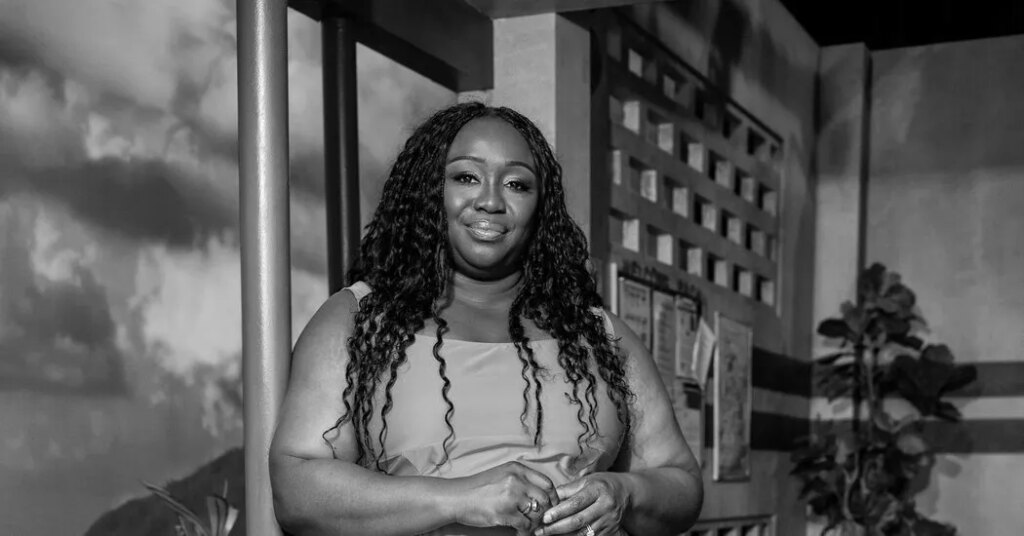
In her breakthrough comedy “School Girls; or, The African Mean Girls Play,” now on Broadway, the Ghanaian-American playwright Jocelyn Bioh evokes the special power and popularity once held by beauty pageants to explore larger themes about beauty, belonging and power.
“I specifically set it in 1986 because at that time, the dream of becoming any sort of Miss Anything — Miss Universe, Miss World, Miss America — one actually could become a superstar,” Bioh, 43, told me recently. “Now beauty pageants and things like that maybe don’t hold the same kind of cultural significance.”
But, she continued, “Vanessa Williams is famous because of a beauty pageant. If you’re a ‘Real Housewives of Atlanta’ fan, you know Kenya Moore won Miss USA, and Halle Berry was Miss Ohio. So there were really opportunities for you to become a superstar.”
I remember that time well. I was 11 when Giselle Laronde won Miss World. She was the second woman from my father’s country, Trinidad and Tobago, to win an international beauty pageant — and she remains the only one to be Miss World. When I think of Laronde, I recall her being both very familiar and out of reach. Her luminous brown skin and dazzling smile, reminiscent of my aunts, and the crown adorning her feathered hair were beauty goals to aspire to. She not only filled the nation with pride, but was also a Black woman being held up to represent universal feminine ideals.
That’s how the teenagers at the Aburi Girls Boarding School in Ghana view the Miss Ghana pageant in the play. For them, being selected to compete in the 1986 Miss Ghana pageant would improve their social stature and get them one step closer to the Miss Universe contest. But for their clique’s villainous queen bee, Paulina (Denée Benton), winning would help her escape poverty. And she’s clearly the front-runner, until Ericka (Jasmine Amy Rogers), the biracial, American-raised daughter of a local businessman, transfers to the school.
The arrival of Ericka, who is lighter-skinned than Paulina, initiates a debate about colorism, and we see the consequences of privileging lighter-skinned Black people over those with darker complexions.
“What I was most interested in, is really introducing it to the audience, who may believe they don’t know colorism, and getting them to understand it right away,” Bioh said during our video interview. “You have that implicit bias perhaps every single day of your life.”
She added: “I also wanted to highlight how we’re all implicated. Who is the person or people who created what is the universal standard of beauty? Who created that, and why have we all gone along with it?”
Bioh, who is also an actress, began writing “School Girls” in 2014, wanting to explore onstage some of the discrimination she had experienced. (It had a critically acclaimed Off Broadway run in 2017.) And she knows the worlds of boarding schools well. Her mother, who emigrated with her father from Ghana in 1968, was a student at the actual Aburi Girls’ Boarding School; and Bioh attended the Milton Hershey School, a boarding school in Pennsylvania for socioeconomically disadvantaged students.
“I’m OK to admit that I had allowed someone else’s standard of beauty to become my standard,” Bioh said. “This play was a way for me to try to shake and break that — even in my own personal journey — and move forward, look at myself in the mirror, and believe that I’m worthy and beautiful, and that I can go through this world feeling like a person who deserves to be here and that I’m not less than just because I’m dark-skinned.”
The play was also inspired by a scandal involving the 2011 Miss Ghana pageant. The title went to Yayra Erica Nego, a multiracial Black woman born in the United States who was allowed to compete because her father was Ghanaian. Her win spurred a debate about eligibility and fairness because the runners-up were born in Ghana and mostly had darker complexions.
According to a recent study published by the National Library of Medicine, lighter-skinned African Americans are more likely to have higher incomes and educational achievements, while darker-skinned African Americans are more likely to experience more racial discrimination. The study also found that Black girls themselves believe that colorism and the value associated with skin complexions make them more vulnerable to violence.
Though “School Girls” underscores how pervasive colorism is globally, Bioh’s script serves up these weighty issues with wit and humor.
First, she subverts expectations. Initially, Ericka’s kindness to her fellow students, her desire to fit in and the ease with which she shares her brand-name wardrobe and pop culture tidbits from the United States make her appear to be the play’s most likable character. It’s quite a contrast to the mean girl Paulina, whose mistreatment of the other students has established her as the villain. And though Paulina is a gifted singer, Ericka also has a set of pipes, which is revealed to great surprise — and humor — when the girls sing Whitney Houston’s “Greatest Love of All.” So she also seems to be the most talented, and thus worthy of advancing in the competition.
And yet, the more my fellow theatergoers applauded Ericka, the more uncomfortable I felt, realizing that their cheering risked reinforcing Ericka’s exceptionalism at the expense of the other girls at the school — Paulina, as well as Gifty (Nia Otchere-Sarfo), Nana (Erin Morton) and Mercy (Jordan Rice).
But once we learn more about Paulina and how far she has gone to be a contender in a world that prioritizes lighter skin, our loyalty is tested, and Paulina’s arc becomes the play’s truest indictment of colorism.
“Where the play ended up, particularly with Paulina’s journey, was me just being curious about humanizing a villain,” Bioh said. “I don’t know what that says about me or the experiences I had that I’m really trying to work through, finding the humanity in someone who we all should seemingly hate. That person is usually speaking to a truth that none of us want to hear, maybe in that moment or ever.”
Bioh knows “School Girls,” with its 85-minute run time, isn’t going to solve the problem of colorism, but wants the play to help audiences think about what they can do to make a difference.
Otherwise, she said, “We’re going to end up with people who see the world in the way that some of the adults in this play see the world, which is you either conform and bend to their standard of beauty or you’re nothing. And I think that’s a really depressing way to move forward.”
Bioh resisted tying things up neatly with a happy ending, instead opting for a bleaker one, serving as an epiphany for her characters as they head into adulthood.
She wanted the girls to learn “a different kind of lesson about how blackness is valued globally” and “about what happened in their little group, their little community, and their school,” she said. “We dealt with colorism, and now I think the end of the play really deals with racism.”
The post Tackling Beauty Standards, With Zingers and Pageant Gowns appeared first on New York Times.