Around 1826, the French inventor Joseph Nicéphore Niépce set out to capture the world’s first permanent photograph. Using a method he called heliography — or sun writing — he dissolved light-sensitive bitumen in oil of lavender, then painted the solution on a pewter plate. He inserted it into a camera obscura, a box that admits light via a pinhole, and set the device by his window.
Hours, perhaps days later, an image of his courtyard traveled on the wings of light and landed, as if by magic, on the plate.
Now, Niépce’s pioneering development and photographic innovations generally are getting their time in the sun, as the French Ministry of Culture marks the 200th anniversary of photography with hundreds of events from September 2026 to September 2027. Some of these bicentennial shows coincide with Art Basel Paris (Oct. 23-25), where several artists are honoring the medium’s origins while pushing the boundaries of its possibilities.
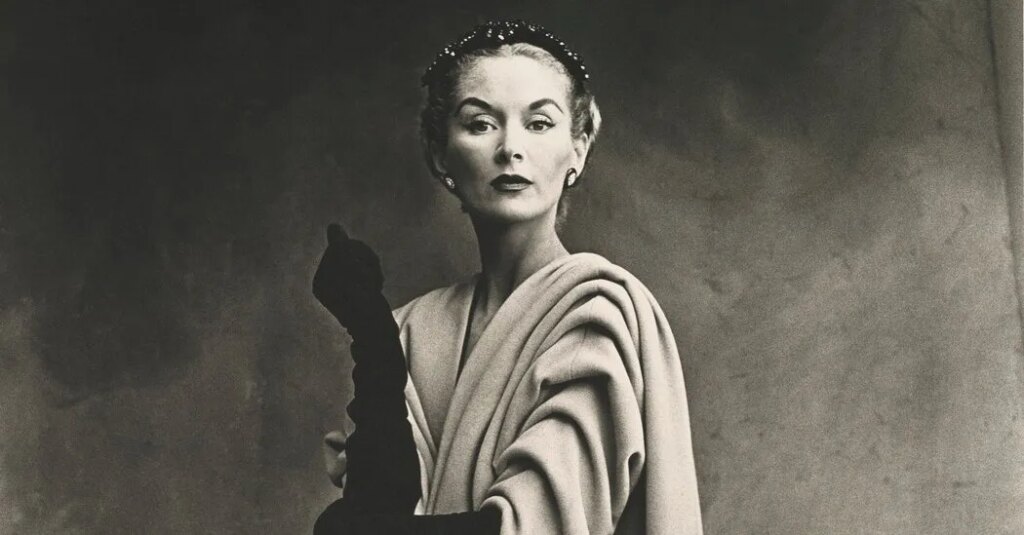
Two shows in Paris, outside the fair, spotlight one of the 20th-century’s most influential photographers, Irving Penn, who is best known for revolutionizing fashion photography through his more than 60-year career with Vogue magazine. When he arrived at Vogue in 1943, fashion spreads often featured ornate backdrops and props. By contrast, Penn’s pared-down style allowed his subjects’ personalities and dramatic silhouettes to pop off the page.
At Maison Européenne de la Photographie, “Penn & Fashion” (through Jan. 17) presents an intimate exploration of the artist’s aesthetic. Vasilios Zatse, deputy director of the Irving Penn Foundation, which promotes the photographer’s legacy and lent more than 30 images to the show, said in a video interview that the highlights of the exhibition are its chronological bookends: Penn’s iconic 1950s photos of Parisian haute couture, and the unorthodox composition and striking color work of the images he made late in life. “The visual impact of the room knocks your socks off,” said Zatse, who was also Penn’s apprentice and studio manager.
Penn’s legacy is also in focus at the Bourse de Commerce — Pinault Collection, in “The World According to Penn” (through Jan. 10), a showcase of nearly 450 Penn photos, including celebrity portraits, ethnographic reportage, beauty shots and still lifes. That show is part of the museum’s larger exhibition “Remember Me,” (through Jan. 18), which honors photography’s bicentennial with around 700 photographs by more than 70 artists, including Gustave Le Gray, Dorothea Lange and Man Ray.
The exhibition begins in the Bourse de Commerce’s glass-domed rotunda, a space that resembles a camera lens or an eye. Here, various photos focus on the notion of seeing, including a collage by Barbara Kruger featuring an eye over the words “Remember Me”: the inspiration for the show’s title and motif of memory. The rotunda is filled with Kruger’s bold text and photos of body parts, interspersed with quotes from literary works, including George Orwell’s “1984.”
The rest of the exhibition is arranged by theme, including seascapes, body language and composition, rather than chronologically. This prompts viewers to ponder why photographers from disparate eras and demographics depicted similar subjects in very different ways.
“I really tried to put the visitor in a position that they will be active and ask questions,” Matthieu Humery, the Pinault Collection’s adviser for photography and the show’s curator, said in a video interview.
At Art Basel Paris, Brunette Coleman, a London gallery, is presenting works by the English artist Nat Faulkner that conceptually fuse analog photography and sculpture.
“I think the most interesting way to use photography is to not think of yourself as a photographer,” Faulkner said in a video interview.
Faulkner fosters the serendipitous discoveries that occur in nature and scientific experiments. He does not regulate the temperature in his London studio’s darkroom and he stores photo paper by a window; this means that seasonal shifts and shafts of sunlight can alter the tones of his images. Some photos are purposely punctuated with fingerprints or tape marks.
In a new, untitled work at the fair, Faulkner photographed flowers with a medical camera designed to capture black-and-white close-ups of teeth and eyes. He then developed the images from black-and-white negatives onto color paper, doing so over multiple sessions to deliberately create variations in hue. Finally he stitched the pieces together into a unified yet heterogeneous floral photo that’s about 10 feet by 8 feet.
For one sculpture, Faulkner created a copper rubbing of his darkroom’s parquet floor, then coated it with silver extracted from X-ray film discarded by hospitals — a nod to the silver gelatin process of photography developed in the late 1800s. And like those 100-plus-year-old photos, the silver in Faulkner’s sculptures will tarnish as it interacts with the atmosphere while on view.
In addition, Empty Gallery of Hong Kong is presenting camera-less photographs by the artist Taro Masushio, who lives and works in New York City.
Masushio explained in a video interview that his work explored the question, “What is a queer image?” Masushio was inspired by screentones — transparent adhesive sheets covered with dots, lines, clouds or other patterns that lend shading and atmosphere to comic books in his native Japan.
He scanned several screentones into his computer, then superimposed and manipulated the images. Next, he turned the digital files into negatives and used special chemicals in the darkroom that give the resulting photos the silvery, sepia-toned sheen of a daguerreotype.
The abstract images, printed with text such as “homo” or the Japanese character for sexuality, are so reflective that they have an ever-shifting fluidity. And they are streaked with iridescent colors from the haphazard flow of darkroom chemicals.
That uncontrollable element was deliberate. “I really wanted to have an aspect of the universe speaking,” Masushio said.
Also at Art Basel Paris, Schiefe Zähne, a Berlin gallery, is presenting photographs by the English artist Anna Clegg of her and her friends staging a violent police break-in, in which the police use guitars as weapons, giving the scene the feel of a music video or adolescent game. Clegg will also show figurative paintings and photographic still lifes of small paper sculptures.
She uses photography to stage fantasies and images derived from music, literature and news. “I’m interested in the subsumption of personal transgression, violence and sexuality under capitalism as something marketable, while power structures globally become increasingly unstable and extreme,” Clegg said in an email interview.
Her works are partly inspired by historical photos of countercultures, as well as smartphone snapshots, with awkward angles and dim lighting.
While smartphones have made snapping photos fast and easy, the proliferation of digital images has led people to devalue photography, said Humery, of the Pinault Collection. In curating a show for the bicentennial, he said he wanted to focus on “the magic of when photography started” — when photographers began with a blank sheet and a sense of uncertainty, before a “magical moment when there is a revelation.”
Together, these shows spotlight the many aspects of the 200-year-old medium that freezes moments in time and place and turns them into art.
The post At Art Basel Paris and Beyond, Celebrating 200 Years of Photography appeared first on New York Times.