It’s almost impossible to force a country to surrender solely through a conventional air campaign in war.
Russia seems determined to try.
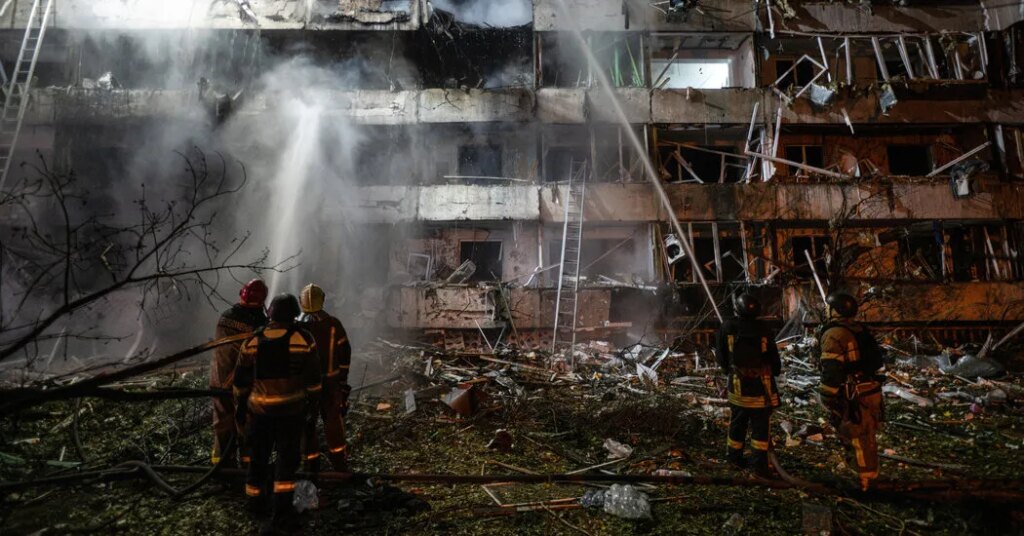
With Ukraine’s air defenses diminished and its infrastructure weakened after years of Russian strikes, Moscow appears to see an opening to pound Kyiv into total submission this winter. Under this new theory of victory, Russia would be wagering that its missile and drone attacks on Ukrainian cities can inflict so much human misery that they will succeed where its troops have failed on the front.
Since the summer, Russia has used its growing arsenal to unleash wave after wave of strikes on ammunition depots, gas stations, book warehouses, steel factories, power plants, data centers and commercial ships. Many of the attacks have been carried out with fast new jet-powered drones that have added a frightening new element to round-the-clock Russian onslaughts.
The result is a sense of increased pressure in the Ukrainian capital, Kyiv, as the economy teeters under the strain and as the energy system, which keeps homes heated and toilets flushing, faces potential collapse in the coming months. Adding to the strain is a new clash between Ukraine and the Trump administration that has come to a head this week.
“The Russians are inflicting a lot of damage in an effort to terrify Ukrainians ahead of winter into giving up,” said Harry Nedelcu, a senior director at Rasmussen Global, a European political advisory firm. “Essentially, into capitulating.”
History — and any understanding of the Ukrainian people — suggests that the effort will fail.
In Vietnam, the Persian Gulf and, more recently, the U.S.-Israeli war against Iran, bombing campaigns that wrecked economies and civilian life failed to force a surrender. Russia’s own air campaign, now in its fifth year, has yielded limited results as Ukraine has found inventive ways to shoot down missiles and as its people adapted to bombardments.
“Punishing the adversaries’ civilian population and trying to break its will has a very poor historical track record for coercing it to concede defeat,” said Seth G. Jones, a military expert at the Washington-based Center for Strategic and International Studies.
Ukraine has waged its own air campaign, using drones to hit Russian oil refineries that help finance the Kremlin war effort. President Volodymyr Zelensky of Ukraine had recently halted the strikes to comply with President Trump’s demand that Russian oil flow back onto global markets.
But with nothing offered in return except more American restrictions on Ukraine’s ability to fight, including a throttling this week of Starlink’s military-grade sister satellite internet service, a visibly angry Mr. Zelensky said on Wednesday that the refinery strikes would resume.
Still, Ukrainian officials and analysts acknowledge that such strikes cannot inflict as much damage on the Russian economy as Russia’s strikes on Ukraine. And they fear that Moscow is now better positioned to succeed in its air campaign than at any other moment in the war.
They point to three main factors. Ukraine’s air defenses have been depleted by years of attacks and a drop in American military assistance. Russia’s arsenal of missiles and drones has grown in both size and effectiveness. And Ukraine’s energy infrastructure is now so fragile that a single hit can inflict as much damage as several strikes once did.
Russia’s confidence that it can knock out Ukraine’s energy system is laid bare in an intercepted attack plan that Kyiv presented to European officials last month, a copy of which was obtained by The New York Times.
The plan estimates that Russia would need some 70 ballistic missiles, 720 long-range drones and 150 guided bombs to cut off the cities of Kyiv, Kharkiv and Odesa from water, power and heating. That is roughly the number of ballistic missiles and drones that break through Ukraine’s air defenses each month on average, according to a Times analysis of Ukrainian Air Force data.
Essentially, that means Moscow thinks that one month of strikes could do what four winters of attacks never did: wreck Ukraine’s energy system.
The grid’s vulnerability was evident after attacks earlier this month. The strikes forced the authorities to introduce scheduled power outages in Kyiv, even as mild autumn temperatures and long daylight hours have kept electricity demand relatively low. Last year, scheduled outages did not begin until late October.
Energy experts say the problem stems partly from Kyiv’s reliance on three combined heat-and-power plants in the capital. Years of attacks have left them unable to operate at full capacity, and each new strike knocks them offline quickly.
Before the war, the three plants had a generating capacity of about 1.3 gigawatts, enough to cover roughly three-quarters of Kyiv’s power needs during winter. That capacity was reduced to about 500 megawatts by this fall, said Maria Tsaturian, an energy analyst at the research group Ukraine Facility Platform.
On Wednesday, Russia struck all three plants with ballistic missiles, further reducing their outputs — at least temporarily.
As a result, Kyiv is likely to enter the winter with very limited electricity generating capacity of its own, according to a Ukrainian government official and a European diplomat in Kyiv, both of whom requested anonymity to discuss a sensitive subject.
That leaves Kyiv dependent on electricity from facilities outside the city, which include a thermal power plant to its south, nuclear plants to the west and three hydroelectric stations. Russia has struck the thermal plant and a number of substations that carry power from the other plants into the capital this month.
Ms. Tsaturian called it a “scorched-earth tactic” designed to cut Kyiv off entirely from power.
If Russia’s attack plan is successful, Kyiv, Kharkiv and Odesa would lose 90 percent of their electrical capacity, have their heating supplies fall by 90 percent, and suffer severe disruptions to their water and sewage systems.
Russia’s confidence largely derives from Ukraine’s shortage of air defenses, above all the U.S.-made Patriot interceptors that are its best protection against ballistic missiles. On Wednesday, Ukraine said it shot down only four of 39 ballistic missiles that Russia launched, most of which were aimed at the country’s energy infrastructure. That assault was one of Russia’s largest of the entire war.
While Ukraine has learned how to intercept many of Russia’s long-range drones, the new class of jet-powered ones, which fly at hundreds of miles an hour, are slipping through. Kyiv is racing to build new interceptors and pressing Western allies for conventional weapons that can bring them down.
Alyona Getmanchuk, Ukraine’s ambassador to NATO, said her list of requests to partners now included air-to-air missiles that fighter jets could fire to down jet-powered drones, along with medium-range surface-to-air systems that have also proved effective.
Russia’s air campaign has also inflicted severe damage on Ukraine’s industrial backbone. Oleksandr Myronenko, chief operating officer of Metinvest, Ukraine’s largest steel producer, said this month that the company had been forced to close its biggest plant after Russia fired 17 ballistic missiles at it.
Metinvest, which employs more than 36,000 people, is one of Ukraine’s largest private taxpayers. The factory shutdown means less money for the state budget and, ultimately, for the war effort. Serhii Marchenko, Ukraine’s finance minister, told Parliament this week that the shortfall in annual tax revenue could reach about $1.7 billion this year.
Ukraine has repeatedly called for a limited cease-fire focused on energy facilities or port infrastructure, arguing that one would be in both sides’ interest. But Mr. Nedelcu, from Rasmussen, said he did not see why Russia would agree to stop its air attacks now, especially before winter.
“The only card they have to pressure the Ukrainians are these air attacks,” he said. “They don’t have anything else.”
Kim Barker contributed reporting.
The post Why Russia Sees a Window to Bomb Ukraine Into Submission appeared first on New York Times.