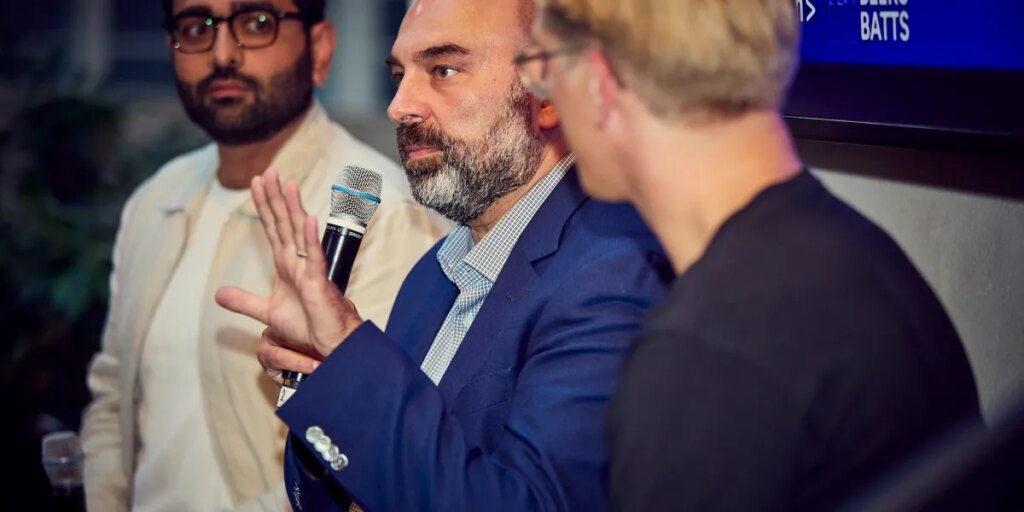
Steven Prast is old enough to remember when a mobile phone came in a bag. It was too heavy to carry around, so most people mounted it in the car. Prast argued in a Zoom interview with Fortune that what eventually shrank it into something you wear on your wrist was more the battery than the transistor, holding up his own phone as proof.
“What took us from that to this is the battery,” said Prast, a former Tesla manufacturing leader who is now chief operating officer of the battery-materials startup Holyvolt.
By his reckoning, lithium-ion technology is at best 20% of the way through its maturity curve, maybe 10% by conservative estimates. The West won’t win the rest of that curve, he said, by fighting with China over the part that’s already finished.
“We will not be able to out-China China on the battlefield that China has defined,” Prast said. “They’re the world champions at being China.”
Holyvolt is putting $45 million behind the alternative, all in equity. The Stockholm-based startup told Fortune that it has raised the round from Fifth Wall, Zone II, CC.VC and several angel investors from the defense and finance industries to hunt for battery chemistries China doesn’t control. The round values Holyvolt at $245 million, according to a person familiar with the company.
The gap Holyvolt is trying to jump is enormous. China makes about 85% of the world’s cathode active material, the part of a battery that largely sets how much energy it stores and what it costs. It makes about 80% of the world’s battery cells. Its lead comes from scaling the two chemistries that dominate today, NMC and lithium iron phosphate, or LFP.
“If we take LFP and we try to out-LFP China, we will lose,” Prast said. “We’ll lose that every day.”
The answer, he said in a statement, is to “invent better materials and processes and make them in the West.” He told Fortune he thinks there must be “another dozen cathode materials that humanity just hasn’t figured out yet.”
A chemistry problem
If batteries are so far from maturity, why haven’t they followed the steady, predictable curve of computer chips? Prast’s answer is that Moore’s Law comes out of physics, a science humans understand well enough to solve on paper, and batteries belong to another tradition.
“If you design an airplane and you do that computationally, I will fly on that airplane,” he said. “With chemistry, there are still huge mysteries.”
“The problem for battery is that it’s a chemistry problem and not a physics problem,” he said. “If it were a physics problem, you’d have Moore’s Law.”
That puts Holyvolt on one side of a split in AI-driven science. Most of the field, Prast said, believes it can solve chemistry computationally. A smaller camp believes AI still needs a physical lab to check its work. Holyvolt is in the second camp.
“We have to go to the lab and we have to go test,” Prast said.
The bet
Holyvolt’s lab is Wildcat Discovery Technologies, a San Diego company it merged with in a deal The Next Web reported at $73 million in March, a figure the firm confirmed as accurate. Founded by Scripps chemist Peter Schultz, Wildcat built a high-throughput system that tests thousands of battery materials in parallel. Over 18 years, the company says, the platform has run more than 225 projects for more than 85 customers, including BMW, and tested more than 500,000 cells.
That pile of data is the asset Mathias Ingvarsson, Holyvolt’s Swedish founder and CEO, built the company around. Ingvarsson was one of the core drivers behind Tempur-Pedic’s international expansion and its success before and after its IPO on the New York Stock Exchange, and ran its European business for six years after the listing. He told Fortune that, as one merged company, Holyvolt has trained AI models on Wildcat’s results and wired them back into the lab, so each round of real-world tests sharpens the next prediction. The data and the lab underpin the AI models being built to deliver the predictions the market is seeking, as well as to speed up R&D and develop next-gen breakthrough chemistries.
Most AI-for-science startups start with models and then look for data. Ingvarsson told Fortune that Holyvolt came at it from the other direction, with “the reinforcement learning we have done for 20 years, which AI needs to actually learn and build on.”
“We’re coming from the other side, which is very, very difficult to build,” he said. “Take years and years and years.”
Ingvarsson said the lab already works 10 times faster than conventional R&D, based on a case study completed with a customer, but Holyvolt thinks closing the loop with AI will push that figure upward compared to conventional R&D. “I’d go so far as to say that we have cracked the code on how to do it,” he said.
The deadline
The first thing out of that loop is DRX, short for disordered rocksalt, a family of cathode materials that use neither nickel nor cobalt. Prast described it as delivering “NMC-like” performance, “better than or equal to” nickel-based chemistry, at roughly the landed cost of LFP in North America. A core design requirement, he said, was that DRX’s supply chain be “entirely friendly.” He declined to identify suppliers. DRX has published performance data at scientific conferences, including the International Battery Conference in March 2026.
The timing includes a built-in deadline. Starting Oct. 1, 2027, Section 154 of the fiscal 2024 defense authorization act bars the Pentagon from buying batteries from CATL, BYD and four other named Chinese manufacturers, even as the military pushes to expand its use of drones. Holyvolt plans to begin commercializing DRX in 2027, starting with unmanned aerial vehicles before moving into mobility. It is also working on formulations for automakers and one aimed at data centers, which need bursts of very high power as GPUs spin up, Prast said.
‘I’ve seen this movie before’
For Prast, the fight is personal. “I grew up in northern Michigan. Long family history in the auto industry,” he said. “I’ve seen this movie before. I know how it ends.”
He framed it as a matter of stability more than rivalry. “It’s unstable when you have too much concentration in any one place,” he said.
Ingvarsson took a similar line. “I have nothing against China,” he said. Then he noted that Volvo Cars, his home country’s best-known carmaker, “happen to be Chinese nowadays.” (China’s Geely owns a majority of the company.)
Holyvolt doesn’t plan to build gigafactories. Prast said the company is open to licensing, toll manufacturing or joint ventures, and would leave industrial scale to partners.
“The transition from there to actual industrial scale is the killer.”
The post Exclusive: ‘I’ve seen this movie before’: A Michigan-raised ex-Tesla exec raises $45 million to break China’s grip on batteries appeared first on Fortune.