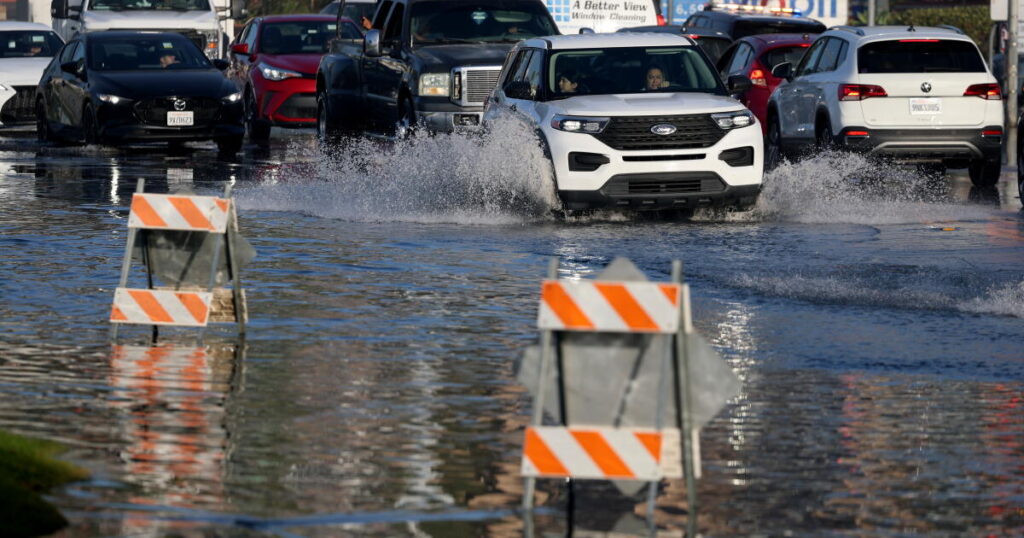
Damage from a week’s worth of high surf and El Niño-related storms brought many warnings from officials. Beaches were closed. Homes were evacuated and red-tagged.
But one alert was targeted to a specific audience: owners of electric vehicles that were submerged by the flooding.
“If you notice smoke, hissing, popping or unusual heat, move away immediately and call 911,” the Laguna Beach Fire Department said. “Do not attempt to move the vehicle or extinguish the fire yourself.” It also warned that if the car had been partially submerged it shouldn’t be driven or charged, even if it appears to operate normally.
California is the epicenter of America’s EV market, representing about 19% of all new car sales, according to a UC Davis study. Now, California faces an exceptionally wet El Niño winter. Most forecasts say it could be the biggest on record, bringing rain and the potential for more flooding.
Experts say electric vehicles are susceptible to starting a fire when their batteries are inundated with salt water. During the weekend storms brought by Tropical Storm Rachel, floodwaters swept into Newport Beach’s Balboa Peninsula and exposed cars parked and driving through the area to standing water, which may have corroded batteries and created hidden hazards. Experts expect more coastal flooding as El Niño peaks in California this winter.
It’s not that EVs are inherently dangerous. But water affects them differently from cars with internal combustion engines. Gas-powered cars have their own problems from flooding, such as electrical system malfunctions, rust and mold.
The flooding challenges of EVs have already hit Florida, New Jersey and other flood-prone states.
Fires fueled by unstable, damaged lithium batteries spread quickly and are difficult to put out — and they can occur days or even weeks after saltwater exposure. Flood damage to not only electric vehicles but also hybrid vehicles and other battery-operated devices such as e-bikes, golf carts and electric scooters should be handled with utmost care, officials said.
If your car is caught in a flood, water may have reached its battery or electrical components, and fire officials recommend contacting your insurance company, arranging for professional towing and having your vehicle inspected by a mechanic qualified to service electric or hybrid vehicles.
An electric vehicle’s battery sits in a sealed box, but it’s not water-proof when submerged.
If the flooding was just a few inches and just brushed the underside of the car, it’s probably okay, said Patrick Durham, a volunteer fire captain in Michigan with a mechanical engineering and electric vehicle development background who now works as a consultant to various fire departments.
But if water breached the “rocker panel,” which in modern electric and hybrid vehicles serves as a structural shield protecting floor-mounted battery packs, that’s a clear red flag, he said.
In other words: “If your floor boards are wet, then you likely have a problem,” Durham said.
Any brand of electric or hybrid vehicle is susceptible, Durham said. Risk of damage depends mainly on how high the battery is located. But because lithium batteries are so volatile when damaged, he said the vehicle should be treated as a hazard if there’s even a question of water exposure and a professional inspection should be a priority.
“If it’s been submerged in water it’s bad. If it’s been submerged in salt water, it’s really bad,” Durham said.
Power drills, leaf blowers, personal electronics and other common household equipment also use lithium batteries, and although fires from smaller batteries won’t be as potent as those from electric vehicles, the devices should also be properly disposed of at household hazardous waste collection centers. (Do not throw them in your regular trash bin, Durham warns, with battery fires on garbage trucks and at recycling centers from improperly disposed gadgets becoming increasingly common.)
The issue of EV fire risks in hurricane- or flood-prone areas is a relatively new one, as such vehicles have become more common. And they have shown to pose potential dangers to passengers, emergency responders and storm recovery personnel.
When Hurricane Sandy floodwater receded from New Jersey’s Port Newark shipping docks back in 2012, 16 Fisker Karmas, which are luxury hybrid plug-ins, burned in a fire there.
Fisker Automotive said that an internal investigation supervised by transportation regulators found salt corrosion had caused a short circuit in the battery, leading to the fire, rather than a preexisting defect.
But the issue didn’t garner much notice until a decade later, after Hurricane Ian in 2022.
After Ian, 36 electric vehicles caught fire in Florida because of water damage, according to researchers at the Idaho National Laboratory collaborating with the National Highway Traffic Safety Administration.
“In several instances, the fire erupted while the impacted EVs were being towed on their flatbed trailers,” the traffic safety agency stated in a 2022 report.
Last month, a dozen fires broke out on the New Jersey shore after severe flooding in the area due to the nor’easter storm along the Eastern Seaboard.
The trigger for lithium-ion battery fires is a process called thermal runaway, a cascading sequence of heat-releasing reactions inside the battery cell. Under normal operating conditions, there is a slim chance of a battery combusting. But the chance increases sharply if the battery is subjected to electrical or mechanical stress. When energy is left stranded in a battery that becomes submerged in salt water, that can lead to a short circuit and an uncontrollable increase in temperature.
The Idaho researchers studied water intrusion on several battery packs affected during Ian and found that some still hadn’t discharged even after about 10 months of storage.
Salty floodwater from Hurricane Helene in 2024 caused some 11 electric vehicles and 48 lithium-ion batteries to catch fire, according to one tally, with some fires spreading to homes.
Fresh water can also destabilize a battery, but salt water is more conductive — meaning an electric current can easily flow through it — thus strengthening the current that catches hold in the battery and its rapid corrosion, wrote Xinyu Huang, a combustion scientist and mechanical engineering professor, in a 2024 blog post at the University of South Carolina.
The National Transportation Safety Board warns that “batteries in hybrid and electric vehicles are highly corrosive and should not be exposed to standing water. Flooded vehicles lead to high-voltage shock hazards, which could lead to a fire. If your EV has been exposed to flood conditions and you suspect your battery is damaged, contact your dealer and/or emergency services.
Amid the strongest El Niño on record and with warming ocean waters helping fuel the activity, California probably will see more coastal erosion, flooding and damage this winter, especially during high tides. Car owners in flood-prone areas should take precautions ahead of time, such as moving vehicles to higher ground before a storm, Durham said.
Durham cautions evacuating drivers from plowing through flood water with an electric vehicle. If forced to leave an electric vehicle behind, do not leave the vehicle plugged into a charger, he said, and make sure it’s parked at least 50 feet away from any other structures or vehicles. And leave the battery at less than 30% charged, he said.
Here are additional safety tips, according to the Federal Emergency Management Agency:
- Notify your local fire department if you believe that lithium-ion batteries in your home or garage might have been exposed to flooding, particularly those in larger devices such as e-bikes, golf carts and electric vehicles.
- Disconnect potentially flooded devices and vehicles from their chargers.
- Remove vehicles from the building to an open space — at least 50 feet from any other structures or vehicles.
- Flood-damaged lithium-ion-powered products should be disposed of properly and carefully. Place the products in metal or noncombustible tubs at least six feet away from debris and structures. Do not leave them with other storm debris for pickup, and never place lithium-ion batteries inside garbage or recycling receptacles.
The post California EV owners, beware: El Niño flooding brings risk of serious battery fires appeared first on Los Angeles Times.