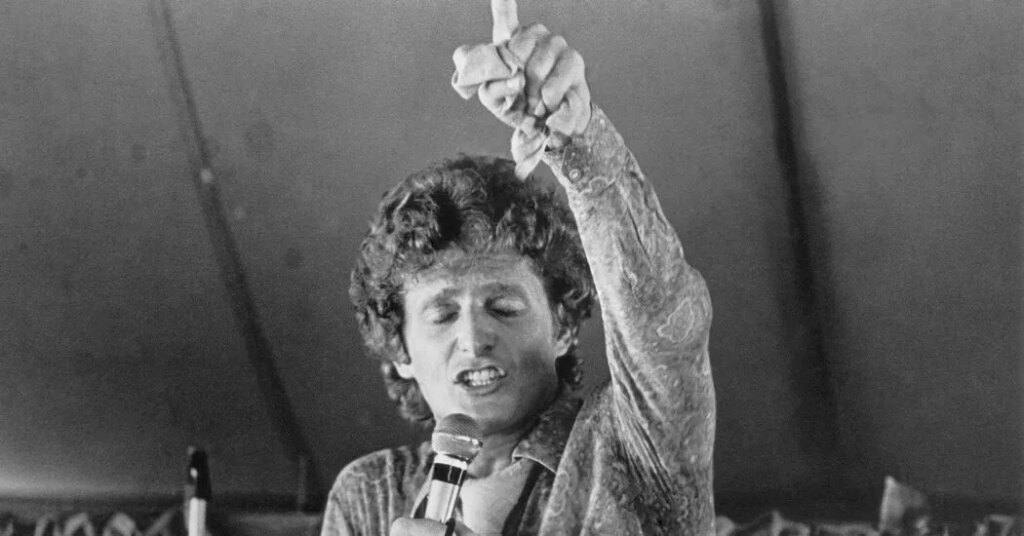
By the time he was 4, Marjoe Gortner was an ordained minister, coached by his parents into a tiny simulacrum of a Pentecostal preacher, belting out hellfire and brimstone.
He was born into the business, the fourth generation of a family of ministering men. But it was his mother, Margaret, known as Sister Marge, who taught him the trade, writing the scripts for his sermons and drilling him in daylong sessions.
He rarely stumbled. When he did, Marge’s teaching method involved pressing a pillow over his face or holding his head under a running faucet. These tactics were successful not only because they were terrifying, but also because they didn’t leave any telltale marks.
He was a hit on the evangelical circuit. Clad in a little white suit and cowboy boots, his hair a nimbus of blond curls that his mother had bleached and permed, he gestured and lunged, delivering his lines in a piping voice from a pint-size pulpit and rolling his R’s as his mother had taught him:
“Hell is a place of extrrreme suffering.”
“I’m herrre to give the devil two black eyes.”
“I thank God for my good Chrrristian mother.”
Marge sewed special pockets into his suits so that when he went through the congregation collecting offerings — $20 would get you a kiss from “Little Marjoe” — there was ample room for the money. Not long before he turned 5, he officiated at the wedding of a young couple, earning copious press coverage and a spot in “Ripley’s Believe It or Not!,” as well as opprobrium from religious leaders who found the publicity stunt unseemly.
He was good at his job, and he enjoyed being onstage, but he never believed in God. And he certainly didn’t believe in hell.
By the time he was 14, the novelty of preaching had worn off, for him and his congregants. His voice was changing, and his father had abandoned the family and absconded with Marjoe’s earnings — some $3 million, he later estimated.
Marjoe decided to leave, too.
He drifted a bit through his native California, living first with an older woman and then, at 16, marrying a girlfriend. He worked as a shoe salesman, as a barker on the Santa Cruz Wharf and as a doorman at a dance club in Los Angeles before starting a rock band and melting into the nascent hippie scene there.
Yet by his 20s, he had returned to preaching. He needed the money, and missed the limelight. At first, he thought he might introduce his pacifist beliefs into his sermons, skipping the sin-and-hell part. That didn’t go over so well — he was not invited back to the churches where he tried it. So he returned to his revivalist techniques, adding some vocal moves he borrowed from Black preachers and some physical ones from Mick Jagger.
Once again, Marjoe was a hit and his collection buckets overflowed. He stayed in the game for another few years, though by then he was thoroughly sick of the con and longed to perform legitimately: He wanted to be an actor. With the help of two documentary filmmakers, he succeeded at that.
Mr. Gortner, who exposed the flimflammery of his former profession in the 1972 Oscar-winning documentary “Marjoe” and went on to become a hard-working mid-list actor, died on Oct. 2 in Santa Fe, N.M. He was 82.
His wife, Susan Magestro Gortner, said the cause was congestive heart failure.
In the spring of 1971, Mr. Gortner was between preaching gigs when he visited New York City, where he hoped to study at the Actors Studio, he told The New York Times. Instead, he ended up pitching his story to Howard Smith, a columnist at The Village Voice, who teamed up with a co-worker, the writer Sarah Kernochan, to make a documentary.
Neither had filmmaking experience, but many of the crew members they hired had worked on an award-winning 1970 documentary about Woodstock, and they all set off with Mr. Gortner that summer as he barnstormed through the country on what would be his final tour.
What they captured was mesmerizing, a lens turned on the evangelical world. Mr. Gortner, handsome and charismatic, roused the faithful in tents and auditoriums across California, Texas and Michigan. He sweated and pranced and sang and prayed, delivering ecstasies to his congregants by pressing a “healing” hand to their foreheads. Many fell to the ground, writhing and speaking in tongues, the inscrutable “language” that signaled communion with the Holy Spirit.
The filmmakers also captured how well those performances made bank, with scenes of Mr. Gortner and another minister counting out the take from the collection buckets. In between performances, Mr. Gortner, often clad in a tie-dyed tank top, hung out with the film crew in motels, smoking pot and explaining the mechanics of his trade. He was a hustler, he admitted, but so were his peers.
“You go into it like a business, and you work it like a business,” he said. “I enjoy getting it off onstage, but I wish I was getting it off as a rock star. I like to think that I’m bad, but not evil. I’m a hype, but I don’t feel I’m a bad hype.”
The film was mostly a critical hit — Judith Christ, writing in New York Magazine, called it “a striking example of intelligent cinéma vérité” — although Vincent Canby of The Times was unmoved by Mr. Gortner’s charms, describing the documentary as a “feature-length screen test for Marjoe.” In that regard, Mr. Canby would be proved correct.
The film won best documentary at the Academy Awards in 1973, the same year that “The Godfather” won best picture and “The Poseidon Adventure” best song (for “The Morning After”).
By then, Mr. Gortner was a star on both coasts, having traded the tent-revival circuit for that of the talk shows. He hung out at Max’s Kansas City in Manhattan, dated beautiful women like the actress Berry Berenson, partied with the Rolling Stones, attended fashion shows with the model China Machado and was featured in Rolling Stone, the magazine, as well as Life. Judith Jamison, the Alvin Ailey dancer, named her marmalade cat after him. He made a rock album, “Bad but Not Evil,” which The Times, while noting that he was a promising pop singer, described as “bad but not hopeless.”
As Ms. Kernochan said in an interview, “He was slurped right up. He had the best agent; he was everybody’s favorite dinner guest.”
“It’s a turn-on for people to have me at their parties,” Mr. Gortner told The Times, which described him as “the celebrity-seeking crowd’s latest bauble.” “But I get so tired of telling the same stories. That’s why I’d like to do something completely opposite as an actor, to show I can make the change.”
He did that with gusto. During the 1970s and ’80s, he was a ubiquitous television presence, landing middling roles on series like “Kojak,” “Barnaby Jones,” “Police Story” and “Falcon Crest.”
He played the outlaw in “Bobbie Jo and the Outlaw” (1976) — a kind of poor man’s “Bonnie and Clyde” — with Lynda Carter, who had recently begun starring in the TV series “Wonder Woman,” playing Bobbie Jo.
In the disaster film “Earthquake” (1974), he played a grocery store manager turned unhinged National Guardsman. The screenwriters had a bit of fun with Mr. Gortner’s past: When his character summons a beat cop to get rid of the Hare Krishna followers outside his store, the policeman, a sour George Kennedy, snaps, “You got something against religion?”
Hugh Marjoe Ross Gortner was born on Jan. 14, 1944, in Long Beach, Calif. His parents, Margaret Ellen (McMillan) Gortner and Vernon Gortner, were ordained ministers, which explains their choice of the name Marjoe, a portmanteau of Mary and Joseph.
The family traveled constantly, preaching in churches and tents throughout the country. Marjoe and his younger siblings, Vernoe and Starloe, were home-schooled by Marge while they were on the road.
Once Vernon left and Marjoe stopped preaching, money was tight. Marge tried unsuccessfully to mold Starloe — now Starr Padilla — to follow in her brother’s footsteps. Recalling her debut at 7, terrified and trying to choke out a sermon on juvenile delinquency in front of an enormous audience, Ms. Padilla said in an interview, “Mom realized I wasn’t Marjoe, by any means.”
“She was a ‘Mommie Dearest,’” Ms. Padilla added, referring to Christina Crawford’s 1978 memoir about her abusive upbringing at the hands of the actress Joan Crawford. Like her brother, she married young, at 17, mostly to get away from Marge.
Mr. Gortner’s marriages to Carol Raney, Virginia Humphreys, Agnes Benjamin and the actress Candy Clark ended in divorce.
He met Ms. Clark when he produced and starred in “When You Comin’ Back, Red Ryder?,” a 1979 film adaptation of a Broadway play by Mark Medoff about a disturbed Vietnam vet who imprisons and terrorizes the patrons of a New Mexico diner. Mr. Gortner played the menacing vet, and Ms. Clark his flower-child girlfriend. (The movie was not a success: “Punishment passed off as entertainment” is how The Los Angeles Times described it. Neither was the marriage, which lasted about a year.)
Mr. Gortner married Susan Magestro in 2019. In addition to her and Ms. Padilla, he is survived by a daughter, Gigi Gortner, from his first marriage; a son, Dylan Becker, from another relationship; two stepdaughters, Marie Ciattini and Stella Magestro; and a step-grandaughter.
Starting in the 1980s, Mr. Gortner produced charitable sporting events for various philanthropies, including Dream Foundation. He retired in 2012, and lived in Sun Valley and Santa Fe, N.M.
For much of his life, Mr. Gortner was estranged from his family, Ms. Padilla said, although they both always reached out on their birthdays. He eventually made amends with his father, she said, but after the documentary was released, he and his mother never spoke again.
“I loved him, and I thought he was a remarkable man,” Ms. Padilla said. “He was flamboyant and outgoing, but also extremely private. All of his life he was made to be a performer, and people always wanted something from him, so he was very guarded with allowing anyone in.”
As Ms. Kernochan put it, “He had been in costume his whole life, and in a way he found he couldn’t take it off.”
She added: “We lost touch after the movie came out. Things were already thorny between us; he was a very paranoid and calculating fellow. The reason the movie begins with him as a child was that you’d forgive him anything if you saw what he went through.”
The post As a Child Evangelist, He Roused the Faithful. Later He Exposed the Con. appeared first on New York Times.