Westfield Topanga is one of the region’s most popular malls, but it has grappled with what to do with the empty space left when it lost its Sears.
Joining a national wave of malls trying to become fancy food destinations, it launched its food hall — Topanga Social — in 2023, with high-end menus and an upgraded ambiance, hoping to attract consumers looking for more than food court fare.
It didn’t work, and almost all of the restaurants that launched the food hall are gone. This summer, it basically started over again from scratch with new outlets and new management, betting it could do better with a rotating roster of nostalgic foods reimagined by local chefs and corporate-sponsored pop-ups serving up buzz-building concoctions like Cheez-It-flavored cheesesteak sandwiches.
“We really looked to be more intentional about the food and the operators,” and visitors are now spending more time in the food hall. said mall General Manager Logan Abbene. “The changes are working, and every week seems to be a little bit more energetic than the last.”
While it is too early to say whether Westfield Topanga has pulled it off, its food journey illustrates how hard it is to convince consumers who have grown used to shopping and ordering meals online to come back to the mall.
For the shopping centers that still attract customers, mall food has rapidly evolved from fast food and hot dogs on sticks memorialized in historic teen movies such as “Fast Times at Ridgemont High” to upmarket food halls and sit-down restaurants.
Upgrading malls with food halls that aim to elevate the eating experience is an attempt to make malls relevant again, said food hall consultant Phil Colicchio in a bullish 2026 industry report.
“The food hall category continues to perform on par with or better than traditional restaurants, reinforcing the model’s long-term viability,” he said, and “represents one of the most resilient, flexible, and scalable formats in modern hospitality.”
More than 450 food halls are operating in the U.S., with another 114 in the pipeline, he said.
Food halls have become a choice replacement for space left behind by defunct big-box stores or even bank branches. In L.A.’s Atwater Village neighborhood, a former Wells Fargo branch is being turned into a food hall anchored by sushi bar Yunomi Handroll.
Westfield Topanga has long been at the cutting edge of mall culture.
It was one of California’s first major enclosed shopping malls when it opened in 1964 with an ice rink surrounded by food sellers. The kind of food court many people remember from the 1980s was created after the rink closed.
The food court was relocated to a new wing in 2007. Panda Express is the only remaining brand from the original food court, Abbene said. Other classic mall fare on the second floor includes Wetzel’s Pretzels and Jamba Juice.
Downstairs, illuminated by skylights and chic industrial pendant lamps, is Topanga Social. It occupies what used to be part of the failed department store Sears.
The food hall launched three springs ago with promising outlets including Fat Sal’s sandwiches, Mini Kabob, Burrata House, Poke Me and Shrimp Daddy. It had bars, live music and DJs and lush plants.
After the initial buzz wore off, some shoppers started griping about noise levels and the quality of food at some outlets. Critics complained that the food was too expensive for the experience and the location was too loud. Many didn’t like the central payment system where each customer had to use kiosks to order.
With the relaunch, Westfield has tried to address some of the issues with new management, new restaurants and a rotating roster of interesting pop-ups. It got rid of the centralized payment system and centralized kitchen, and it’s going to bring in different groups to temporarily run some storefronts.
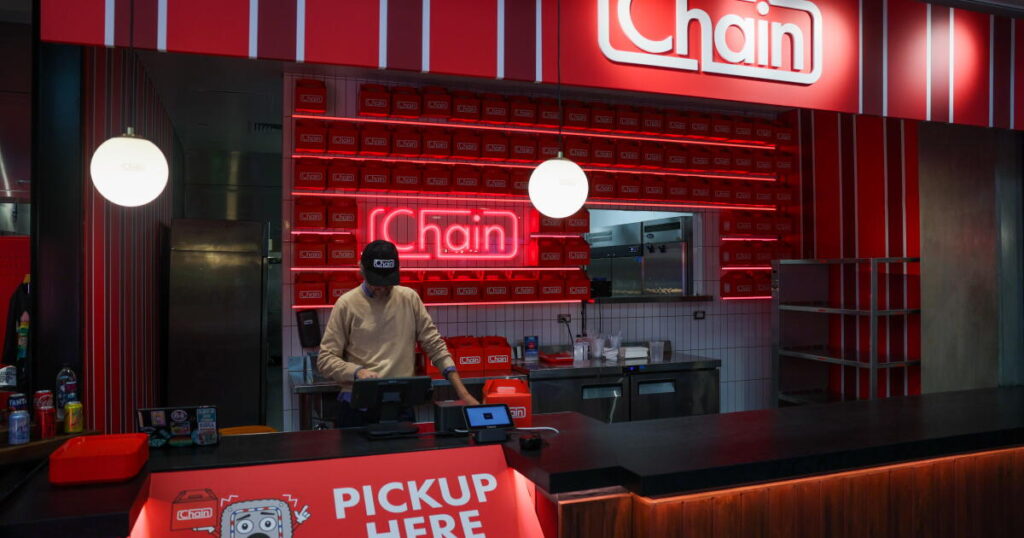
First up to bat is Chain, a popular pop-up restaurant with Hollywood connections that became Instagram-famous in recent years, with fast food turned into haute cuisine by celebrity chefs. The company, co-founded by actor and writer B.J. Novak, will operate in the food hall for at least six months.
Chain’s food offers reimagined dishes found in popular mass-market eateries such as an elevated Blooming Onion-inspired appetizer, a Wagyu beef Taco Bell dish or a Pizza Hut-like pan pizza with 24-month aged Vacche Rosse Parmigiano — all with the help of Michelin-starred chefs.
Leading the menu at Westfield Topanga is chef Mei Lin’s Mapo Wagyu Cruncho Perfecto, a $17 Sichuan peppercorn and Wagyu beef Crunchwrap-style creation, and chef Calvin Eng’s $16 Crispy Cantonese Fishwich, a Cantonese-spiced wild cod and shrimp patty with scallion tartar sauce.
The unexpected pairings are attempts to mine the origins of mall food and other fast food but elevate it to a level more sophisticated mall-goers can enjoy, said Chain President Steve Milton.
“We’re tapping into that nostalgia, that celebration of pop cuisine,” he said.
Chain is also testing branded collaborations, including Cheeze-It Court last month, where the snack food was turned into cracker-infused fare such as a Cheeze-It-flavored cheesesteak and a Wagyu hot dog coated in crushed crackers.
Chain is also collaborating with General Mills to develop snacks and desserts, turning well-known cereals into such creations as Lucky Charms Taco Frio ice cream sandwiches and Cinnamon Toast Crunch Tiramisu. The latest addition is a Pillsbury shopwith biscuit sandwiches.
To build its profile as a culinary destination, Topanga Social will soon add Kura Revolving Sushi. Nearby, the mall plans to bring in Din Tai Fung, one of the country’s top-grossing restaurant chains, next summer. It has knocked down the walls between four stores and relocated a Tesla dealership. It’s set to open late next summer.
To be sure, the old food court is still doing great, mall general manager Abbene said.
“No one stopped going to the food court,” he said.
The post Inside Westfield Topanga’s struggle to reinvent mall food appeared first on Los Angeles Times.