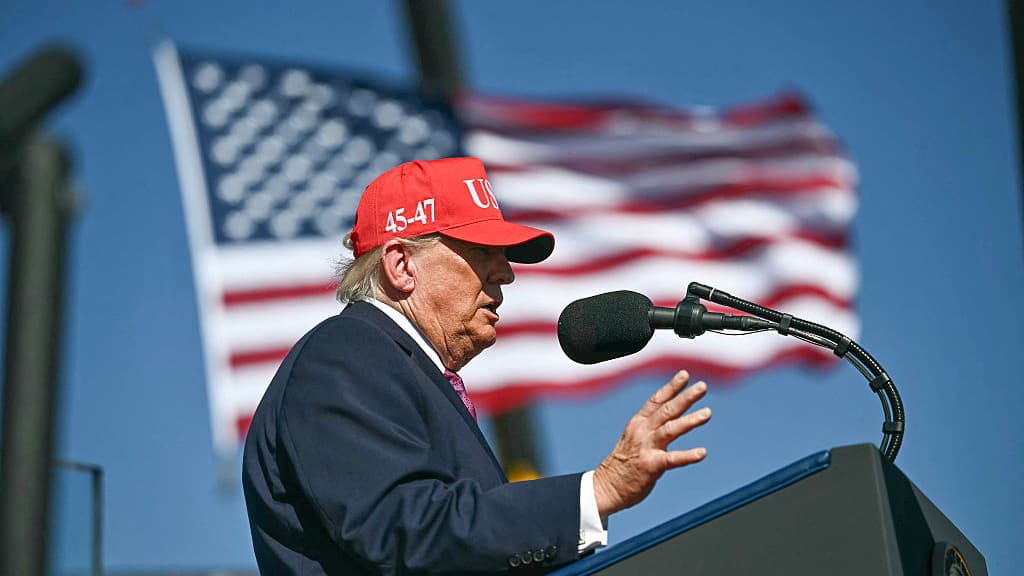
President Donald Trump suggested on Wednesday that people who leak sensitive information about the government to the media “should be shot,” calling them the “scum of the earth.”
“In my opinion, leakers should be shot,” Trump said Wednesday during a rally in Bullhead City, Arizona. “In the old days, we used to shoot leakers, you know, when they leak what time you’re going to attack a country.”
Trump’s remark came as he described a planned raid on Iran that he said had to be delayed after somebody “leaked the time we were leaving, the time we were arriving.” He appeared to be referring to Operation Midnight Hammer in June last year, when the U.S., in a surprise attack, struck three of Iran’s most critical nuclear sites as Tehran was in a 12-day war with Israel.
In the wake of the June attack, a leaked Defense Intelligence Agency preliminary report found that Iran’s nuclear sites had not been as damaged as the Trump Administration first claimed them to be and that Iran could still enrich uranium. Reports also said Iran may have also moved enriched material from the facilities before the attack.
“Somebody leaked—some sleazebag,” the President said. “They ought to go to jail and be shot. For the rest of their life, They should be in jail. But they leaked that we were leaving at 12:07 from Missouri, and it was in the New York Times, CNN.”
Moments later, Trump pointed to the journalists covering his rally and said they were “almost as bad” as leakers. “They leak false information,” the President said. “That makes them a leaker, right?”
Trump’s long-held view that leakers are bad—most of the time
Leakers have incensed Trump even before he was President. In a 2010 clip previewing the radio show of Fox News’ Brian Kilmeade, Trump assailed WikiLeaks, which, at the time, had just released hundreds of thousands of classified U.S. military and diplomatic documents provided by Army private Chelsea Manning. “I think it’s disgraceful,” he told Kilmeade. “I think there should be like death penalty or something.”
As a civilian flirting with the U.S.’s top job, he frequently lashed out at former National Security Agency intelligence contractor Edward Snowden on social media and in public remarks. Snowden’s leaks in 2013 revealed NSA programs that sparked a global debate about government surveillance. Trump, in reaction to the leaks, said that he was a “spy” who “should be executed.”
As President, when the New York Times reported in 2017 that his campaign had repeated contacts with senior Russian intelligence officials in the year before the 2016 presidential election, Trump took to then-Twitter to lament how “leaking, and even illegal classified leaking, has been a big problem in Washington for years” and raged that such leakers “will be caught.”
When a whistleblower came forward in 2019 with a complaint alleging that Trump was “using the power of his office to solicit interference from a foreign country” in the 2020 U.S. election, Trump told the staff of the U.S. mission to the U.N. that he wanted to know who gave the whistleblower information. “That’s close to a spy,” he said. “You know what we used to do in the old days when we were smart, right, with spies and treason, right? We used to handle them a little differently than we do now.”
But Trump has welcomed leaks that benefit him politically. Days before the 2016 presidential election, at a rally in Wilmington, Ohio, he celebrated how WikiLeaks released private emails from John Podesta, the campaign chair of his Democratic opponent Hillary Clinton, as well as emails from the Democratic National Committee. “Boy, I love reading those WikiLeaks!” Trump said. He also mused about Russia having hacked into Clinton’s email, and urged them to publish what they may have found. Trump even said that he could be a fan of Snowden if he released former President Barack Obama’s birth records at a time when conspiracy theories largely fanned by Trump hounded the Democratic former President.
Trump Administration tries to crack down on leaks
The second Trump Administration has since stepped up to limit leaks to the press. When reports of the U.S.’s dwindling ammunition stockpiles amid the war with Iran emerged, the Pentagon subjected dozens of civilian employees and military officers to polygraph tests to identify the source of the leak. Trump had called for the leakers to face long-term jail sentences.
Journalists from the Wall Street Journal and the Washington Post received subpoenas after reporting on national security issues. But the news organizations pushed back against those summons, and the Justice Department withdrew them. In January, the FBI raided a Post reporter’s home, as part of an investigation into a government contractor accused of mishandling sensitive national security information.
The Justice Department has also charged alleged leakers: in April, the department announced it arrested a former Army employee, alleging that she transmitted classified national defense information to unauthorized recipients, including a journalist.
The Defense Department also threatened to withhold Pentagon access to journalists unless they signed an agreement not to publish unauthorized material. Much of the Pentagon press corps declined, and a federal judge sided with the press in March, striking several parts of the department’s press access policy.
Trump has wanted others “shot” too
It’s also not the first time that Trump has floated having certain people shot .
Three years ago, at a California lunch with Republicans, Trump said he was in favor of shooting store robbers and looters, painting himself as tough on crime before the 2024 elections. “They actually go and take everything out of the store, and then you see these guys selling stuff five miles away or selling it from behind cars. It’s a horrible thing. When the police are allowed to do their job—and that means, in some cases, shoot them—this will stop immediately.”
The President has also previously pitched shooting migrants to keep them from entering the country. According to the book Border Wars: Inside Trump’s Assault on Immigration, by New York Times reporters Michael D. Shear and Julie Hirschfeld Davis, Trump in March 2019 detailed extreme methods to keep them out, privately suggesting to aides that soldiers shoot migrants who cross the border in the legs. But he was told it would not be allowed. Trump addressed the allegations on social media, saying: “I may be tough on Border Security, but not that tough.”
He’s also suggested doing the same to protesters: during the George Floyd protests in the spring of 2020, Trump was reportedly enraged, and, according to his first-term Defense Secretary Mark Esper, the President also considered ordering the military to shoot the racial justice protesters in the legs.
Last week, the President approved what would be the U.S. Army’s first execution of a soldier via firing squad since World War II, and has even shown enthusiasm for livestreaming it. Trump, however, has since changed his tune, amid a chorus of negative feedback.
“There are two thoughts: don’t show it and show it,” Trump told reporters on Saturday. “‘Cause you know, by showing it, maybe other people won’t be doing what he did. So I’ll make a decision, ultimately. I know what the military would like to do, but we’ll make a decision.”
The post Trump Says Leakers ‘Should Be Shot’ and Rails Against Media at Rally appeared first on TIME.