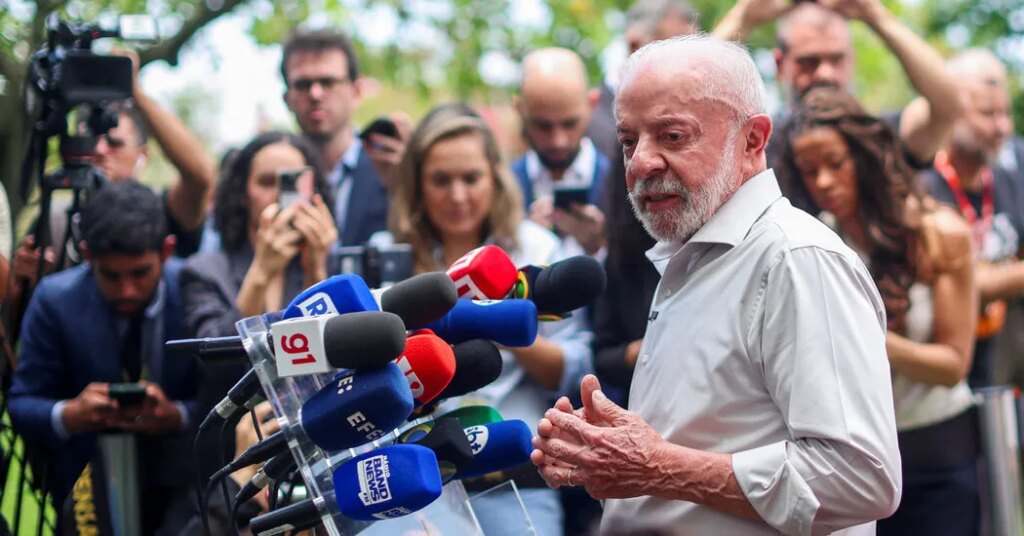
Less than two weeks before the election, the leftist president of Brazil and independent watchdog groups accuse Meta and its social media platforms of giving his right-wing rival, Flávio Bolsonaro, favorable treatment.
President Luiz Inácio Lula da Silva and groups monitoring social media say search results omit progressive activists, videos critical of the right-wing challenger are taken down without explanation and posts lauding Mr. Lula reach fewer people.
Mr. Lula’s campaign, which is racing to shore up millions more votes ahead of a runoff against Mr. Bolsonaro on Oct. 25, filed a complaint filed with the nation’s electoral court on Saturday, demanding fair treatment online.
“The scenario is,” the complaint said, “that of a platform illegally practicing algorithmic selectivity, in the midst of a fierce presidential contest.’’
Meta has firmly rejected claims of political bias, saying in a response to the court that it “does not operate its systems to harm or favor candidacies.” It attributed some of the issues that Mr. Lula’s campaign highlights to technical glitches or unintended errors. Meta also dismissed findings from independent research groups suggesting uneven treatment, arguing they are anecdotal cases and impossible to verify.
“It is unfortunate that minor technical issues are being spun into a political narrative,” Meta said in a statement. “Nothing could be further from the truth.’’
In Brazil, where social media and disinformation have played a central role in recent elections, fears that online debate could again sway a narrow presidential race have touched a nerve. The firestorm over Meta has also raised questions about the neutrality of social media platforms, at a time when political movements shift from town squares to digital spaces.
Social media platforms, by controlling how they deliver and amplify political messages to millions of people, have enormous influence, according to Marilda Silveira, a prominent Brazilian lawyer and expert on digital platforms and electoral law.
“The platforms themselves play a role in curating this content — and this is not random, nor neutral,” she said. “And they don’t just play a role, they hold power here.”
The debate over online speech is familiar to Brazilians. To combat a deluge of online disinformation, Brazil has implemented some of the world’s toughest social media regulations.
Alexandre de Moraes, a justice on Brazil’s Supreme Court, led those efforts. Arguing that online falsehoods threatened democracy, he ordered platforms like Meta and YouTube to take down thousands of posts, blocked influential right-wing accounts and even banned Elon Musk’s platform, X, from operating in Brazil when it refused to follow Brazilian laws.
Some hailed these moves as trying to protect democracy, but critics said they censored right-wing voices.
Justice Moraes, however, is now embroiled in a scandal involving his alleged links to a disgraced banker at the center of a sweeping corruption scheme. With another justice leading Brazil’s powerful electoral court, experts say social media companies face less pressure.
While the court sets strict rules on what can be said online during elections and asks social media companies to police their platforms and remain neutral, it does not require them to prove that their algorithms are impartial.
After Mr. Bolsonaro emerged as the front-runner in the first round of voting this month, Mr. Lula’s supporters have taken to social media hoping to turn around a narrow election. Mr. Bolsonaro’s margin over Mr. Lula was the smallest after a first-round vote in Brazil’s history.
Videos critical of Mr. Bolsonaro, the son of the former president jailed for trying to stage a coup, have flooded social media platforms. But left-wing influencers and advocates, some with hundreds of thousands of followers, have complained of unusually low engagement and strange glitches like frozen view counts or broken share buttons.
In a 30-page complaint to Brazil’s electoral court, Mr. Lula’s campaign accused Meta of suppressing posts from the president’s account and those of his progressive allies.
In late September, days before the first round of voting, Meta also temporarily blocked Mr. Lula’s paid advertising accounts on Facebook and Instagram over unspecified violations of its rules. In its response to the court, the company said the suspension lasted one hour and resulted from an unintentional error triggered by a new anti-fraud filter.
Mr. Lula’s campaign also pointed to a recent report by a global independent watchdog group, Ekō, which said Meta allowed shadow accounts, some run from outside Brazil, to buy political ads that pushed disinformation and deep fakes generated by artificial intelligence to Brazilian voters.
These ads, approved by Meta but ultimately not published, contained A.I. images showing the chief of Brazil’s electoral court falsely declaring a new election date. They also included deepfake videos of President Trump endorsing Mr. Bolsonaro. Meta dismissed the report, arguing that its filters would have flagged and blocked the ads before they went live.
This week, CTRL + Z, an independent Brazilian nonprofit, also published a report saying it had identified 1,088 cases of electoral censorship, account bans, and restrictions in reach on Meta’s platforms. The group says these measures disproportionately affected content supporting Mr. Lula compared to content backing Mr. Bolsonaro.
Meta did not answer emailed questions about the group’s findings. In its court response, it admitted a glitch on Oct. 7 led some users to see fewer view counts on their posts, but said the worldwide issue was resolved within hours and also affected posts favoring Mr. Bolsonaro.
On Wednesday, public outrage grew when a prominent journalist posted photos of the A.I. agent embedded into WhatsApp, Meta’s messaging platform, refusing to generate images of Mr. Lula, but obliging when prompted to produce ones of Mr. Bolsonaro.
Álvaro Marzochi, a 39-year-old influencer who supports Mr. Lula, said he suspected Instagram might favor right-wing posts so he created a new account to test the platform’s neutrality.
Instagram, he said, automatically showed him posts praising Mr. Bolsonaro and recommended right-wing accounts favorable to the candidate. “It’s not a fair playing field,” said Mr. Marzochi, whose video of the experiment went viral.
Experts said algorithms may have simply amplified posts targeting a more engaged audience of right-wing Brazilians, who have harnessed the power of social media for years to build their political movement. Right-wing politicians and influencers have amassed huge followings, which could help their content reach a larger audience.
But Ms. Silveira said that without transparency around how social media algorithms work to deliver content to users, it’s impossible to know whether they are truly impartial. “We’re being asked to just take their word for it,” she said.
Many Brazilians are now taking a new approach online. To try to trick the algorithm, left-wing influencers have started filming videos wearing Brazil’s yellow jersey — a symbol of the right — and using hashtags friendly to Mr. Bolsonaro’s movement. Some of those videos have become hugely popular, adding to public suspicion of Meta.
In what started as a joke, Luís Felipe Rissati Faria, 23, a content creator with 800,000 followers, posted a video sarcastically declaring his vote for Mr. Bolsonaro, but to the tune of a searing jingle denouncing the candidate. The video quickly drew 14 million views.
“I don’t know if it was just catchy or if it confused the algorithm,” Mr. Faria said, “but no other video of mine has ever reached that many people.”
In recent days, scrutiny over online debate reached Brazil’s top electoral authority.
In a separate case, the electoral court’s chief justice, who was appointed by the candidate’s father, responded to a request by Flávio Bolsonaro asking to shut down a WhatsApp channel mobilizing Mr. Lula’s supporters on social media. The channel had quickly attracted four million subscribers.
In his decision, Justice Kássio Nunes Marques said the channel was spreading falsehoods and ordered Meta to take it down. But after the ruling was challenged by another member of the court, the channel was temporarily suspended before being allowed to restart under new rules.
André Janones, a leftist lawmaker who started the channel, called the efforts to shut it down an attempt to silence the left’s movement.
“I was teaching supporters how to use social media,” he said. “This is a digital revolution. It’s what we need to win.”
Steven Lee Myers contributed reporting from San Francisco, Adam B. Ellick from São Paulo, Thayz Guimarães from Brasília, and Isabela Cruz, Leonardo Coelho and Lis Moriconi from Rio de Janeiro.
The post Brazil’s Leftist President Accuses Meta of Helping His Right-Wing Opponent appeared first on New York Times.