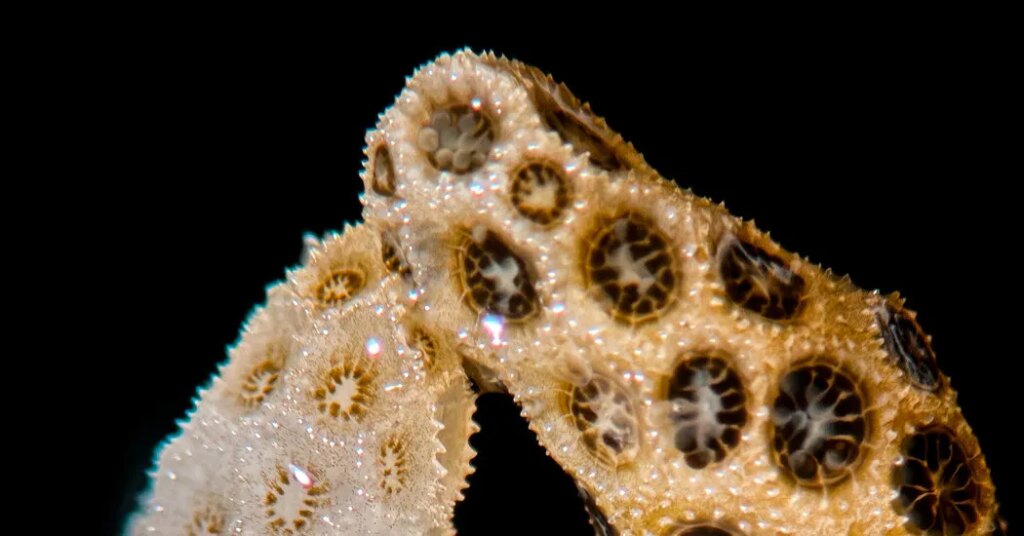
Danny Collins looked into his microscope and could scarcely believe his eyes: A piece of healthy coral was healing a sick one just by touching it.
These were tiny coral nubbins, not a whole colony. And they were in a lab in California, not on an actual reef. Still, the transformation was striking: The ghostly, heat-shocked coral was regaining its color in a matter of weeks, not the months it might take in the wild.
“Wow, not only is this happening,” Mr. Collins, a doctoral student in ocean science at Stanford University, remembers thinking. “It is happening at an incredible rate.”
His and his colleagues’ discoveries, in that experiment and the ones that followed, point to intriguing new possibilities for treating reefs that are devastated by marine heat waves, which are becoming more frequent because of climate change.
When the water around corals becomes too warm, they expel the colorful algae living inside their tissues. These algae use photosynthesis to nourish the corals; the corals provide shelter in return. But when heat stress severs this partnership, the corals starve and grow sickly. Their white limestone skeletons show through.
Bleached corals can recover if the water doesn’t stay hot for long. But repeated bleaching or prolonged exposure can be fatal. By some estimates, coral cover worldwide has shrunk by half since the 1950s, leading to diminished fish habitats, increased exposure of coastlines to storms and immeasurable losses of natural beauty. More catastrophic decline might be upon us soon: In the coming months, the El Niño pattern in the Pacific Ocean is expected to bathe many reefs in record-warm waters.
The healing touch that Mr. Collins and his colleagues observed was the result of algae from the healthy corals rushing back into the bleached ones. Their experiments involved just a handful of specimens, though the results were remarkably consistent: After direct contact with healthy coral of at least one week, all of their bleached samples were completely better within seven weeks.
In interviews, Mr. Collins and his colleagues were quick to caution that their findings, published on Wednesday in the journal Science Advances, didn’t offer a miracle cure.
The researchers tested only one species, Pocillopora damicornis, which is sometimes called cauliflower coral. They found that healing took place only when the two fragments were clones; they clashed if they didn’t share the same genes. This limits the practical potential of using physical contact to heal corals in the wild: All polyps in a coral colony are genetically identical, but to treat a bleached part of a colony, other portions would have to remain healthy.
In general, of course, touching bits of coral against one another for days at a time would be tough to pull off at scale in the ocean.
Still, the findings suggest that other, more practical ways of transplanting algae could someday deliver results, said Stephen Palumbi, a professor of marine sciences at Stanford who contributed to the study.
It was hardly a given that algae would flood into bleached coral and replicate at high speed, Dr. Palumbi said.
“That is the surprise here,” he said. “That’s what gives us this hope that this set of mechanisms that we’ve discovered is actually conceivably really useful.”
Their discovery came about almost by accident.
Mr. Collins had been thinking about past research showing that corals could contract diseases simply by becoming tangled in plastic trash. Clearly, they were sensitive to physical contact. Could this fact be harnessed to help reefs, not sicken them?
He took his idea to Dr. Palumbi, who remembered something surprising he’d noticed in a tank at his lab. A healthy piece of coral had fallen onto a bleached one, and right where the two were in contact, the sick piece was recovering. “Never seen anything like that,” Dr. Palumbi thought.
So Mr. Collins started experimenting. He placed vibrant and bleached coral at different distances from each other. He kept them in contact for different lengths of time. He tried longer pieces and shorter ones.
Andréa Grottoli, a professor of earth sciences at the Ohio State University who wasn’t involved in the new research, called the findings “super interesting” and said they opened the door to methods for helping reefs that are “more organic” and less technology intensive.
For coral’s future writ large, the big challenge is rebuilding populations that have already died, said Terry Hughes, an emeritus professor of marine biology at James Cook University in Australia. No amount of grafted algae can do that, he said.
During the most severe ocean heat waves, millions of corals can die before they’ve even had time to bleach.
“The best solution to help corals survive global warming, and to help their populations to recover, is to curb global emissions of greenhouse gases,” Dr. Hughes said.
The post To Heal These Bleached Corals, All It Took Was a Little Touch appeared first on New York Times.