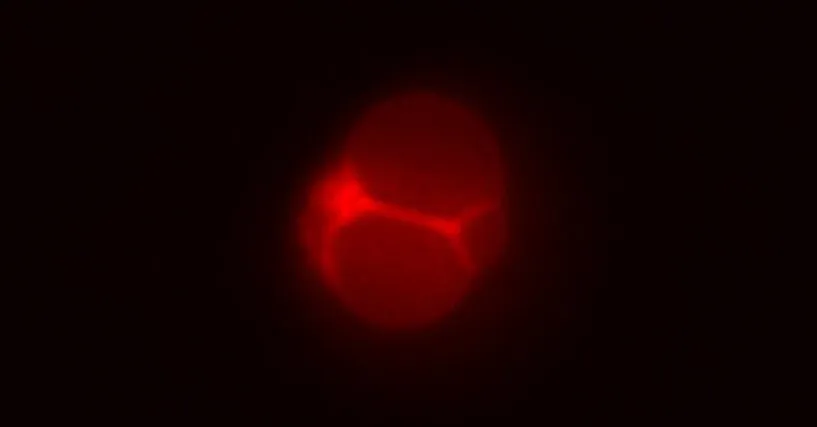
Kate Adamala paced the stage at the Science History Institute in Philadelphia, a glowing red blob looming on the auditorium screen above her. She wore a black suit with a sticker on a lapel. On it was a cartoon blob smiling as it planted a flag on the moon.
“One Small Spud for Cellkind,” the sticker read — a riff on SpudCell, the name that Dr. Adamala, a synthetic biologist at the University of Minnesota, had given to the red orb floating above her.
A SpudCell can grow, copy its DNA, divide in two, and start its cell cycle all over again. But this cell is made by people, created from lifeless ingredients. Unveiled in July, SpudCell was hailed by some experts as the closest that science has come to making life from scratch.
Now, Dr. Adamala had arrived in Philadelphia to meet with researchers and ethicists, along with representatives from the biotech sector and the government. The time had come to decide how to bring SpudCell closer to life, and to decide how to safely use it to make life better.
“With the creation of synthetic cells, we have a biological system that we can fully understand and fully control,” Dr. Adamala told the audience. “And that’s where the fun can really start.”
In July, Dr. Adamala and three other scientists founded a nonprofit called Biotic to support research on SpudCell. The idea was to make a self-sustaining cell that researchers could study and engineer to make medicines, foods, fuels and other items that could not be produced with ordinary biology.
The meeting last month was Biotic’s debut. The scientists called it Bloomsday, a hopeful counterpoint to Doomsday. A dozen of them described the nuts-and-bolts work they were starting in order to advance SpudCell.
SpudCell intrigued many scientists when it made its July debut, and not just because it was so close to being truly alive. Natural cells are complex and deeply mysterious. Even the smallest microbes have dozens of genes that scientists don’t yet understand.
Having built SpudCell from scratch, Dr. Adamala and her colleagues have a clear understanding of every part they used. They hope that thorough knowledge will make SpudCells easier to engineer than ordinary cells.
But some scientists have reacted to SpudCell with skepticism and are waiting to see if the technology can live up to its promise.
“I don’t find it a compelling study,” said Cees Dekker, a physicist at the Delft University of Technology.
Dr. Dekker said that he felt that, for now, there was less to SpudCell than meets the eye. Dr. Adamala and her colleagues endowed it with 36 genes, he noted, but in their experiments, only one of those genes was active.
Another indication of scientific skepticism came when a journal, Cell, rejected a paper detailing the invention of SpudCell. For now, the paper is available online as a preprint. At the Bloomsday meeting, Dr. Adamala said the paper was being considered by another journal.
At Bloomsday, Dr. Adamala and other SpudCell researchers readily acknowledged that they still had a lot of work to do to create a self-sustaining cell that any scientist could manufacture from prepared ingredients.
Biological cells make proteins in molecular factories called ribosomes, for example. But in order to use ribosomes, the cells have to make the ribosomes in the first place.
SpudCells, by contrast, cannot make their own ribosomes. Scientists have to feed them ribosomes harvested from other cells. As a SpudCell makes proteins from the ribosomes, the factories wear out.
Yoshiru Shimizu, a molecular biologist at RIKEN, a national research institute in Japan, is tackling this problem by running experiments on the dozens of molecules that make up the ribosome, hoping to find a way to prompt them to assemble into new factories.
Other researchers are testing proteins to see if they can make SpudCells divide more accurately. And still others are investigating how to make the SpudCell’s DNA light-sensitive, so that they can turn on its genes with flashes of different colors.
All the SpudCell projects underway across the world face the same challenge: too many choices. There are a practically infinite number of possible recipes for a ribosome or any other feature of SpudCell.
Roseanna Zia, a computational biologist at the University of Missouri, is narrowing down these options by building a virtual SpudCell. Dr. Zia and her colleagues have already created detailed computer models of natural microbes.
“We have the ability to peer deeply inside these types of cells and see exactly at every moment in time where all the molecules are with position at every point in time,” she said.
Now her team is simulating the millions of molecules inside a single SpudCell. They hope these virtual experiments will yield an upgraded SpudCell that any lab can produce for itself, using an open protocol from Biotic.
The scientists draw their inspiration from Unix, a pioneering computer programming language created in the 1970s. Because it was open and simple, Unix attracted a global community of computer scientists who used it to innovate.
Researchers hope that SpudCell will be a Unix for biotechnology — a simple cell that can be engineered in scores of useful ways.
While much of the meeting in Philadelphia was consumed with scientific planning, ethicists and biosecurity experts also discussed the moral questions raised by SpudCell.
“Is this the creation of life?” asked Laurie Zoloth, a bioethicist at the University of Chicago.
Dr. Adamala and her colleagues have often stressed that they have not, in fact, created life — but also that it can be very hard to draw a line between life and non-life.
Still, scientists realize that SpudCell may be misused, and that public trust in this form of biology could crater. Dr. Zoloth noted that OpenAI, like Biotic, was first formed as a nonprofit, dedicated to safe artificial intelligence for the good of humanity.
“What went wrong there?” Dr. Zoloth asked. “Why are people so distrustful of A.I. in general that they’re ready to picket data centers?”
Dr. Adamala and her colleagues are taking security seriously from the start. Before they make SpudCell widely available, they are engineering its DNA and proteins it so that it can only survive on an exotic diet of chemicals not found in nature.
The researchers hope these measures will ensure that SpudCell can’t escape from labs or be unleashed as a biological weapon.
“We can safeguard biology on the most fundamental level,” Dr. Adamala said.
The possibilities, and perhaps dangers, are immense for a microscopic bubble that for now can barely survive even with a lot of care and feeding.
“We’ll take all the good karma and good luck we can get,” said Drew Endy, a synthetic biologist at Stanford University and a founder of Biotic. “We’re going to need it.”
The post They Created a Cell That’s Almost Alive. What to Do With It Now? appeared first on New York Times.