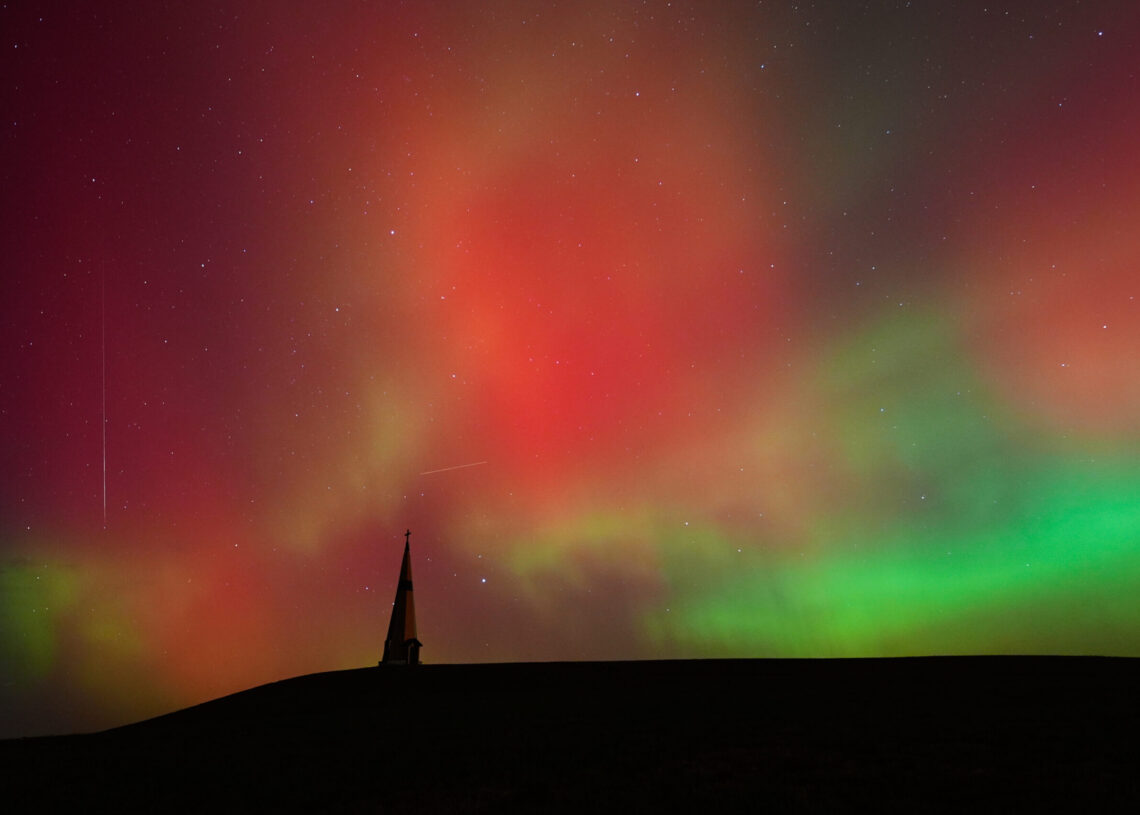
The heavens lit up with pulses of dancing aurora borealis well to the south of usual on Tuesday night as a severe geomagnetic storm struck Earth’s atmosphere. Even under bright city lights and not far from the border with Mexico the northern lights put on a memorable show.
Whether it was plainly visible to the naked eye, or mainly on the more sensitive lens of a camera, regions that rarely see red and green night skies did so.
The heavens lit up with pulses of dancing aurora borealis well to the south of usual on Tuesday night as a severe geomagnetic storm struck Earth’s atmosphere. Even under bright city lights and not far from the border with Mexico the northern lights put on a memorable show.
Whether it was plainly visible to the naked eye, or mainly on the more sensitive lens of a camera, regions that rarely see red and green night skies did so.
The lights reached unusually southern locales that included Florida, Alabama, Louisiana, South Carolina, Texas, New Mexico and California.
In northern latitudes more accustomed to one of nature’s finest exhibitions, skywatchers were equally wowed. In Montana, the aurora was actually most visible to skywatchers as they looked south — signaling the unusual intensity of the event.
There were also reports of an unusual amount of deep reds in Alaska. Dominant displays of red tend to occur with the most intense events when charged particles from the sun interact with the limited amounts of oxygen at the highest levels of the atmosphere.
NOAA’s Space Weather Prediction Center reported that aurora activity was eight times the normal background strength. Rated a G4 on a 1 to 5 scale, the storm closed in on being a 5 at times.
The D.C. area was treated to its second auroral encounter in a little over a year. Smartphones picked up subtle hues of pink and green even inside the District; photographers captured the lights in Logan Circle and the Washington National Cathedral.
The display turned more vibrant in D.C.’s outer suburbs, away from city lights. Skywatchers in northern Maryland, Central Virginia and near the Chesapeake Bay witnessed shimmering curtains of pink, purple and green.
The D.C. region wasn’t alone when it comes to city lights of the peculiar side.
Spectacular aurora filled skies in other population centers throughout North America including Atlanta, Boston, Calgary, Charlotte, Chicago, Daytona Beach, Florida, Phoenix, Raleigh, North Carolina, Reno, Nevada, and Seattle. Even Ciudad Juárez — just south of the border with Texas — had hints of red show up on the horizon.
“Best Colorado northern lights show in the 15+ years I’ve lived here,” meteorologist Chris Bianchi wrote on Bluesky. Many other voices concurred.
The geomagnetic storm occurred as the first of several coronal mass ejections (CMEs) — clouds of charged particles unleashed by the sun — arrived Tuesday evening, faster than expected and with greater strength.
It was launched from an active sunspot group that is pointed at Earth.
Forecasts initially called for a strong geomagnetic storm but it reached severe levels as it bombarded Earth, allowing the northern lights — normally confined to high latitudes — to expand unusually far south.
When CMEs strike Earth, they interact with its magnetic field. The planet’s magnetosphere transforms these blasts of potentially harmful energy into visible light — the aurora.
When there’s a lot of this energy and the associated geomagnetic storm reaches severe levels, it overwhelms the magnetic field near the polar regions and aurora spill down to the mid- and even southern latitudes.
The event was reminiscent of two other high-end geomagnetic storms in about the last 18 months, during peak of the current solar cycle. On May 9, 2024, one of the most extensive auroral displays in modern records occurred; the northern lights were seen as far south as Jamaica and Central America.
And on Oct. 10, 2024, another severe geomagnetic storm brought aurora into the D.C. area and even more southern latitudes.
The sun has emitted five X-class solar flares in the past several days, the most intense kind.
Most are emanating from sunspot 4274, a bruise-like splotch on the sun that’s throbbing and pulsating with magnetic energy. The strongest flared was an X5 launched Tuesday morning and it has an associated CME, stronger and faster than its predecessors, that has yet to hit Earth.
Data suggests this CME will arrive Wednesday, though timing is uncertain.
NOAA and NASA models suggest an impact around lunchtime Eastern time.
It’s unclear if the severe portion of the associated geomagnetic storm will last into the evening, but strong levels are forecast to continue into the night, which could bring more northern lights in night skies.
It will come on the heels of the two or three other CMEs that have already disturbed Earth’s magnetic field. Although it is likely the strongest of the group, whether it can outperform Tuesday night is a question to resolve.
Nonetheless, skywatchers across the United States, Canada, most of Europe and parts of the Southern Hemisphere should keep their eyes on the sky Wednesday night.
The post Northern lights danced above the U.S. Will there be more aurora tonight?
appeared first on Washington Post.