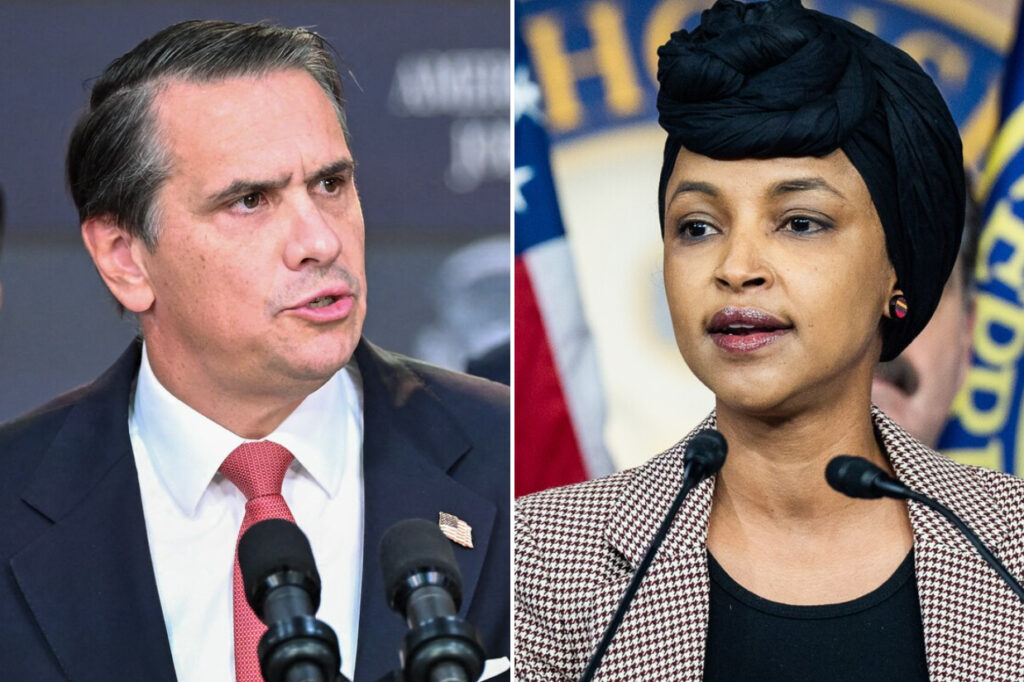
When federal immigration officials executed a search at Rep. Ilhan Omar’s Washington home on Monday morning, it brought renewed attention to a vague but long-standing Justice Department principle: the 60-day rule.
Under the rule — which is not law, and which officials have interpreted in various ways — federal prosecutors historically have refrained from taking public steps in politically fraught cases, such as executing a search warrant or seeking an indictment, in the run-up to an election. The aim of the unwritten rule, also known as the “blackout period,” is to ensure that law enforcement actions do not influence elections and are not perceived as attempting to sway elections.
But the search in D.C. — just 22 days before the U.S. congressional elections in Minnesota, where Omar (D) will be on the ballot — was the latest in a long line of actions demonstrating how the Justice Department during President Donald Trump’s second term has upended long-standing norms intended to ensure that investigations are not politicized or seen as such, according to legal experts.
Administration officials defended the timing of the search and noted that a judge signed off on the warrant used to justify it. Democrats criticized the move, and legal experts questioned the decision to act only weeks before voters cast ballots.
“If they don’t have some particular reason why they would need to execute this warrant at this particular moment, this strikes me as not a wise decision,” said Jonathan Kravis, a former prosecutor in the Justice Department’s Public Integrity Section during the Obama and first Trump administrations who now works at the law firm Liu Shur Kravis. “At the very least, this could be perceived as them trying to hurt her chances in the election. At worst, maybe that is what they are trying to do, and that would be very, very bad.”
Federal law enforcement officials are investigating whether Omar or her father may have lied on government forms decades ago to secure legal status and eventually U.S. citizenship, The Washington Post has reported.
Born in Somalia, Omar fled the country’s civil war with her family when she was a young girl and immigrated to the United States in 1995. She became a naturalized U.S. citizen in 2000.
On Monday, Omar wrote on X that Trump had targeted her with “baseless lies.” She called the search “the latest escalation in his campaign of political intimidation.”
Homeland Security Investigations, the investigative arm of the Department of Homeland Security, executed the early-morning search of Omar’s Northeast Washington home. The Justice Department confirmed that it secured a court-authorized warrant for a law enforcement action that morning.
Allegations regarding Omar’s immigration history have circulated in conservative circles for years, though federal officials who have promoted the claims have not provided substantiating evidence. Critics of the Trump administration have said that the public could question the legitimacy of the investigation, in part because the president has publicly excoriated Omar over a period of years and because the probe appears to be gaining momentum so close to her election. Trump on Monday called Omar a “terrible person.”
Omar won the Democratic primary for Minnesota’s 5th Congressional District in August and is seeking her fifth term representing Minneapolis. The general election is in November, and Omar is expected to win reelection in the heavily Democratic district.
In response to questions about the 60-day rule, a Justice Department official said that the law enforcement agency is not bound by it, and that written prosecutorial guidelines say that the agency is only barred from choosing the time of a law enforcement action to sway an election.
Officials contend that they are not trying to influence Omar’s election.
“The ‘60-day rule’ is an informal practice, not written policy,” a Justice Department official said in a statement. “The standard is purpose, not proximity to Election Day. Department policy does not require the Department to stop ongoing work during an election season.”
The rule is part of a sweep of post-Watergate practices adopted at the Justice Department to ensure that politics does not intertwine with criminal investigations and to maintain some distance between the White House and the law enforcement agency.
The Trump administration has eroded many of these norms, with the president openly talking about whom he wants to be prosecuted, and Attorney General Todd Blanche saying that the president has a duty to identify who should be investigated. In recent weeks, Blanche also has spoken at Republican campaign rallies, highly unusual appearances for the nation’s most powerful law enforcement official.
A government official who spoke on the condition of anonymity to discuss an ongoing investigation defended the execution of the search warrant, saying that law enforcement officials adhered to guidelines on politically sensitive investigations by first consulting the Public Integrity Section, as required in instances in which the timing of an investigation could be called into question. Blanche also signed off on carrying out the warrant, the official said.
Former Justice Department officials, however, questioned whether those consultations and approvals provided the same kind of safeguards as they have in the past. Under the Trump administration, the Public Integrity Section has been gutted, with scores of experienced prosecutors being pushed out or fired.
Only a small number of attorneys remains in the division, and they have largely been cut out of sensitive political investigations, according to multiple people familiar with the office.
Legal experts said there are generally accepted exceptions to the 60-day rule, including when prosecutors fear that evidence could be damaged or moved, or in instances of public safety concerns.
The legal experts interviewed said that based on what has so far been revealed publicly, those exceptions do not appear to apply in the search of Omar’s home.
The 60-day rule is “part of one of the post-Watergate efforts to improve not only the reality, but also the perception of the Justice Department by keeping it isolated and insulated from the political process on the eve of an election,” said Philip Allen Lacovara, the deputy solicitor general during the Nixon administration who later served on the Watergate special prosecutor team. “Traditionally, at least in the last 50 years, there has been a high degree of sensitivity in trying to avoid these types of actions.”
Trump previously stressed the importance of the 60-day rule. As a criminal defendant in 2024, Trump complained that the Justice Department under Attorney General Merrick Garland violated the rule as it prosecuted him for allegedly trying to obstruct the results of the 2020 election.
In that instance, less than 60 days before the presidential election, a federal judge unsealed a massive filing from special counsel Jack Smith that contained damaging evidence against Trump. Smith made the filing to comply with a judge’s deadline.
At the time, Justice Department officials argued that once a case is in front of a judge, they must follow the court’s schedule — even if that schedule collides with a presidential election.
Still, Trump contended that was in violation of the policy.
“FOR 60 DAYS PRIOR TO AN ELECTION, THE DEPARTMENT OF INJUSTICE IS SUPPOSED TO DO ABSOLUTELY NOTHING THAT WOULD TAINT OR INTERFERE WITH SAID ELECTION,” Trump wrote on Truth Social in 2024. “THEY DISOBEYED THEIR OWN RULE IN FAVOR OF COMPLETE AND TOTAL ELECTION INTERFERENCE. I DID NOTHING WRONG, THEY DID!”
The 60-day rule also came under intense scrutiny in the days before the 2016 presidential election between Trump and Democratic nominee Hillary Clinton.
On Oct. 28, 2016, 11 days before voters were set to head to the polls, FBI Director James B. Comey publicly announced he was reopening an investigation into Clinton’s use of a private email server.
The move was later denounced by the department’s inspector general, and the FBI ultimately did not change its recommendation that Clinton shouldn’t be prosecuted.
At the time, Trump campaigned on that disclosure, accusing Clinton of being too irresponsible and careless to serve as president.
The post How the pre-election search of Rep. Ilhan Omar’s home breaks Justice Dept. norms appeared first on Washington Post.