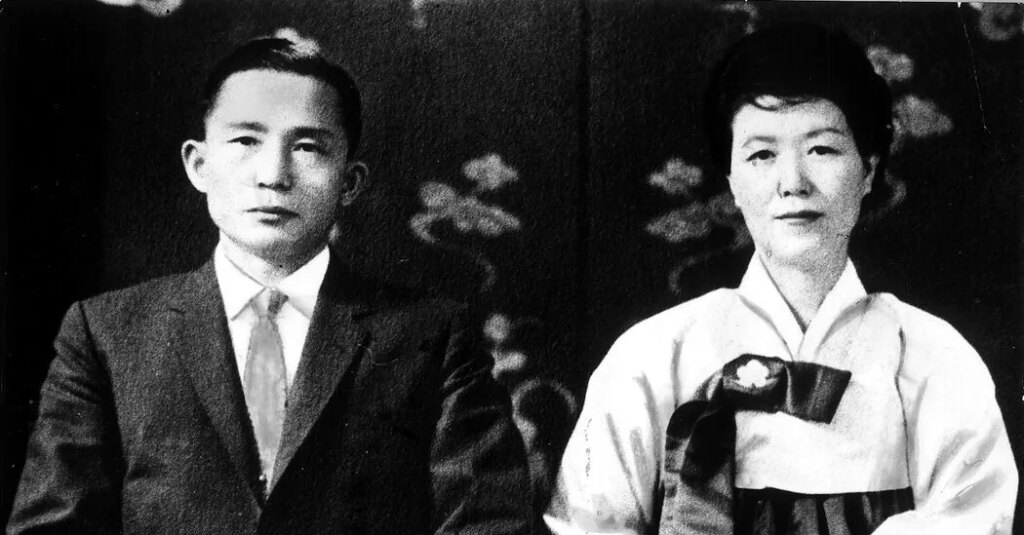
On Aug. 15, 1974, the South Korean leader Park Chung-hee was delivering an address at Seoul’s National Theater when an assassin charged down an aisle, brandishing a .38-caliber Smith & Wesson.
Shots cracked. Mr. Park ducked behind a bulletproof podium as bodyguards and citizens subdued the gunman. But the first lady, Yook Young-soo, whose gentle public persona had contrasted with her husband’s iron-fisted rule, was hit in the head. After Mr. Park’s dying wife was rushed away, he resumed his speech commemorating the end of Japanese rule to a crowd erupting in cheers.
The killing has remained a disputed episode, spawning conspiracy theories that the dictator may have secretly orchestrated the attack and the gunman had not acted alone, in echoes of the assassination of President John F. Kennedy.
Now, a movie has reignited those controversies by placing the killing squarely within cross hairs of this nation’s fierce contemporary culture war. “The Assassin(s)” has exposed the competing interpretations of a turbulent modern history marked by colonial rule, military dictatorship and a bloody struggle for democracy.
Mr. Park, a schoolteacher-turned-general, seized power in a 1961 military coup and ruled until his spy chief gunned him down in 1979. Almost a half-century after his death, he remains a disputed figure in South Korea. Conservatives revere him as the architect of the country’s transformation from postwar poverty into an industrial powerhouse. Progressives emphasize his darker legacy: the kidnapping, torture and execution of dissidents; his rewriting of the constitution to make himself president for life; and his ruthless censorship.
Mixing real events with cinematic fiction, “The Assassin(s)” follows a journalist and a police officer struggling to uncover the truth behind the 1974 shooting. They navigate a perilous era where, as the journalist notes, “seeing what you can and writing what you should” carries immense danger. Standing in their way is the feared K.C.I.A., the Korean Central Intelligence Agency. Mirroring real history, the film depicts an agency that dictates headlines, sends thugs armed with two-by-fours into newsrooms and brutally crushes anyone, from defiant reporters to honest cops, who dares to intervene.
Released on Sept. 23, the movie has topped the box office and sold three million tickets as of Sunday.
The film’s creators have denied any political motive, but conservative opposition lawmakers have accused them of distorting history to portray Mr. Park as a coldblooded dictator who orchestrated his wife’s murder for political gain. The backlash has included boycott campaigns against brands endorsed by the cast, including Burger King.
Right-wing activists picketed the home of lead actor Yoo Hae-jin, demanding a halt to “left-wing propaganda.” Fearing for their safety, the cast withdrew from this month’s prestigious Busan International Film Festival in Korea, and Mr. Yoo received police protection.
Progressives, who include members of the governing party, have defended the film, condemning the conservative backlash as censorship. They have organized group screenings and traded insults with protesters outside theaters. The Directors Guild of Korea has warned of a threat to the creative freedom driving South Korean cinema’s global success.
“Because it depicts such a momentous episode in our history,” said moviegoer Lee Min-ho, “I wondered which parts were factual, which were dramatized and why so many questions remain unanswered after all these years.”
A Japan Connection
A government investigation after the attack concluded that the assassin, a Japan-born Korean named Mun Se-gwang, had acted on behalf of a pro-North Korean residents’ association in Japan. It said that one of his bullets struck Mr. Park’s podium while another fatally wounded Ms. Yook.
The assassination attempt came as Mr. Park was under mounting pressure from both anti-government protests against martial law and diplomatic tensions with Japan, which was angered after the K.C.I.A. abducted opposition leader Kim Dae-jung from a Tokyo hotel.
Ms. Yook’s death stirred public sympathy for Mr. Park, allowing him to link the attack, however tenuously, to Japan.
Mourners wailed as they watched her chrysanthemum-covered hearse move through central Seoul. Men severed their fingers to write anti-Japanese slogans in blood. Crowds stormed the Japanese Embassy, tearing down its flag and setting a car ablaze. Mr. Mun was hanged on Dec. 20, 1974, three days after being convicted of “murder with intent to commit insurrection” and six days shy of his 23rd birthday.
Yet questions persisted, fueled by the case’s extraordinary circumstances.
Mr. Mun told investigators that he had stolen the pistol from a Japanese police station. He obtained a South Korean visa using a fake Japanese passport, smuggled the weapon through the airports of both countries inside a radio set and entered a presidential event without the required government-issued identification tag.
Missing Bullets?
Investigators said seven shots were heard that day, but not all have been fully accounted for. Officials said Mr. Mun fired four rounds and that a presidential bodyguard also shot, killing a high school student in the audience. At trial, Mr. Mun denied firing at Ms. Yook. The bullet that killed her has never been made public, and no ballistic test of it is known to exist. Under Mr. Park’s grip on the flow of information, the official account stood despite those gaps.
In 1989, a retired police forensics officer, Lee Geun-woo, testified that Mr. Park’s presidential security service had removed bullets from the scene before his team reached the theater. He doubted that any of Mr. Mun’s rounds had killed Ms. Yook.
Hur Jin-ho, the movie’s director, said that television programs in the early 2000s, which explored unanswered questions about the shooting, led him to believe there may have been more than one assassin. “That’s why I put the ‘s’ in parentheses in the film’s title,” he said.
His film does not identify Ms. Yook’s killer, but through its characters it challenges the official narrative: Did Mr. Mun have an accomplice? Was a second gunman targeting Ms. Yook while Mr. Mun served as a pawn? Could Mr. Park have been involved in a plot that led to her death?
The controversy surrounding the film reflects a broader political struggle over how South Koreans remembered their history.
Left-leaning governments have passed laws criminalizing “false” narratives about two events of particular significance to progressives: the 1980 military massacre of pro-democracy demonstrators in the city of Gwangju and the suffering of Korean “comfort women,” who were forced into sexual slavery by Japan’s military during World War II.
In recent years, some on the political right have portrayed the comfort women as prostitutes and the Gwangju uprising as a “riot” instigated by North Korea. The right-wing attacks on “The Assassin(s)” are part of a broader backlash against what conservatives see as progressive attempts to dictate how history is told.
“It is a horrific hypocrisy to sanctify and protect, through the threat of imprisonment, only the history they have chosen,” said Na Kyung-won, a conservative lawmaker.
Park Geun-hye, Mr. Park’s daughter who was elected president decades later and impeached over a corruption scandal, has remained silent on the film. Through an aide, however, she released a handwritten letter from her late father.
“Your mother took the fatal bullet meant for me,” Mr. Park wrote. “I often wonder how much better it would have been had I been the one hit while your mother survived.”
The post A Movie About a Political Killing Fuels South Korea’s Culture Wars appeared first on New York Times.