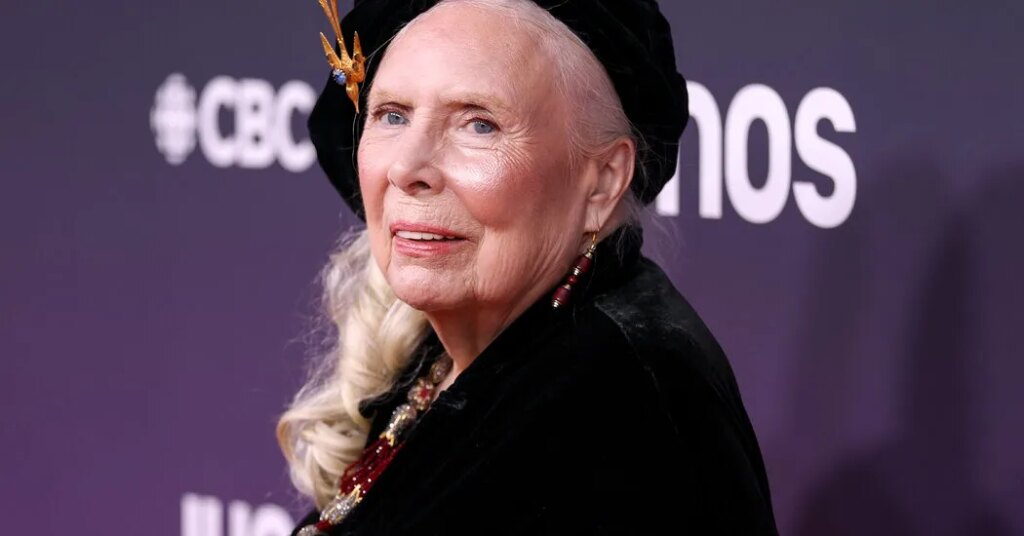
“Joni Mitchell, Canada.” Loud applause surrounded this call-out at a U.S. citizenship ceremony on Tuesday morning, as Ms. Mitchell was summoned to the front of a room to take her oath.
Wearing a red beret and a navy blue floral shirt, she had been sitting in the front row waiting her turn. Ms. Mitchell, the folk singer known for defining the genre and for anthems like “Big Yellow Taxi” and “Woodstock,” later shared a video of the moment on social media, alongside a photo of herself with a U.S. flag in hand and a larger one behind her.
She captioned her post: “A journey that began 62 years ago.”
Ms. Mitchell, now 82, was a young Canadian folk singer with no record deal and only a handful of songs to her name when she arrived in Detroit in the mid-1960s, alongside her husband, Chuck Mitchell, also a musician. They had wed in June 1965 and were looking to make it as artists in America.
Two years later, when their marriage dissolved, Ms. Mitchell traded her sprawling five-bedroom apartment in Detroit (she called it her “tenement castle” in the song “I Had a King”) for a one-bedroom in the Chelsea neighborhood of Manhattan. It was there that she wrote “Chelsea Morning.”
“I Had a King” appeared on her debut album, “Song to a Seagull” (1968). Her second album, “Clouds,” featuring her Chelsea ballad, arrived in April 1969. It became a U.S. Top 40 hit, won her a Grammy Award for Best Folk Performance and led to her gracing the cover of Rolling Stone magazine that May.
Joni Mitchell’s career was born.
Around that time, she moved to Los Angeles, first to Laurel Canyon in 1968, then to Bel Air in 1975. She would travel between California and British Columbia, Canada, where she had at one time bought a seaside property. She resides in Santa Barbara.
Ms. Mitchell has made no public mention of why she had chosen this moment to embrace U.S. citizenship, and a request for comment to her representative went unanswered.
She had, however, touched upon the issue in 2024 at a performance in Los Angeles roughly two weeks before the presidential election. “I wish I could vote,” she said onstage.
“I’m a Canadian — I’m one of those lousy immigrants,” she added, tongue-in-cheek, most likely in reference to the Trump campaign’s hard anti-immigration stance.
(If Ms. Mitchell hopes to vote this midterm election season, she still can. Registration for Santa Barbara closes on Oct. 19.)
The subject of her citizenship became part of a larger cultural conversation in April this year when The New York Times created a list of “the 30 greatest living American songwriters.” Ms. Mitchell was not included.
“We elected not to steal that honor from Canada,” The Times wrote in an article about its selection process.
(Just a month before, the Juno Awards, Canada’s equivalent to the Grammys, had honored Ms. Mitchell in Ontario with a lifetime achievement award.)
The Times’s reasoning did not sit well with fans and cultural commentators who felt that she — one of the most important songwriters to emerge from the 1960s folk scene in New York City, alongside Bob Dylan, who did make the list — should nevertheless have been included.
The post Joni Mitchell Is Now an American, After 60 Years of Living in the U.S. appeared first on New York Times.