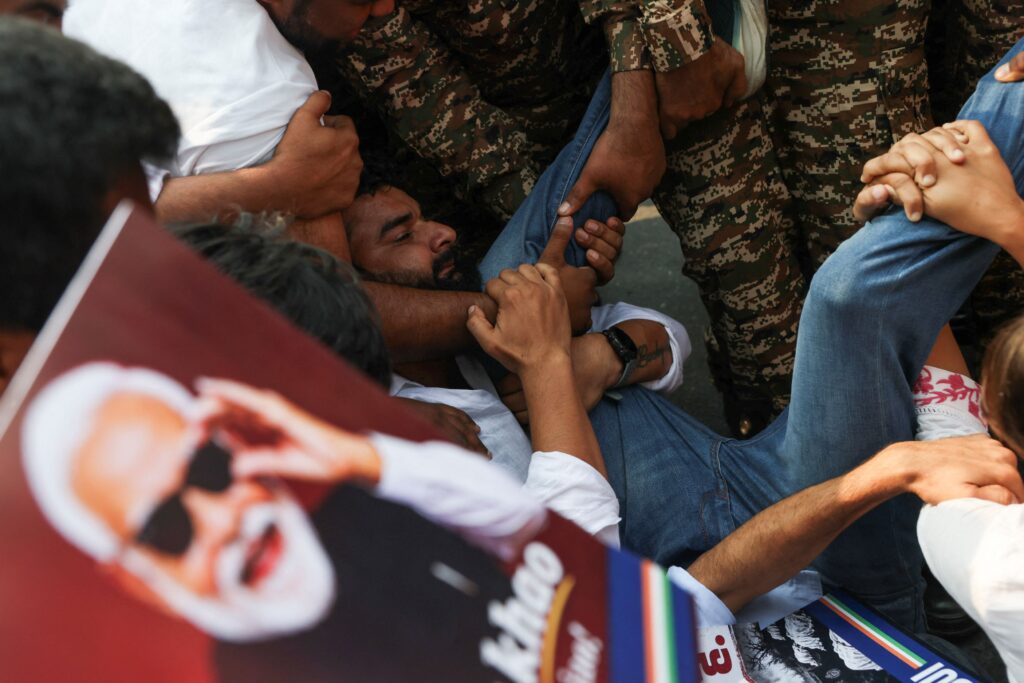
NEW DELHI — Prime Minister Narendra Modi talks a good game about India being the “mother of democracy” and a “steady lighthouse” in the world. Yet when protests bubble up, he likes to dispatch the police to put them down. So it was in recent days as the government turned the capital city into a fortress and detained thousands of demonstrators.
The latest bout of unrest began in earnest on Oct. 10 after the Cockroach Janta Party, the All India Students’ Association and other left-wing organizations called for the resignation of Chief Election Commissioner Gyanesh Kumar. Their concern has been the commission’s ostensible cleanup of voter rolls than began in 2025. The ruling Bharatiya Janata Party has described that effort as necessary to preserve the electoral system’s integrity; the opposition worries it is unduly targeting otherwise eligible voters. More than 130 million names have reportedly been removed so far.
Modi evidently couldn’t tolerate the criticism. Paramilitary forces, Delhi Police personnel and riot-control units placed the city under lockdown. They cut internet connectivity, erected tall yellow barricades and disrupted essential transportation services, among other things.
The restrictions extended beyond Jantar Mantar, the original protest site, too. Police forced inbound students off their trains and instructed hotels not to admit some guests. At least one cop reportedly made an announcement at a mosque, asking residents to prevent their children from participating in any gathering. When members of the Cockroach Janta Party landed at the New Delhi airport, police detained them for 24 hours. They were released on the condition that they commit “no breach of peace for one year.”
Young lawyers, professors and economists such as Jean Drèze were detained simply for standing with placards. At the protest site, I met Sakshi, a young engineering student who had been detained for eight hours on Oct. 10 for holding such a sign. She was frightened not only by what the police might do to her but also by what might happen if her parents found out. Her family, she told me, was firmly right-wing. Her life could take a dramatic turn if they discovered she had become an “anti-national.”
A young woman, Amrita, told me she had managed to move through the protests without being apprehended because she had cracked the code: Wear a saffron tilak on your forehead, and no police officer will touch you. She had a point. A number of saffron-clad men and women openly displaying their allegiance to the Hindu right — and aggressing against the protesters — were left unscathed.
By contrast, a young university student who sang a line from the famous revolutionary song “Hum Dekhenge” was grabbed by the neck and pulled into a police van. Another man, Mohammed, a Muslim PhD student, told me that state intelligence officers had visited his home to warn him against attending the protest after learning he planned to participate. According to media reports, close to 7,000 protesters were detained and 25,000 police and paramilitary personnel were deployed.
Some alleged excessive brutality, such as being kicked and punched. Two of the female protesters I spoke to said their hijabs had been snatched off. I wasn’t spared, either. Despite being a journalist with a public profile, I was shoved and struck by police with a baton, which injured my back. When I confronted Delhi Police officers for standing by as Hindu nationalists called me a prostitute and hurled obscene remarks at me, they dragged me into a van for a brief stay on the theory that I was “making trouble.”
As Delhi’s streets became a theater of confrontation between the state and its citizens, the prime minister posted on Instagram an old photo of him visiting a temple (“Happy Navratri everyone!”). His apparent indifference stood in stark contrast with the protesters’ cries for help. Modi has yet to comment publicly on the episode. When the United Nations expressed concern, the government said that was “unwarranted” and constituted “unacceptable interference.”
The prime minister may have initially seen the crackdown as a victory. By Monday, however, the security cordon had eased, and opposition leaders and thousands of party workers were marching toward the Supreme Court. The rally followed a high court order directing authorities to ensure unrestricted movement and to refrain from detaining peaceful protesters.
Three things have become clear. The prime minister is worried about his carefully cultivated mask of invincibility slipping, and the country that accounts for one-sixth of humanity is in no mood to give him a free pass. The youth movement has brought anti-government mobilization back onto the streets — a serious blow to the image of a prime minister who has spent more than a decade projecting himself as unassailable. The controversy over voter rolls has raised the stakes as several elections approach next year.
Worst for Modi: Turning the capital into a fortress has revealed not the strength of his government but the fears beneath its show of power. Nothing says “world’s largest democracy” quite like canceling trains, surveilling citizens and detaining thousands of protesters — all to stop people from exercising their democratic right to protest.
The post Indians took to the streets. Then came the government crackdown. appeared first on Washington Post.