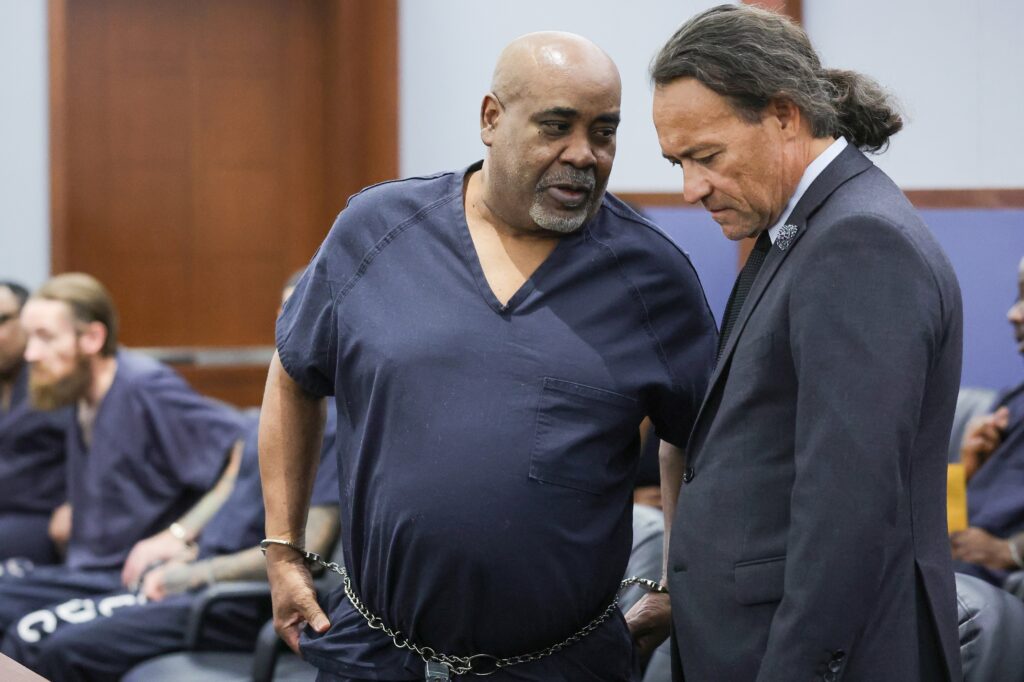
A former gang leader was sentenced Tuesday in Las Vegas to 40 years to life in prison for the 1996 murder of rapper Tupac Shakur, a case that gripped the public and went unsolved for decades.
Duane “Keffe D” Davis was convicted in August of orchestrating Shakur’s fatal shooting near the Las Vegas Strip. Police said they renewed their investigation several years ago after Davis opened up about the killing in media interviews and a memoir.
Prosecutors said Davis sought revenge amid a feud between Davis’s gang, the South Side Compton Crips, and another gang closely linked to Shakur’s record label, Death Row Records. Davis didn’t pull the trigger, authorities said, but he procured the gun and handed it to associates who opened fire.
Davis’s conviction in August brought closure to a 30-year mystery memorialized in pop culture. Shakur was a chart-topping star when he died at 25, known for hits like “California Love” and “Dear Mama.”
On Tuesday, Judge Carli Kierny of Nevada’s Eighth Judicial District Court sentenced Davis to 20 years in prison for first-degree murder with an extra penalty of 20 years for using a deadly weapon during the crime; both to be served consecutively.
“You don’t get to take a man from his family,” Kierny said before delivering Davis his sentence. “You don’t get to take his very life, his whole future from him and just walk away from it. Especially when that man is Tupac Shakur. The world never forgot about him and his death, and neither did Las Vegas.”
Authorities said the case might have stayed cold if Davis had not started talkingin recent years, recounting how he and a few others went to confront Shakur on Sept. 7, 1996. Shakur and his associates had beaten up Davis’s nephew earlier in the evening, and Davis was furious.
“In this world, silence means survival,” Clark County Deputy District Attorney Binu Palal said during the trial. “The one person who has a hard time being silent is Duane Davis.”
As prosecutors used Davis’s words against him in court, the defense argued Davis was not reliable. His book was embellished for profit, a defense lawyer said. His account sometimes deviated from that of other witnesses.
But a Nevada jury found Davis responsible for Shakur’s killing after two weeks of testimony. Prosecutors played video of Davis promoting his book as “the real truth” and called dozens of witnesses, some of whom were still reluctant to talk as they recalled a bloody gang rivalry.
The prosecution also drew on a pivotal interview that Davis gave to law enforcement in 2008. A federal task force was investigating the murder of another rapper — Christopher Wallace, also known as the Notorious B.I.G. — and questioned Davis, who went on to describe his role in Shakur’s shooting.
Davis said in the interview that he helped chase Shakur down and passed a gun to people in the back of his car because they had a better position to shoot.
“I sang because they promised I would not be prosecuted,” Davis wrote in his memoir.
For years, law enforcement took no action against Davis. But then Davis recounted Shakur’s death for a 2018 BET documentary series, “Death Row Chronicles,” and wrote a 2019 memoir, “Compton Street Legend.”
“We knew at this time that this was likely our last time to take a run at this case,” Jason Johansson, then a lieutenant with the Las Vegas police, said at a news conference where officials eventually announced charges against Davis.
Prosecutors argued the 2008 federal task force interview was fair to use at trial because Davis discussed the interview and Shakur’s death publicly.
Davis said immediately after his conviction that he planned to appeal.
He has said that his nephew, Orlando “Baby Lane” Anderson, ultimately fired at Shakur from the back seat of their Cadillac. Anderson and others who were in the car have died, so Davis was the only one who could stand trial.
Davis suggested in his memoir that Shakur drew his gun first. The rapper “pulled out a strap” and “one of my guys from the back seat grabbed the Glock and started bustin’ back,” Davis wrote.
But prosecutors said Davis could not claim self-defense because he was the original aggressor who set out for revenge.
N.Kirkpatrick contributed to this report.
The post Man sentenced to 40 years to life in prison for Tupac Shakur’s murder appeared first on Washington Post.