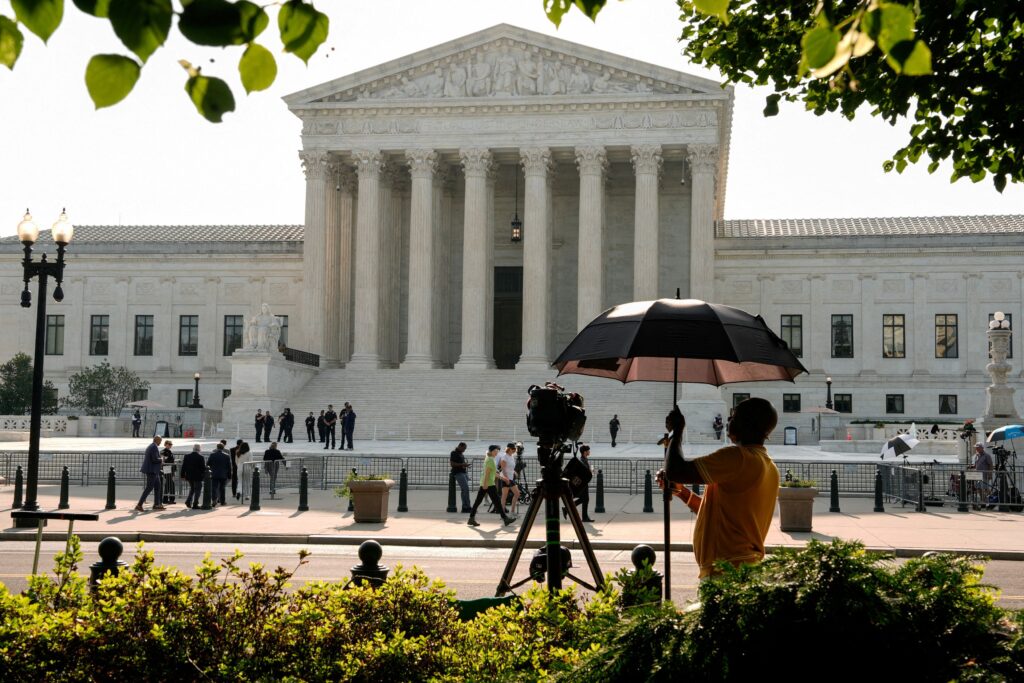
The Supreme Court gaveled in its new term earlier this month, bringing with it no shortage of controversial, high-profile cases. Five Post Opinions writers share the cases they’re watching.
A question of deportation
Can the United States government deport someone, without meaningful due process, to a country where they have never been, don’t speak the language and might be tortured? The justices will hear oral arguments about third-country removals on Dec. 9 in Department of Homeland Security v. D.V.D. Over objections from the three liberal justices, the Supreme Court has twice allowed this practice to continue as the underlying case wound its way through lower courts.
More than 25,000 illegal immigrants have been shipped to countries they have no connection to since President Donald Trump returned to office. Countries accepting deportation flights include the Central African Republic, Liberia and Equatorial Guinea. These aren’t exactly bastions of human rights.
The Trump administration says it needs somewhere to send migrants with final removal orders from U.S. immigration judges if their home country won’t take them. The government has also been using this cruel practice as a deterrent: flying people to Africa after they illegally crossed the U.S.-Mexico border, for example. Hard-liners hope the threat of third-country removals might convince undocumented people to self-deport.
Last month, a three-judge panel on the U.S. Court of Appeals for the 1st Circuit agreed with a district judge’s ruling in Boston that the Trump administration’s policy doesn’t give migrants sufficient notice or opportunity to contest where they’re being sent. Just because someone faces a valid deportation order shouldn’t mean they lose their ability to challenge subsequent decisions about their fate that could lead to persecution.
— James Hohmann, deputy opinion editor
Who can decide climate policy?
Viewed from the standpoint of the Constitution’s purpose and structure, Suncor Energy v. County Commissioners of Boulder County is an easy case. A principal motive for replacing the Articles of Confederation with the Constitution was to constrain states’ economic aggression toward each other. Giving individual localities the power to set national and even global policy on climate change, as Boulder wants, cannot possibly be consistent with that understanding.
But reaching that decision based on individual provisions of the Constitution — and, even more, on existing Supreme Court doctrine about those clauses — is a trickier matter. A narrowly clause-based version of originalism and a persistent romanticism about the alleged virtues of regulation by state and local governments both get in the way of the founders’ goals. So does an excessive fear of the judge-made law that would be required to distinguish between states’ legitimate regulations and impermissible attempts to police activities outside their jurisdiction.
The real questions before the justices, then, are whether they can revive a robust conception of federalism as a protection of state and local governments from one another, not just from the federal government — and whether, failing that, they can find a plausible way to duck the issue.
— Ramesh Ponnuru, contributing columnist
A voting rights fight
Does the state or the federal government get the final say on voting rights? Republican National Committee v. Mi Familia Vota, which will be argued in December, is asking the Supreme Court to decide if either the National Voter Registration Act — signed by President Bill Clinton in 1993 — or a federal consent decree supersedes 2022 laws passed in Arizona.
If Arizona’s laws are upheld, they would require residents to show “satisfactory evidence” when registering to vote on a state form and would allow the state to audit and then remove a voter’s registration if they are not a U.S. citizen. Mi Familia Vota, a nonprofit specializing in Latino voter enrollment, is fighting to prove federal voting laws preempt state law. The RNC, acting as the petitioner, wants Arizona state law to triumph.
Voter ID laws have been a major focus of Trump’s domestic policy. The theme has dominated the first half of his second term, as he has pushed the Save America Act, which would mandate proof of citizenship for voter registration nationwide. Notably, while the president calls for federal power to be expanded over voting rights, the RNC is fighting for a state law to supersede federal law.
Either way, what the Supreme Court decides could have major implications for voter enrollment and turnout in 2028.
— Kate Andrews, editorial writer
Can an agency judge its own disputes?
Joe and Russell Marino deserve their day in court. The brothers owned a New Jersey orchard that was ordered to pay more than $550,000 after the Labor Department claimed it broke a labor contract. The Labor Department won in a decision rendered by an administrative law judge who works for … the Labor Department. Whether the Marinos are entitled to an independent judge is the issue in Department of Labor v. Sun Valley Orchards.
For decades, federal agencies have been allowed to play prosecutor, judge and jury in regulatory disputes by appointing agency judges to decide cases. You can imagine how that goes. One such judge at the Securities and Exchange Commission came under scrutiny in 2015 for never once ruling against the agency.
The Supreme Court has reined in the practice, most recently in SEC v. Jarkesy. When defendants’ private rights hang in the balance, they deserve a neutral judge. But the justices have let agencies decide cases in-house when they deal with public rights — such as privileges given by government.
What’s the difference? Chief Justice John G. Roberts Jr., writing for the majority in Jarkesy, said that the court hadn’t fully explained the distinction, “and we do not claim to do so today.” Shucks. The justices should provide more clarity on when an agency can judge its own disputes. Or, better yet, the court could strengthen the right to a judge who doesn’t work for the prosecutor.
— Thomas McKenna, researcher
A religious freedom challenge
Should a religious school receiving public money be able to turn away a child with gay parents? My answer is an emphatic no. Unfortunately, conservative justices on the Supreme Court are likely to disagree, further eroding the rights of LGBTQ Americans in the name of religious freedom.
Next month, the court will hear oral arguments in St. Mary Catholic Parish v. Roy, which centers on a Colorado program that provides tuition dollars to faith-based schools so long as they agree not to discriminate against families based on sexual orientation or gender identity. Multiple Catholic schools sued, claiming the requirement infringed on their religious freedom.
Set aside the morality of the plaintiffs’ position (refusing to teach a child because of their family’s background is not very Christian). Focus instead on the legal issue: No one disputes that a religious school can make enrollment decisions based on students’ adherence to that institution’s faith. The question is whether, when those schools receive public dollars, the state can restrict them from barring an entire class of people.
This is not an easy issue, but I can’t help but think about previous efforts to use religious freedom to defend discriminatory practices against Black Americans and women. They failed, and for good reason.
— Robert Gebelhoff, editorial writer
The post ‘Not an easy issue’: Five writers share the Supreme Court cases they’re watching appeared first on Washington Post.