On a tense debate stage in Georgia on Thursday, Democratic Sen. Jon Ossoff branded his opponent a bigot: “You’ve hired half the Third Reich.”
In Michigan, Democratic nominee Abdul El-Sayed dismissed former Rep. Mike Rogers as a yes-man for the Trump agenda who is “weak, cowardly, won’t stand up until his poll numbers drop.”
And in Maine, Democratic nominee Troy Jackson denounced Sen. Susan Collins as a war profiteer: “Senator Collins and her husband are making money—more—off this war, and so are a whole bunch of other people.”
The trio of Republicans in those marquee Senate races had their own rejoinders—attempting to paint Ossoff as a trust-fund kid, El-Sayed as having family ties to terrorist networks, and Jackson as being inconsistent on abortion rights. But it was the Democrats’ jabs that were ricocheting across social media like the viral moments that they were intended to be.
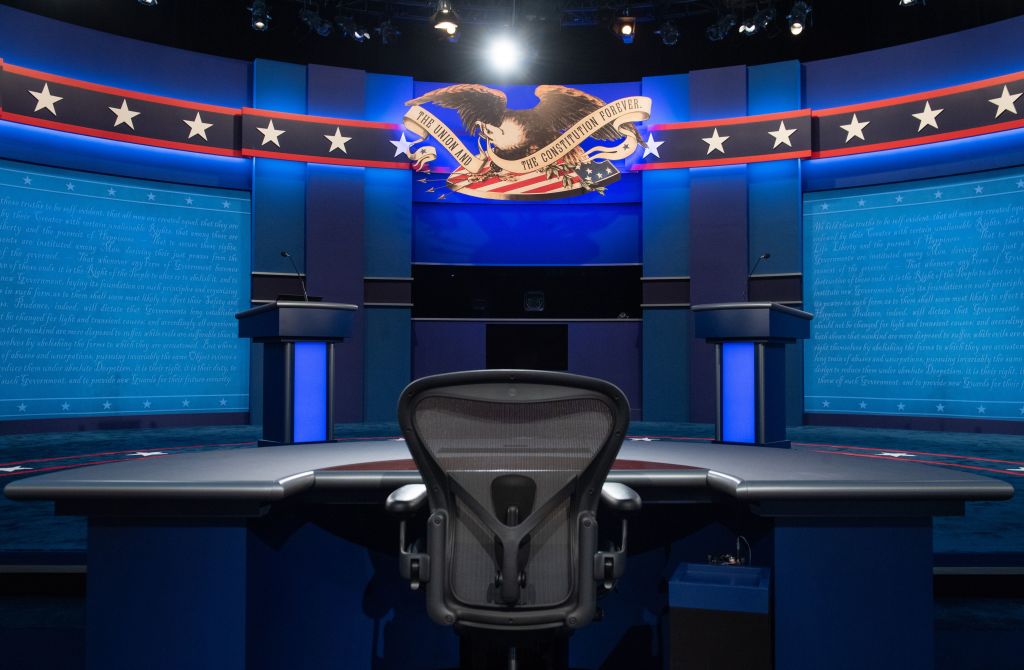
It’s that dynamic that reveals why the Thursday night trifecta of high-profile debates was an anomaly this election season. In dozens of races up and down the ballot, candidates are forgoing the hallowed tradition of facing their opponent in person to debate actual policy.
In more than half of the races for Governor and Senate, the two major-party candidates are not expected to participate in any debates before Election Day. The trend holds even in races viewed as competitive. The non-partisan Cook Political Report rates five races for Governor as true toss-ups. Three—Georgia, Nevada, and Ohio—are not likely to hold a debate. The same is true so far for two of the hardest-fought Senate races—Texas and Ohio.
Strategists explain the evolution as a response to how voters are consuming information. They say few voters watch the debates themselves. The more in-depth coverage of a debate offered by local journalists rarely reaches as many voters as the gaffes and gotchas from the event that are clipped and amplified by partisan media.
It’s a cliche in the political class that no one really wins a debate, it’s just that someone loses. Sen. Darlene Graham learned that last lesson the hard way. After being appointed to fill the balance of her late brother’s term, her bid for a full term left her stumbling in August through her first debate showing: “I’m just going to be honest here,” she said. “I’m not that informed on national security.” The audience gasped in shock given how much Sen. Lindsey Graham’s legacy was tied to his shaping of U.S. foreign policy.
In Texas, Trump Prods Paxton to Debate
Nowhere has the debate over whether to debate been more tortured than in Texas, where Democrat James Talarico and Republican Ken Paxton are vying for a Senate seat. Talarico has been trying to bait Paxton to the stage for months, going so far as to suggest they do it on GOP-friendly Fox News. Paxton has so far refused.
Which made things all the more awkward last week when Trump inserted himself in the discussion. As Talarico had been missing from the trail for days—his campaign said he was recovering from the flu—Trump mercilessly mocked the Democrat at a San Antonio rally, suggesting he was absent from the trail because he is a secret vegan whose body is rejecting the barbecue he’s been eating at photo-ops.
The President then punched up the messaging on his way out of Texas, calling on Paxton and Talarico to get together for a debate to show voters who was physically up to the job.
“Ladies and Gentlemen, upon information and belief, James TalaFREAKo, who is running for the United States Senate in Texas, is MISSING IN ACTION!” Trump wrote Wednesday night on his social media platform. “He should immediately report to a Debate Stage against Ken Paxton, who is ready, willing, and able.”
Talarico jumped at the clear opening: “President Trump just said Ken Paxton should debate. I agree,” Talarico said on social media. “Ball’s in your court, Ken.”
Do debates matter?
On-stage debates have long been treated as race-defining moments—the event in which the candidates, unable to lean on spin doctors or teleprompters, show who they really are.
Of this year’s 36 races for governor, 21 races, or 58%, won’t see a debate between the two major-party candidates, according to a recent ABC News analysis. The same ABC News analysis pegs the share of Senate races likely to reach Election Day without a debate at 60%.
The Brookings Institution has been tracking this trend for a quarter century. In 2000, the top five most competitive Senate races had a combined 17 debates. That number hit single digits in 2018.
Some political pros also question how much debates even matter, particularly in the most hard-fought races where voters are being bombarded with ads. In the fierce Texas Senate race, for instance, voters there have already seen more than $425 million in political ads and counting. Or, as one savvy ad buyer noted, more than four times the cost of the final season of Game of Thrones.
Two years ago, Donald Trump became the presidential nominee for a third time without ever debating any of his fellow Republicans. His argument then was that he was so far ahead in the polls, there was no point in elevating the also-rans.
A similar argument is being made this cycle in Alabama. Sen. Tommy Tuberville, who is running for Governor, has refused to debate former Sen. Doug Jones, saying the evening would be “about differences of opinion” and not actually governing. Republicans argue they’re already all-but-guaranteed a win in the race and putting Jones on the same stage would diminish Tuberville.
And then there’s those who insist they are rejecting a debate on principle. Amy Acton, who is in a tight race to become Ohio’s first Democratic Governor since 2011, has refused to debate the Republican nominee, Vivek Ramaswamy. Acton’s campaign says it refuses to “platform” Ramaswamy. Or as Acton put it recently: She doesn’t want to debate “a chronic liar.”
The absenteeism from the debate stage in the midterms may be a harbinger of what’s to come in 2028—which is shaping up to be dominated by two crowded and noisy fights for the Republican and Democratic presidential nominations. As recently as 2024, trailing Republican candidates fought to claw their way on the main debate stage, lest they end up seated in undercard debates that were often unfavorably compared to a holiday kids’ table. Looking ahead, candidates may rethink that strategy, sidestepping the potentially tough questioning of televised debates in favor of viral moments and base-serving showmanship that they can better control.
The post The New Campaign Strategy: Don’t Debate appeared first on TIME.