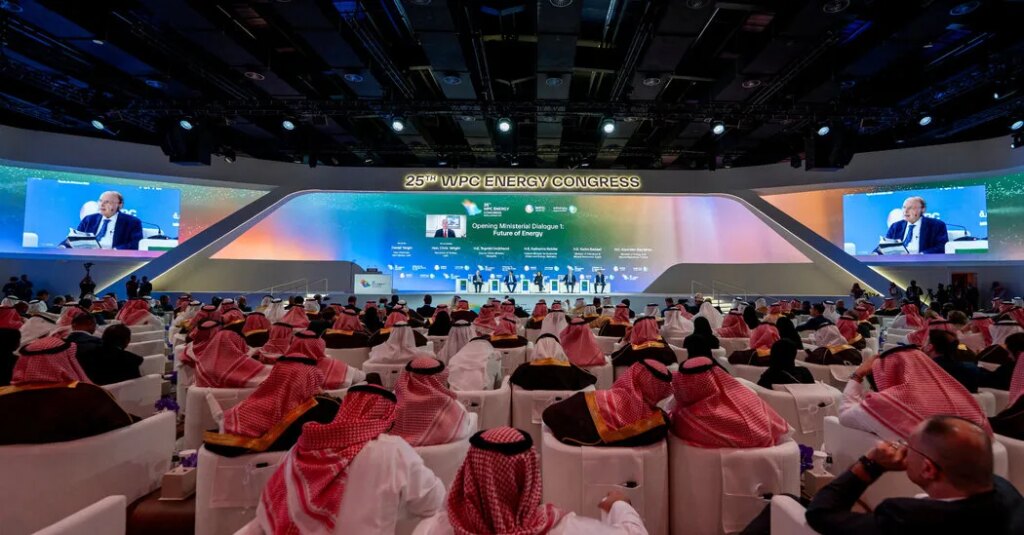
Outside Riyadh’s cavernous exhibition center, where hundreds of oil and gas executives gathered this week for an international energy summit, foreign diplomats received a warning of a potential missile bound for the Saudi Arabian capital.
Inside the hall, there was an urgent announcement: Attendees should please take their seats, because Prince Abdulaziz bin Salman, the Saudi energy minister, was about to take the stage.
Saudi Arabia has faced a severe escalation of cross-border missile and drone attacks from the Iran-aligned Houthi militia in Yemen. Missile strikes on King Khalid International Airport in Riyadh have killed at least 17 people and injured hundreds. Saudi authorities suspended commercial operations at the airport until further notice.
The timing was hard to miss. Delegates to the WPC Energy Congress, which started on Sunday, were forced to reroute to other airports and even countries in the region. Some including the chief executives of Exxon, Shell, Chevron and BP canceled their scheduled appearances altogether.
Despite the threats, Saudi officials are working to convey an air of unflappable calm at the conference, which is scheduled to continue until Friday.
“The word ‘fear’ in the Saudi dictionary does not exist,” Prince Abdulaziz said defiantly on Monday.
The war in Iran, now in its eighth month, has upended numerous elements of the economic and security order in the Middle East. Ports in the United Arab Emirates that are linchpins to global trade were trapped behind what was suddenly a battlefront at sea. The sophisticated facilities in Qatar that produce the liquefied natural gas that powers large parts of Asia sustained devastating damage.
Few places were tested recently quite like Saudi Arabia, the region’s longtime oil producing leader.
The Saudis, as did other oil producers, lost much of their access to the Strait of Hormuz, their most efficient path to export oil to the world, when Iran started using force to control who could pass. When they redirected exports through a pipeline to the Red Sea, Iran-backed militia in Iraq attacked it.
Throughout, Saudi Arabia’s rulers, and its state oil giant Saudi Aramco, adapted to get crude out of the region. It was costly, but oil producers were minting huge profits because prices had surged.
But the strikes in the past days underscored the growing risks to not only Saudi Arabia’s projection of security in the region, but also the kingdom’s determination to become an increasing center of global finance.
Iran’s attacks have posed similar challenges to the Emirates and particularly Dubai, which has long been a safe haven for business in a volatile Middle East. Iran has launched hundreds of missiles and drones at Persian Gulf countries, which host several U.S. military bases.
Later this month, Riyadh is scheduled to be the host of what in many ways is an even more important event for Saudi Arabia: Crown Prince Mohammed bin Salman’s annual investment summit. The conference, known as the Future Investment Initiative and sometimes nicknamed “Davos in the Desert,” typically draws world leaders, billionaires and executives. It brings financial firms hunting big-game projects as investment vehicles for their clients’ money.
The conference is a platform for Prince Mohammed’s ambitions to transform the Saudi economy. Known as Vision 2030, the program aims to diversify Saudi Arabia from dependence on oil into a global destination for trade, sports, technology, culture and tourism.
Organizers of F.I.I. said in a statement on Tuesday that the conference would continue as planned and promised “comprehensive security measures” including assistance with transportation.
But the consequences the Houthis wrought on the WPC Energy Congress this week were an urgent reminder of the risks facing the investment conference.
Darren Woods, the chief executive of Exxon Mobil, and Meg O’Neill, the head of BP, stayed away. Several key government officials, including Chris Wright, the U.S. energy secretary, participated via video link, as did the energy security minister of Italy.
It is still unclear whether prominent C.E.O.s and others will feel safe enough to attend this year’s investment summit, set for Oct. 26-29.
The WPC Energy Congress was initially scheduled for April, but it was postponed after the United States and Israel launched military strikes against Iran on Feb. 28, igniting what later became a wider conflict in the Middle East.
The event, which started in the 1930s and originally called the World Petroleum Council, is held every three years. This is the first time Saudi Arabia has hosted. The event is taking place in Riyadh’s exhibition and conference center, about 10 miles from the international airport.
Analysts said keeping major events on schedule despite the attacks was both an economic and a security calculation for the kingdom.
“Despite all the mess happening in the region, they continued with the agenda because that is ultimately what keeps confidence,” said Yousef M. Alshammari, president of the London College of Energy Economics, a think tank.
“If there is no confidence, it would be difficult to attract foreign investments,” he said.
Beyond the economic implications, analysts note there is a strategic imperative at play. In addition to weakening investor confidence, canceling flagship events in Riyadh could also hand the Houthi militant groups a “psychological” victory, said Neil Quilliam, a Middle East energy policy expert at Chatham House, a London-based research institute.
“It would suggest that attacks on the kingdom are succeeding in disrupting the economic transformation and damaging Saudi Arabia’s international standing,” he said.
Still, Mr. Quilliam cautioned that continued assaults would make it harder for the government to maintain that message.
“Hosting major events demonstrates resilience, but there are limits to what symbolism can achieve,” he said.
The WPC Energy Congress was expected to draw more than 25,000 attendees. The number who turned out was not yet clear. Many of the conference attendees appeared to take the threats of fresh attacks in stride, and some ministers and executives from the Persian Gulf said they made a point of attending in person.
“Especially when the kingdom suffers heinous attacks against its infrastructure, we stand up and be counted with the Saudis,” Sheikh Nawaf S. Al-Sabah, the deputy chairman and chief executive of the Kuwait Petroleum Corporation, said in an interview in Riyadh.
For Saudi Arabia, projecting stability is also critical to preserving the kingdom’s reputation as the world’s central banker of oil.
Inside the hall, security was the theme of the day. Prince Abdulaziz sought to reassure jittery markets, declaring Riyadh “the capital of energy security” and casting Saudi Arabia as a reliable energy supplier despite deepening conflict in the Middle East.
He highlighted the rapid restoration of the Saudi East-West pipeline, a critical system that was temporarily shut down in September after a drone attack launched from Iraqi territory.
The pipeline, which delivers crude from Saudi Arabia’s eastern oil fields to a port along the Red Sea coast, has been described as the country’s lifeline in recent months because it bypassed the Strait of Hormuz, which Iran effectively blocked shortly after the war began.
Prince Abdulaziz said the kingdom planned to expand the pipeline’s capacity to approximately 10 million barrels per day from its current maximum of seven million barrels.
“Energy security can’t be taken for granted,” Prince Abdulaziz said, adding, “For Saudi Arabia, these circumstances have tested our infrastructure, our institutions, our people and our resilience. They have also tested decisions made long before the present crises, because resilience is built before crises begin.”
Jenny Gross contributed reporting from London.
The post War Collides With Saudi Ambition at a Gathering of Oil Powers appeared first on New York Times.