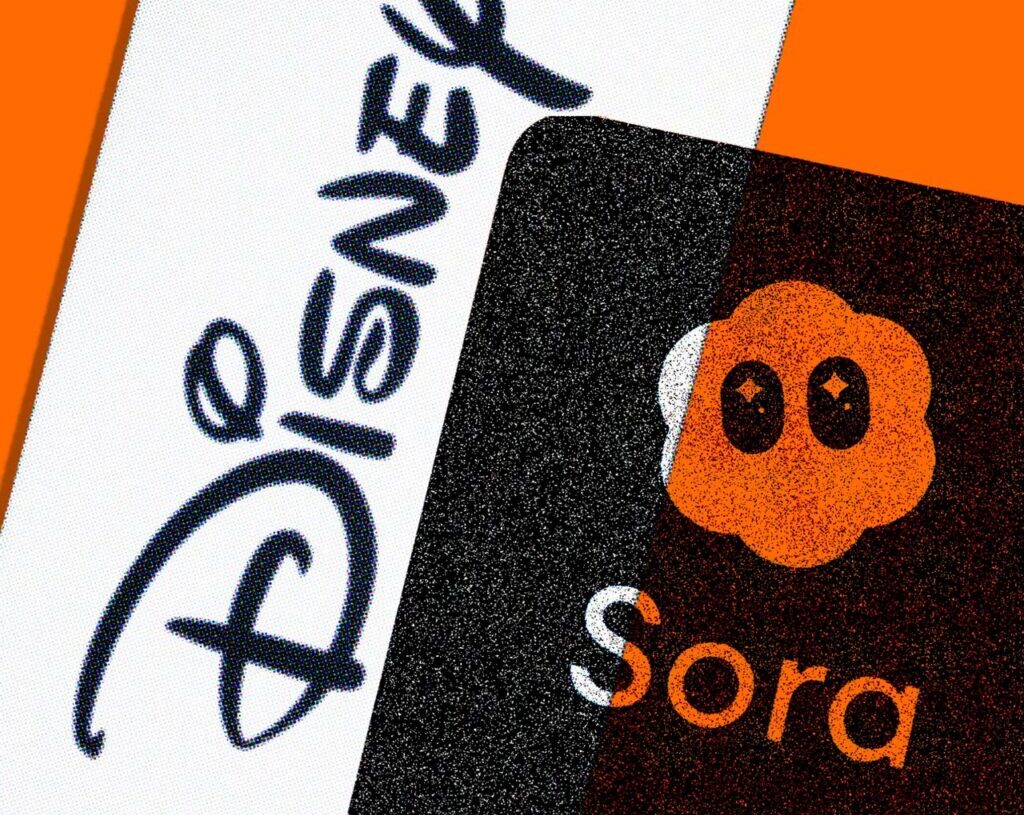
On Thursday, Disney and OpenAI announced a deal that might have seemed unthinkable not so long ago. Starting next year, OpenAI will be able to use Disney characters like Mickey Mouse, Ariel, and Yoda in its Sora video-generation model. Disney will take a $1 billion stake in OpenAI, and its employees will get access to the firm’s APIs and ChatGPT. None of this makes much sense—unless Disney was fighting a battle it couldn’t win.
Disney has always been a notoriously aggressive litigant around its intellectual property. Alongside fellow IP powerhouse Universal, it sued Midjourney in June over outputs that allegedly infringed on classic film and TV characters. The night before the OpenAI deal was announced, Disney reportedly sent a cease-and-desist letter to Google alleging copyright infractions on a “massive scale.”
On the surface, there appears to be some dissonance with Disney embracing OpenAI while poking its rivals. But it’s more than likely that Hollywood is embarking down a similar path as media publishers when it comes to AI, signing licensing agreements where it can and using litigation when it can’t. (WIRED is owned by Condé Nast, which inked a deal with OpenAI in August 2024.)
“I think that AI companies and copyright holders are beginning to understand and become reconciled to the fact that neither side is going to score an absolute victory,” says Matthew Sag, a professor of law and artificial intelligence at Emory University. While many of these cases are still working their way through the courts, so far it seems like model inputs—the training data that these models learn from—are covered by fair use. But this deal is about outputs—what the model returns based on your prompt—where IP owners like Disney have a much stronger case
Coming to an output agreement resolves a host of messy, potentially unsolvable issues. Even if a company tells an AI model not to produce, say, Elsa at a Wendy’s drive-through, the model might know enough about Elsa to do so anyway—or a user might be able to prompt their way into making Elsa without asking for the character by name. It’s a tension that legal scholars call the “Snoopy problem,” but in this case you might as well call it the Disney problem.
“Faced with this increasingly clear reality, it makes sense for consumer facing AI companies and entertainment giants like Disney to think about licensing arrangements,” says Sag.
By partnering with OpenAI, Disney gets a say in how its characters are used in Sora. (The two companies “affirmed a shared commitment to maintaining robust controls to prevent the generation of illegal or harmful content,” according to an OpenAI press release, although the internet tends to find a way around those.) The company’s Disney+ streaming platform will feature a curated selection of “fan-inspired Sora short form videos,” a new form of storytelling for the 102-year-old studio. And with access to OpenAI’s tools, it can try to ensure it’s not left behind by an AI-generated entertainment revolution, as unlikely as that may seem today. (Remember that OpenAI is currently backing a feature-length animated film that will be largely AI-generated.)
The $1 billion stake in OpenAI is a hedge as well, and not entirely out of character for the entertainment giant. Just last year, Disney invested $1.5 billion in Fortnite developer Epic Games. (Which is illustrative in itself; when Darth Vader made an in-game appearance in May, players promptly made him swear and misbehave.) As entertainment preferences continue to flow from big screens to smaller ones, both OpenAI and Epic give Disney an opportunity to meet its customers where they’re at—or where they’re going.
“Bringing together Disney’s iconic stories and characters with OpenAI’s groundbreaking technology puts imagination and creativity directly into the hands of Disney fans in ways we’ve never seen before,” said Disney CEO Robert Iger in the press release, “giving them richer and more personal ways to connect with the Disney characters and stories they love.”
As for OpenAI, it not only gets access to more than 200 internationally recognized characters, but also a significant monetary injection as it continues its relentless pursuit of scale. OpenAI and Disney did not immediately respond to requests for comment.
More than anything, though, the deal signals that Disney is ready to play ball. It clarifies that the AI copyright war isn’t about keeping iconic characters out of models anymore. It’s about finding the right price to keep them in.
The post The Disney-OpenAI Deal Redefines the AI Copyright War appeared first on Wired.